South Korea’s export credit agency is providing Glencore with $1 billion in working-capital finance linked to copper supply for Korean companies.
The agreement does not identify Africa as the source, but Glencore’s DRC assets make the continent strategically important.
For producer countries, the contest is now about processing, jobs and bargaining power, rather than extraction alone.
Copper Finance Becomes Economic Security Policy
South Korea has joined the intensifying race to secure copper by linking $1 billion in working-capital finance for Glencore International AG to supplies for Korean companies.
The transaction shows how export-credit institutions are moving beyond conventional trade support and using public finance to protect access to materials needed for artificial intelligence infrastructure, renewable power, electric equipment and grid expansion.
Copper is becoming a strategic constraint because electrification is metal-intensive and new mines take years to permit, finance and build.
For South Korea, a manufacturing economy exposed to imported raw materials, the arrangement is a form of supply insurance.
For Africa, it is another sign that the continent’s mineral base is being drawn into the economic-security strategies of major powers.
Africa Matters Without Guaranteed African Supply
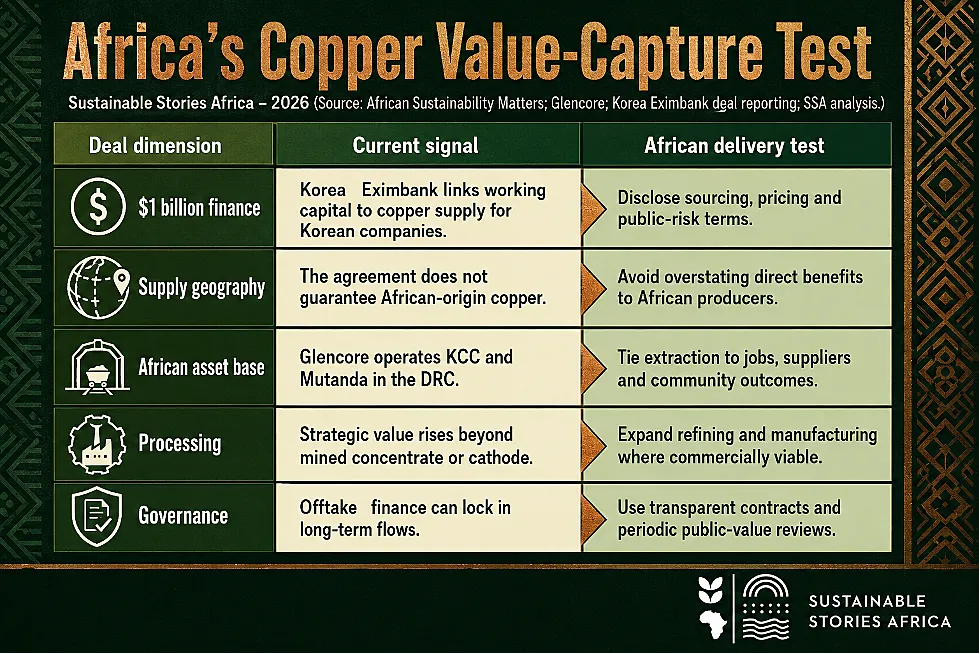
The agreement does not specify that copper mined in Africa will be delivered to South Korea.
- Korea Eximbank has referred to Glencore’s global network, including mines and trading relationships in Latin America, as a source of supply resilience.
- It would therefore be inaccurate to present the loan as a direct offtake from the Democratic Republic of Congo.
Africa nevertheless sits close to the centre of the story.
- Glencore extracts and processes copper in the DRC through Kamoto Copper Company and Mutanda Mining, with assets elsewhere.
- Its own-sourced copper production reached 851,600 tonnes in 2025, and the company has outlined a pathway to exceed one million tonnes annually by the end of 2028.
The DRC’s Copperbelt and neighbouring Zambia are attracting competing infrastructure, finance and offtake initiatives.
That attention can unlock investment, but it can also reproduce a familiar pattern in which ore leaves while higher-value refining, manufacturing, technology and skilled employment develop elsewhere.
The financing model deserves attention because it shifts competition upstream.
- Instead of waiting for shortages to appear in spot markets, importing countries can use cheaper state-backed capital to secure relationships years in advance.
African producers need comparable negotiating capacity: geological data, contract expertise, coordinated infrastructure plans and disciplined project selection.
Without it, the cost advantage supplied by foreign public finance may influence who controls production and where future value is created.
Producer Countries Can Negotiate More Value
The opportunity is to convert strategic demand into better development terms.
Governments can link licences, infrastructure access and fiscal incentives to credible plans for local processing, supplier development, worker safety, community benefit and environmental rehabilitation.
Regional cooperation could also reduce pressure to compete among neighbouring producers through tax concessions.
Transparent contracts matter.
- Citizens need to know the duration of supply commitments, pricing mechanisms, public guarantees, local-content obligations and environmental liabilities.
- Buyers, meanwhile, gain more resilient supply when communities see durable benefits and producing states retain confidence in the bargain.
Move From Ore Security to Partnership
African governments should treat each strategic-minerals proposal as a portfolio decision, rather than a stand-alone mine deal.
Power, rail, water, skills and processing policy must be negotiated together, with clear thresholds for public value and responsible production.
South Korea and Glencore can strengthen the legitimacy of their arrangement by explaining sourcing safeguards and supporting traceable, lower-impact supply.
The new minerals race will be judged not only by who secures copper, but by whether producing countries build stronger economies from it.
Path Forward – Turn Strategic Demand Into Shared Value
African producer countries should coordinate fiscal, infrastructure, and local-content terms before committing future copper output, while publishing the benefits, risks and obligations embedded in strategic finance.
Buyers and miners should support traceability, responsible production and commercially credible processing.
The objective is not to obstruct supply, but to make mineral security compatible with African industrialisation and community resilience.