
A global PMI-GPM study has exposed a steep confidence gap between leaders setting sustainability targets and professionals expected to deliver them.
For African organisations, the findings sharpen a familiar concern: ambition is expanding faster than project capability, measurement and governance.
Closing that gap could decide whether climate promises become reliable infrastructure, resilient services and investable outcomes.
Confidence Falls Nearer The Work
Africa does not lack sustainability ambition. Governments and companies have published targets for renewable energy, adaptation, water security, sustainable agriculture and responsible investment.
The harder question is whether those commitments survive contact with budgets, procurement, engineering and daily operating decisions.
New research from the Project Management Institute and Green Project Management suggests confidence falls sharply as responsibility moves closer to delivery.
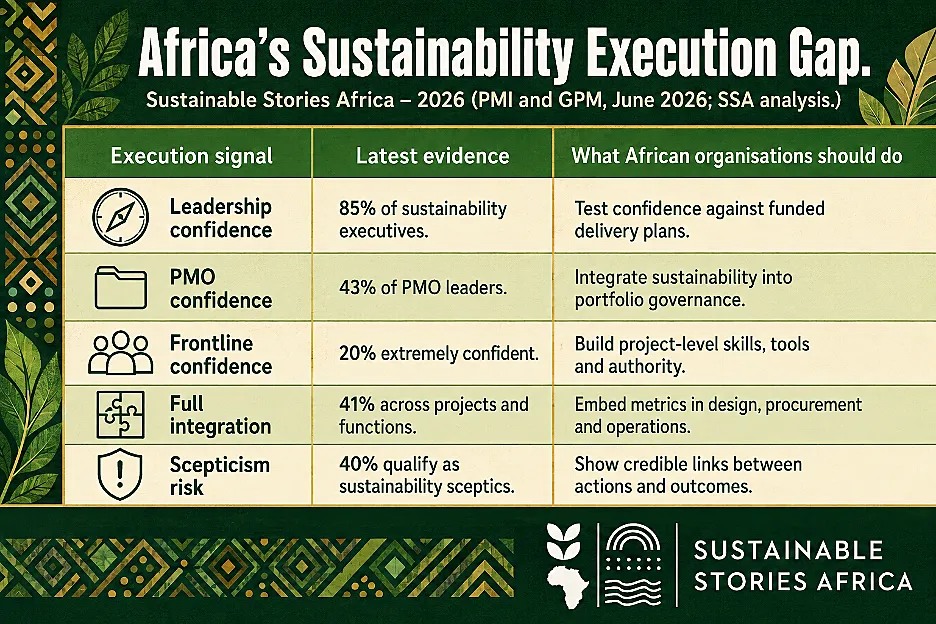
In a survey of nearly 1,600 professionals across 35 countries, 85% of sustainability executives said they were confident their organisations could achieve their goals.
Only 43% of Project Management Office leaders agreed, while just 20% of project professionals were extremely confident.
That 65-point gap between executives and frontline project professionals is a warning, rather than proof that every African organisation will miss its targets.
The study was global. Still, its diagnosis is highly relevant where capital is scarce, infrastructure gaps are wide, and every delayed project carries an economic and social cost.
Strategy Weakens Across Delivery Systems
The research found broad belief in sustainability; however, integration was much weaker. 79% of respondents linked sustainability to long-term success, yet only 41% said it was fully embedded across projects and functions.
That means 59% had not completed the shift from policy language to operating practice.
Six recurring friction points explain the slide:
- Benefits are difficult to quantify.
- Sustainability is visible but does not drive decisions.
- Goals are unclear.
- Priorities change under pressure.
- Daily actions are poorly connected to impact.
- Results often appear beyond the usual reporting horizon.
PMI also found that 40% of respondents qualified as sustainability sceptics inside their organisations.
In practical terms, an emissions pledge has to become a capital plan, a technical specification, a supplier requirement, a project schedule and verified performance indicator.
- A solar target still needs land, permits, grid studies, financing and maintenance.
- A water-security promise needs functioning assets, accountable operators and communities that can access the service.
Better Projects Can Unlock Value
The opportunity is larger than compliance.
- PMI says sustainability was the strongest predictor of project success in its analysis, ranking above methodology and governance.
- Projects built around sustainability succeeded at nearly twice the rate of those that were not.
The finding supports a business case for treating environmental and social outcomes as delivery requirements rather than decorative reporting.
For African organisations seeking green bonds, concessional finance or sustainability-linked capital, stronger execution can also improve credibility.
Investors increasingly want baselines, milestones and evidence that promised outcomes will last.
Clear accountability can reduce rework, expose risks earlier and make scarce public or corporate capital work harder.
Put Sustainability Inside Project Controls
Boards and public authorities should ask project-level questions before approving another headline target:
- Who owns the outcome?
- What changes in procurement?
- Which indicators are measured, by whom and how often?
- What happens when cost or schedule pressure competes with environmental and social safeguards?
Organisations should connect sustainability teams with PMOs, finance, operations and internal audit; train project professionals; and tie executive claims to funded delivery plans.
As PMI Sub-Saharan Africa Managing Director George Asamani put it, strategy alone does not build infrastructure; projects do.
Africa’s credibility will therefore be earned through completed, measurable outcomes, not the number of commitments announced.
Path Forward – Make Delivery Evidence Visible
African organisations should translate every material sustainability target into funded projects with named owners, milestones, baselines and lifecycle indicators.
Boards, governments and financiers should align incentives, procurement, PMO capability and assurance so delivery teams can challenge unrealistic commitments early and report outcomes transparently.