
Institutional investors are being urged to redirect more of their climate engagement towards policies that reshape energy, transport and infrastructure.
Research based on discussions with more than 100 investors managing about $33 trillion suggests disclosure still dominates their efforts.
For African markets, stronger policy engagement could help convert climate commitments into investable projects, clearer rules and lower transition risk.
Capital Markets Cannot Transition Alone
Investors have spent years setting portfolio net-zero targets, backing climate solutions, pressing companies for transition plans and, in some cases, divesting from fossil fuels.
However, a Reuters commentary argues that these tools cannot by themselves deliver the economy-wide change required to protect long-term returns from climate disruption.
The core problem is one of direction.
- Climate change is created in the real economy, where power is generated, goods are transported, food is produced, and infrastructure is built.
- Better corporate information can help markets price risk, but pricing risk does not automatically rewrite electricity rules, transport standards or industrial incentives.
The argument is therefore simple: change the real economy and capital is more likely to follow.
Disclosure Still Commands Investor Attention
The analysis draws on conversations held over 18 months with more than 100 institutional investors managing roughly $33 trillion.
- It found growing interest in policy engagement, but also a striking imbalance.
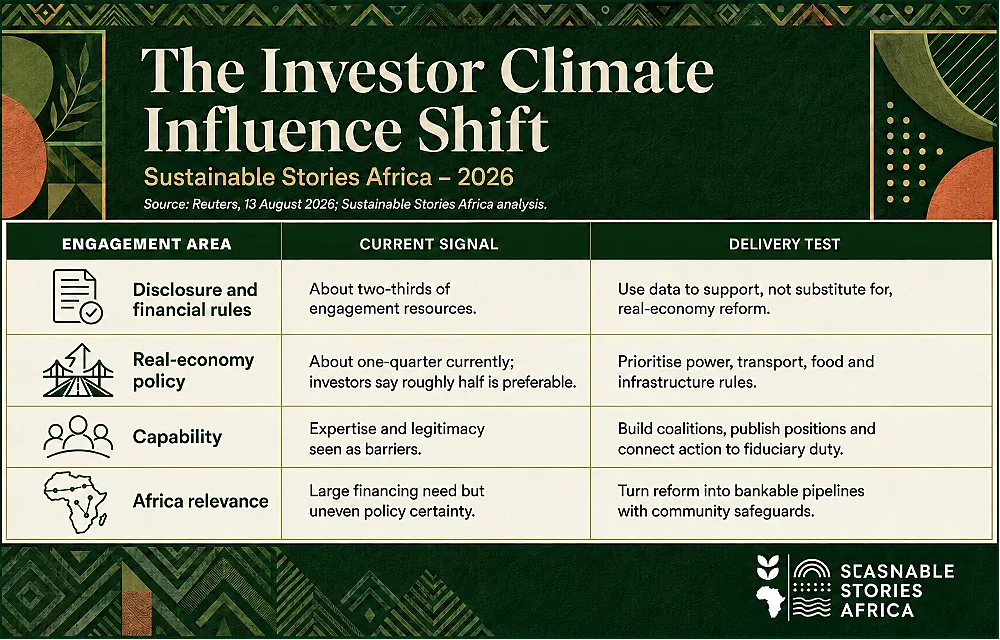
- Around two-thirds of investors' climate-engagement resources still go to disclosure standards and financial regulation, while only about one-quarter goes to policies affecting real economic activity.
Investors reportedly considered a better allocation closer to half of their engagement resources.
In Asia, the share of significant investors engaging on climate policy and regulation rose from one-quarter to one-third between 2024 and 2025, showing that the shift is possible.
The remaining barriers are often framed as limited expertise or doubts about whether investors have the legitimacy to influence public policy.
Why Policy Engagement Changes Outcomes
Those barriers are not insurmountable.
- Investors can build technical capability, work through coalitions and focus on the broad policy direction needed to make low-carbon projects commercially viable.
- They do not need to draft legislation to explain that predictable carbon rules, credible power-sector reform or resilient infrastructure pipelines would reduce systemic risk.
This matters in Africa, where capital frequently waits for bankable projects and stable implementation frameworks.
- Investor engagement could support clearer renewable-energy procurement, credible transition plans for carbon-intensive sectors and public-private structures that protect communities as economies adjust.
- It can also bring the cost of delay into discussions normally dominated by immediate fiscal or political pressures.
Domestic asset owners have a particular role.
- Pension and insurance capital is exposed to inflation, infrastructure weakness and climate shocks within the economies where beneficiaries live.
- Coordinated, evidence-led engagement on grid reliability, resilient cities and agricultural adaptation can therefore protect portfolios while supporting public outcomes. The safeguard is transparency: engagement objectives, partners and results should be visible to beneficiaries and regulators.
Fiduciary Duty Requires Wider Influence
Policy engagement must be transparent and tied to beneficiaries' long-term interests.
- It should not become a channel for narrow political preferences or private rulemaking.
- Asset owners should disclose the positions they support, test those positions against science and development needs, and ensure their trade associations do not lobby against their stated climate goals.
For pension funds, insurers and sovereign investors, the question is no longer whether climate change can be diversified away.
- It is whether their stewardship strategy reaches the rules that determine emissions in the first place.
Continuing to demand more disclosure while avoiding the economic policies that make transition possible risks better measurement of a worsening problem.
Path Forward – Policy Engagement Must Become Core Stewardship
Investors should map the real-economy policies as the most material to their portfolios, set public engagement priorities and report progress alongside company-level stewardship.
African regulators and asset owners can build joint forums around power, transport, agriculture and infrastructure, linking credible policy reform to investable pipelines and measurable social safeguards.
Culled from: The climate strategy that most investors overlook | Reuters