Companies are reporting sharper forecasts and more productive teams from artificial intelligence, yet many are not becoming more resilient.
Executive interviews across retail, technology and consulting suggest gains remain trapped within functions while supply chains, incentives and decisions stay disconnected.
The lesson for African businesses is clear: technology must be matched by governance, flexibility and responsible infrastructure choices.
Smarter Functions Can Still Fail Together
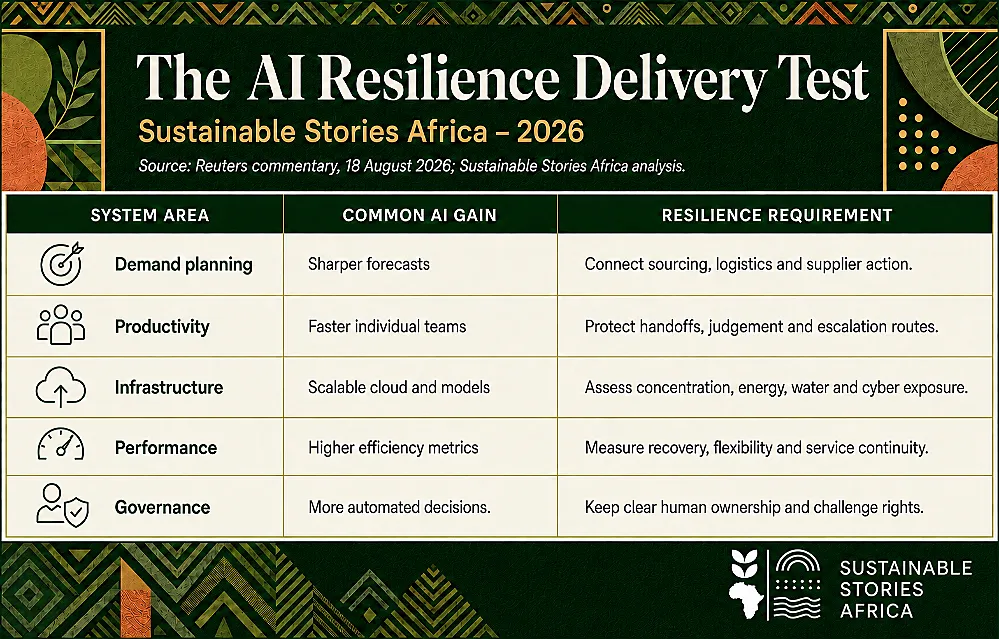
Artificial intelligence is improving forecasts, customer insight and productivity, but those gains are not automatically making companies stronger.
A study based on interviews with leaders from H&M Group, ICA Gruppen, Ingka Group, Microsoft, Google, AWS, BCG and other organisations found that AI is advancing faster inside individual functions than executives are redesigning the connections between them.
A retailer may predict demand with greater precision, for example, while sourcing, manufacturing, logistics and supplier relationships continue to operate through slow processes and misaligned incentives.
The forecast improves, but delivery does not. Value is lost at the handoff between a smarter team and the unchanged system around it.
Efficiency Gains Can Conceal Fragility
This disconnect creates what the researchers call a fragility trap.
- Individual measures look better under stable conditions, but the organisation has less spare capacity, flexibility and room to respond when conditions change.
- Optimisation can therefore produce an enterprise that is efficient in the expected scenario and brittle in the real one.
That matters as companies face simultaneous shocks from tariffs, geopolitical tension, climate events, cyber risk, regulation and rapidly changing customer expectations.
- Installing AI within an old operating model treats the technology like an earlier IT upgrade.
- Resilience instead requires changes to authority, accountability, incentives and the measures used to judge performance.
Dependence on a small group of cloud and model providers also creates concentration risk.
Energy and water demand from data centres adds another exposure, turning AI infrastructure into an environmental and operational issue as well as a technology choice.
Africa Needs Connected Digital Resilience
African companies can gain enormously from AI in logistics, agriculture, banking, health and energy, where better prediction can stretch scarce resources.
However, the benefits will remain narrow if suppliers lack digital access, data cannot move across departments, or frontline teams have no authority to act on insights.
A resilient approach starts with the business system, not the model.
- Leaders should map how an AI recommendation travels from data to decision and from decision to execution.
- They should identify the people, suppliers and infrastructure on which that chain depends, then test what happens during power disruption, connectivity loss, regulatory change or a sudden market shock.
This also protects workers.
- When incentives reward only headcount reduction or speed, teams may remove the knowledge and redundancy needed during a crisis.
- Measures should instead include recovery time, supplier diversity, service continuity, error escalation and the ability to change course.
The same discipline applies to public services.
- An AI system that predicts medicine demand or grid faults is useful only when procurement, maintenance and frontline response can act on the signal.
- Resilience plans must cover data quality, connectivity and local fallback procedures, particularly where infrastructure is uneven.
Technology should shorten the path to action, rather than create a new single point of failure.
Boards Must Govern the Whole System
Boards should require AI investment cases to explain organisational dependencies, environmental resources, vendor concentration, cyber controls and human accountability.
Pilots should be judged not only by forecast accuracy or cost savings but by whether downstream teams can respond safely and quickly.
Companies also need scenario exercises that combine technology failure with operational disruption.
This makes resilience visible before a crisis and clarifies where manual alternatives, local capacity or additional suppliers are worth maintaining.
Path Forward – Resilience Begins Beyond The Algorithm Alone
Businesses should redesign decisions, incentives and supply-chain coordination alongside every major AI deployment, measuring adaptability as deliberately as efficiency.
African leaders can use AI to strengthen scarce systems, but durable value will come from connected operations, accountable people, diverse infrastructure and the capacity to recover when predictions fail.
Culled from: Why investing in AI alone won’t make companies more resilient | Reuters