
Informational interviews can help professionals explore new fields, countries, collaborations and job pathways without turning an initial conversation into a job request.
Nature Careers advises candidates to research carefully, ask for only 15 minutes and make the exchange mutually useful.
For Africa’s young workforce and research community, the approach can widen access to knowledge, networks and opportunity.
Career Opportunity Often Starts Informally
A short conversation can reveal more about a career than weeks of browsing vacancies. Informational interviews are informal exchanges used to understand a field, organisation, role, country move or possible collaboration.
Their power comes from making networking a mutually beneficial relationship rather than a one-sided request for employment.
Nature Careers columnist Alaina Levine argues that these conversations reveal what drives a field, where its problems sit and how a professional's skills might help.
They also show qualities that applications cannot capture easily: curiosity, judgement, collegiality, problem-solving style and the chemistry between two people.
Preparation Makes The Invitation Easier
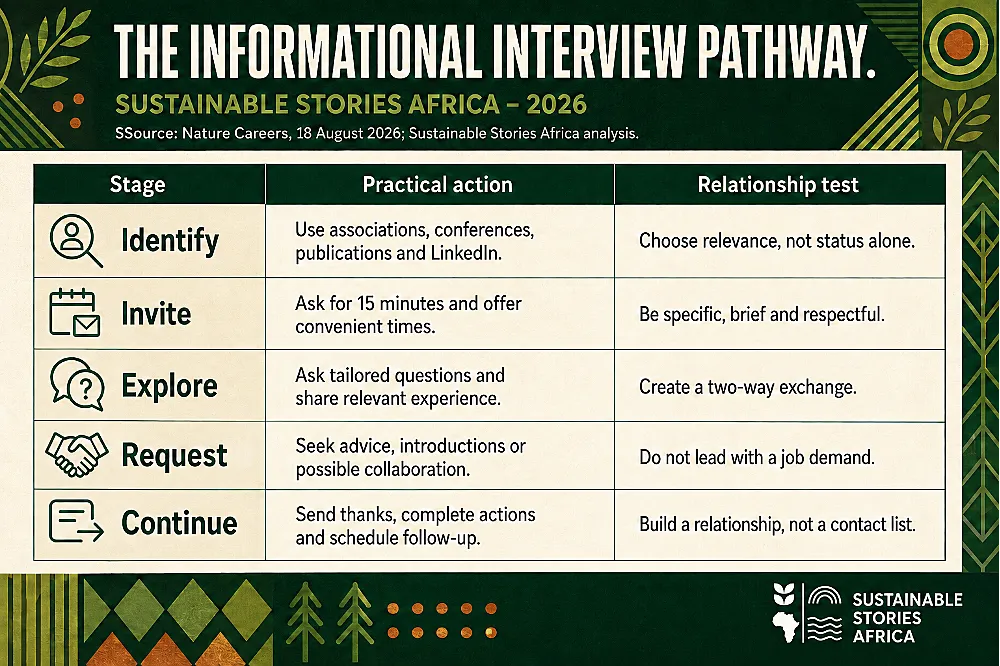
The first task is finding relevant people.
- Professional associations, conference programmes, publications, institutional websites and LinkedIn can serve as networking nodes.
- A strong prospect is not merely senior; it is someone whose experience connects clearly with the question the candidate wants to explore.
The initial message should introduce the sender, explain how the person was identified and mention a specific point from their work.
- Levine recommends asking for only 15 minutes, calling the meeting informal and offering several time options in the recipient's time zone or an easy booking link.
- The candidate should respect the promised duration.
Virtual tools make this approach particularly useful across Africa, where geography and travel cost can limit access to sector leaders.
- A researcher in Ibadan, an entrepreneur in Kigali or a climate professional in Accra can reach a specialist elsewhere through a brief Zoom or WhatsApp conversation, provided the request is specific and respectful.
The Best Conversations Create Mutual Value
An informational interview should not imitate a formal job interview.
- Candidates should share relevant parts of their own experience while asking tailored questions.
- Useful prompts explore the best part of a person's job, how they entered the field, the challenges they are solving, how the sector is changing and which skills, associations or publications matter.
The candidate can ask how to position for future success or whether the contact would feel comfortable making another introduction.
- Asking directly for a job too early can make the exchange feel transactional.
- Asking how the candidate could collaborate or help keeps the conversation honest while leaving room for future opportunity.
Value does not require seniority.
- Early career professionals can share a useful paper, offer local insight, introduce a contact, support an event or contribute a technical method.
- The credible offer to help signals that networking is not extraction.
The practice should also be inclusive.
- First-generation professionals and people outside established hubs may not know the unwritten rules of approaching senior colleagues.
- Universities and employers can provide example messages, peer practice and alumni directories, while mentors can make warm introductions.
Clear etiquette turns informal access from a private advantage into a learnable career skill.
Follow-Up Turns Contact Into Relationship
The interview should end with one agreed action:
- Sending a resource, making an introduction, arranging another conversation or reconnecting around a conference.
- A prompt thank-you message and a calendar reminder protect the momentum.
The aim is not to collect names.
- It is to build an association that develops through useful, periodic contact.
As confidence grows, informational interviews become less awkward and more effective, helping professionals discover unadvertised pathways while allowing others to see how they think and contribute.
Path Forward – Build Networks Through Generous Professional Curiosity
Professionals should prepare one clear learning goal, request a brief conversation, ask tailored questions and offer genuine value before seeking opportunity.
Universities, research institutes and professional bodies can teach this practice and create networking nodes that connect African talent with mentors, collaborators, employers and global communities.
Culled from: How to get the most out of an informational interview | Nature