
Kenya’s revised 2026 telecommunications structure places commercial data centres primarily under the Network Facilities Provider Tier 2 licence.
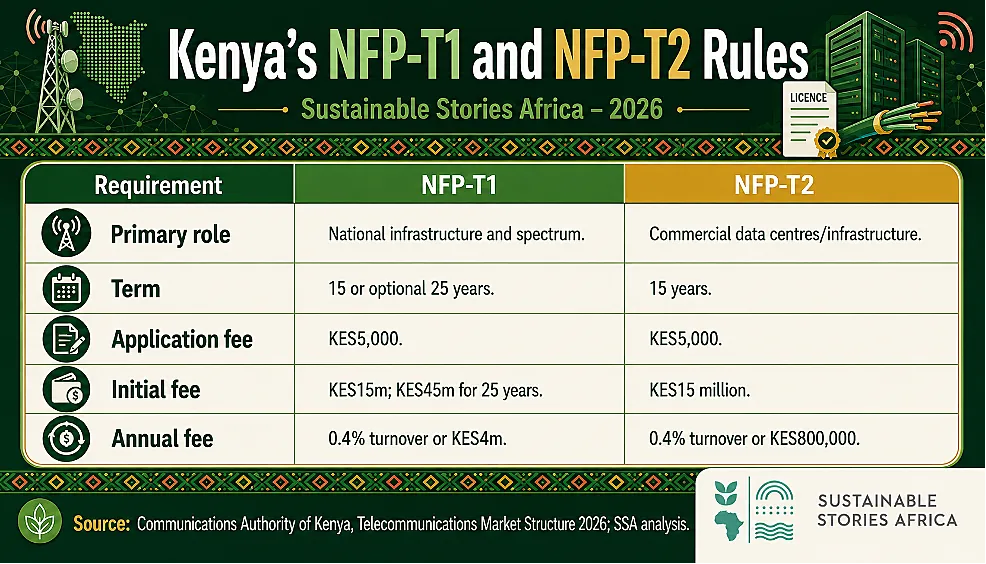
NFP-T2 carries a KES15 million initial fee and an annual charge of 0.4% of audited gross turnover or KES800,000, whichever is higher.
The framework could strengthen accountability, but entry costs may weigh more heavily on smaller operators.
Data Centres Enter Critical Infrastructure Rules
Kenya has brought commercial data centres firmly into its telecommunications licensing framework as cloud platforms, financial systems, government applications and artificial-intelligence workloads make the facilities increasingly critical to daily life.
Under the Communications Authority’s revised market structure for 2026, dedicated commercial data centres are licensed primarily through Network Facilities Provider Tier 2, or NFP-T2.
The framework does not create a separate data-centre licence.
- NFP-T1 holders, which have broader national network and spectrum rights, may also establish commercial data centres without an additional licence.
- NFP-T2 is the more direct starting point for a dedicated operator that does not need Tier 1’s nationwide spectrum position.
Fees Reflect Scale but Raise Barriers
The official schedule sets a KES5,000 application fee and KES15 million initial fee for both NFP-T1 and NFP-T2.
- The NFP-T2 licence runs for 15 years and carries an annual operating charge equal to 0.4% of audited annual gross turnover or KES800,000, whichever is higher.
- For NFP-T1, the annual floor rises to KES4 million, and an optional 25-year term is available at a higher initial cost.
These figures matter because licensing is only one part of an operator’s capital burden.
- Data centres also require land, power, cooling, security, connectivity and compliance investment.
- A flat initial fee may be manageable for multinational platforms but more difficult for local or specialised entrants, potentially shaping market concentration before competition begins.
Oversight Can Strengthen Trust and Resilience
The Communications Authority’s rationale is that facility operators can control whether customers reach essential data and services, making accountability necessary.
- Licensing can create clearer responsibility for service quality, outages, consumer protection and infrastructure resilience.
- It may also give investors greater confidence that the market has defined rules.
However, a licence must not replace detailed standards.
- Kenya will still need enforceable expectations for cybersecurity, incident reporting, data protection, energy efficiency, water use, renewable power claims and business continuity.
- Regulators should coordinate to avoid duplicative approvals and publish transition guidance for existing operators.
Power policy will determine whether regulation produces sustainable capacity.
- Data centres require continuous electricity and often depend on backup generation when grids are unreliable.
- Kenya’s renewable-rich system is an advantage; however, operators should report energy consumption, power-usage effectiveness, backup fuel, water demand and the basis of renewable claims.
- Common disclosure rules would allow customers and financiers to compare facilities, reward efficient operators and prevent sustainability marketing from running ahead of measured performance.
Calibrate Rules to Risk and Competition
The Authority should monitor whether the cost structure deters smaller credible operators or regional facilities outside Nairobi.
Proportionate pathways, transparent service standards and clear timelines can protect users without freezing innovation.
Operators should build licensing, annual charges and sustainability requirements into financial models from the beginning rather than treating compliance as a late-stage expense.
Path Forward – Regulation Must Enable Resilient Digital Growth
Kenya’s new framework recognises that data centres are no longer invisible server rooms.
They are infrastructure supporting finance, public services, commerce and AI.
Implementation should now focus on proportionate compliance, coordinated standards and competitive access.
Strong oversight will succeed if it improves reliability and trust without pricing capable local investors out of the market.
Culled from: Kenya Data Center License: NFP-T1 and NFP-T2 Explained