The European Commission has published ten guidance documents for non-EU producers, authorised declarants and verifiers implementing the Carbon Border Adjustment Mechanism.
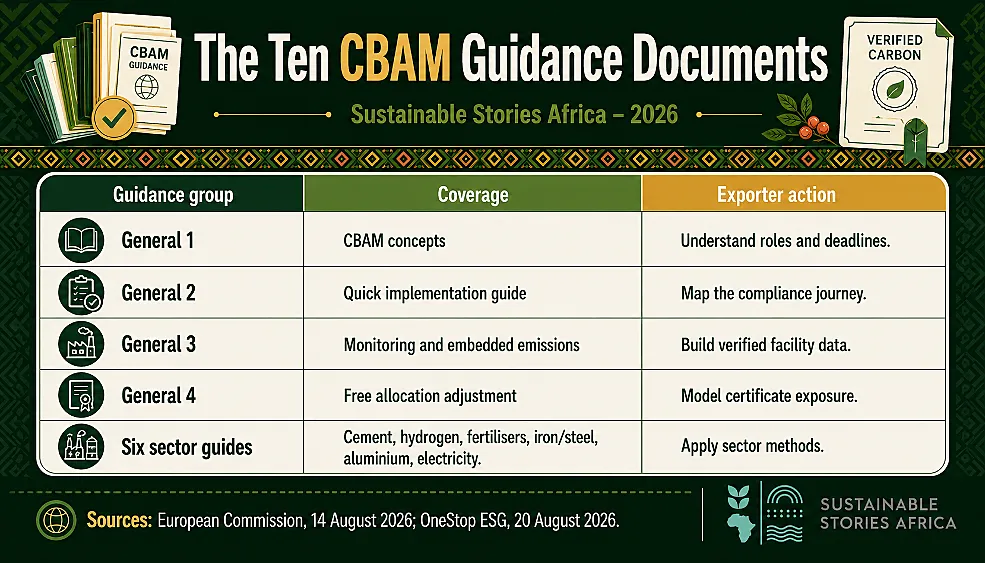
Four guides explain general concepts and calculations, while six cover cement, hydrogen, fertilisers, iron and steel, aluminium and electricity.
African exporters now face an urgent data challenge: verified facility-level emissions can directly influence market access and carbon cost
Ten Guides Translate Rules Into Practice
The European Commission has released ten guidance documents to help businesses implement the Carbon Border Adjustment Mechanism during its definitive period, which began on 1 January 2026.
The package is aimed particularly at operators outside the European Union, authorised CBAM declarants and verifiers responsible for monitoring, reporting and financial compliance.
Four general guides cover CBAM concepts, a quick implementation roadmap, embedded-emissions monitoring and calculation, and the adjustment linked to free allocation under the EU Emissions Trading System.
Six sector guides address cement, hydrogen, fertilisers, iron and steel, aluminium and electricity, reflecting the industries currently covered by the mechanism.
Actual Emissions Data Can Change Costs
During the definitive period, declarants may report eligible goods using default values or verified actual embedded emissions, subject to the applicable rules.
- Actual values require facility-level monitoring, data collection and independent verification.
- That is a heavier compliance burden than relying on Commission defaults, but it can reward producers whose processes emit less carbon than the benchmark assigned to their origin and product.
The opposite is also true:
- A carbon-intensive producer may face a higher exposure if its actual emissions exceed the default.
The guidance therefore has commercial consequences beyond paperwork.
- Carbon data is becoming part of price formation, supplier selection and competitiveness in the EU market.
African Exporters Face a Data Deadline
African producers of aluminium, cement, fertiliser, iron and steel, hydrogen or electricity-related goods must translate technical guidance into operational systems.
- That means mapping emissions sources, choosing approved calculation methods, maintaining auditable records and coordinating with EU importers and accredited verifiers.
- Smaller exporters may struggle with specialist skills, metering and verification costs.
Guidance No. 4 addresses the technically complex adjustment for free allocation under the EU ETS.
- Because European producers still receive some allowances without charge as these allocations are phased down, CBAM certificate requirements must reflect comparable treatment for imports.
- Worked examples can reduce uncertainty; however, businesses will still need sector expertise and reliable production data.
Regional coordination can reduce duplicated costs.
- African standards bodies, export agencies and industrial associations can align measurement approaches and develop shared pools of trained verifiers, while national governments improve emissions factors and grid data.
- Producers also need contractual clarity on who owns facility data, who pays for verification and how carbon costs are allocated between exporter and importer.
Addressing those questions early will reduce disputes and help smaller suppliers avoid exclusion from European value chains.
Build Shared Compliance Capacity Across Africa
Governments and industry associations should establish sector helpdesks, accredited verification capacity, common data templates and affordable technical assistance.
Exporters should conduct gap assessments now, assign clear responsibility for CBAM data and engage their EU customers before annual declarations are due.
Development finance can support metering, energy efficiency and lower-carbon production so compliance spending also improves competitiveness.
Path Forward – Turn Carbon Reporting Into Industrial Strategy
The Commission’s documents clarify the route, but exporters must still build the systems that make verified reporting possible.
Waiting for an importer’s request will be too late.
African trade and industry policy should link CBAM compliance with cleaner power, efficient production and credible verification.
Better data can reduce avoidable carbon costs; real decarbonisation can protect market access over the longer term.
Culled from: EU Publishes Ten Guidance Documents to Support CBAM's Definitive Period