
Malawi’s Finance Minister Joseph Mwanamvekha says the government will review taxes on smartphones, internet data and communications equipment.
The levies were introduced as temporary measures to stabilise public finances, but no review timetable or list of affected taxes has been published.
Any reform will have to balance short-term revenue with the economic and social value of affordable connectivity.
Ministers Put Digital Affordability Back Centre
Malawi’s government has signalled that relief may be coming for consumers and businesses facing taxes on smartphones, internet data and communications equipment.
Finance Minister Joseph Mwanamvekha told the Digital Africa Summit in Lilongwe that the levies were temporary stabilisation measures and would be reviewed.
The commitment followed a public request from Information Minister Shadric Namalomba, who urged his colleague to remove taxes that raise the cost of communicating and accessing information.
Mwanamvekha said the measures helped the government sustain health, education and other services during difficult economic conditions inherited last year.
He did not specify when the review would begin, which charges it would examine or whether they would be reduced or removed.
Temporary Revenue Can Create Lasting Exclusion
Smartphone and data taxes can generate revenue quickly because connectivity is increasingly essential.
However, they can also suppress adoption, reduce usage and widen the gap between people who can afford digital services and those who cannot.
- For households, the cost is not just entertainment: a connected phone can provide job information, mobile money, school resources, health guidance and access to government services.
Businesses carry the burden through higher communications costs and a smaller reachable customer base.
- Start-ups, traders and rural enterprises are particularly exposed.
- When devices and data remain expensive, public investments in digital platforms deliver less value because fewer citizens can use them consistently.
Smarter Reform Can Protect Revenue Gains
The policy choice need not be a simple contest between revenue and access.
- Government can model how lower rates might increase the number of users, formal transactions and taxable digital activity over time.
- It can target relief at entry-level smartphones, productive data bundles or equipment needed to extend networks, while retaining taxes on luxury devices.
The review should also examine whether savings reach consumers.
- Removing a levy will not automatically reduce retail prices if exchange-rate pressure, wholesale costs or limited competition absorb the benefit.
- Regulators therefore need baseline price data, transparent pass-through monitoring and engagement with operators, device sellers, civil society and consumer groups.
The review also offers a chance to simplify the wider digital-tax environment.
- Multiple small charges collected at import, sale and usage stages can be harder for consumers to see and for businesses to administer than one clearly stated measure.
- Publishing the combined effective burden would allow policymakers to compare Malawi with neighbouring markets and test whether the system discourages formal device imports.
- Anti-fraud safeguards can then focus on genuine leakage rather than preserving complexity that raises compliance costs for legitimate businesses.
Set a Deadline and Publish Evidence
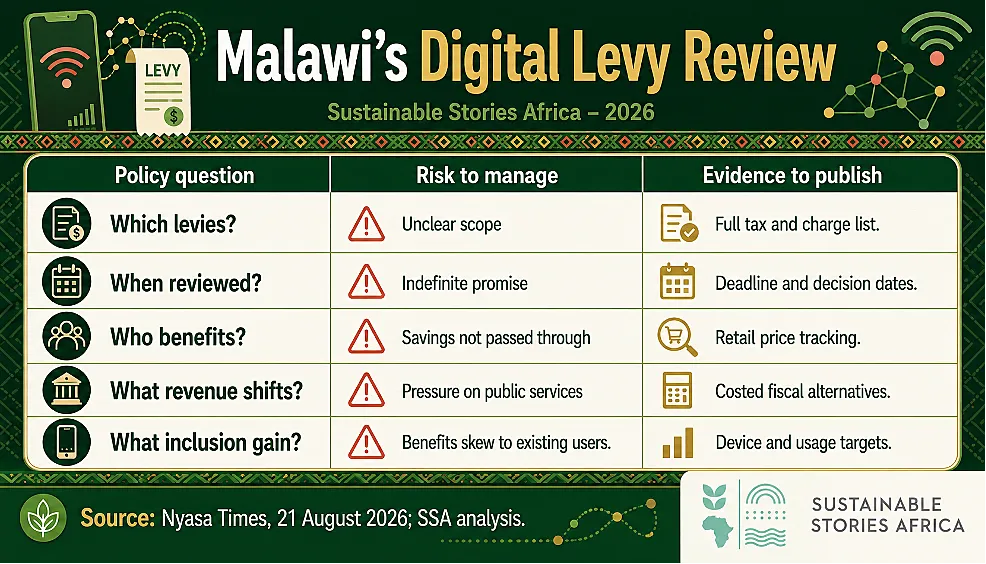
The Finance Ministry should publish the scope, timetable and fiscal assumptions for the review, including expected effects on revenue, device prices, data usage and digital inclusion.
Parliament and the public need to know which measures were temporary, what conditions justify ending them and how any funding gap for essential services will be managed.
Path Forward – Make Connectivity Relief Measurable and Fair
Malawi’s review should move quickly from ministerial signal to published policy analysis. Affordable access must be treated as economic infrastructure, not only household consumption.
Any tax change should include price pass-through checks, inclusion targets and a credible revenue plan.
That is how temporary relief can create lasting gains in opportunity, service delivery and growth.