Starlink has moved from public resistance to direct regulatory engagement as it seeks a South African licence.
The shift follows a policy opening that may allow foreign communications firms to meet empowerment obligations through investment rather than a 30% local equity transfer.
The outcome will test whether digital inclusion, regulatory sovereignty and economic transformation can advance together.
Regulatory Talks Replace Public Standoff
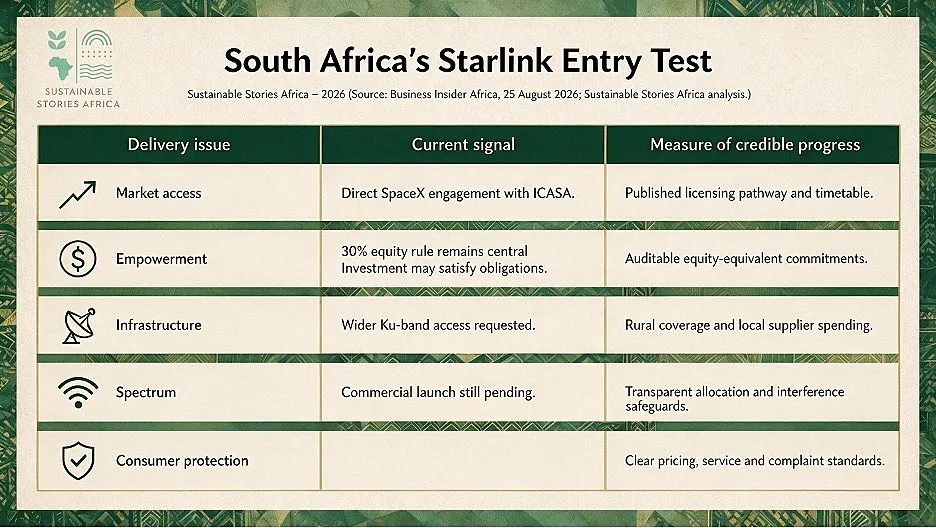
Starlink is moving closer to South Africa’s market after nearly four years of regulatory and political friction, with SpaceX now engaging the Independent Communications Authority of South Africa on the ownership, licensing and spectrum conditions that would govern satellite operators.
The change is significant because the company is no longer only arguing that the rules keep it out.
Ryan Goodnight, SpaceX’s senior director for market access and development, appeared before ICASA to seek practical clarity on compliance.
Starlink wants blanket licences for terminal fleets, lower gateway charges, wider Ku-band access for aircraft and ships, and licence terms lasting at least ten years.
South Africa remains a conspicuous gap in Starlink’s African footprint.
Nigeria became its first market on the continent in January 2023, and by mid-2026 the service operated in more than two dozen African markets.
However, Africa’s most industrialised economy has remained outside the network.
Ownership Rules Meet Connectivity Demand
The main obstacle has been South Africa’s Broad-Based Black Economic Empowerment framework.
- Certain communications licences have required at least 30% local equity to be held by historically disadvantaged South Africans.
- SpaceX has resisted surrendering such a stake, while the government has defended empowerment as a response to apartheid-era exclusion.
In December 2025, Communications Minister Solly Malatsi introduced a policy route under which foreign-owned communications companies could use equity-equivalent investment programmes.
Spending on digital infrastructure, skills development and other qualifying priorities could count toward empowerment objectives without a conventional equity transfer.
That approach creates room for agreement, but it is not yet a licence. ICASA must still define how the alternative applies to satellite businesses, protect competition and ensure that investment commitments deliver measurable local value.
Inclusion Gains Need Enforceable Commitments
Satellite broadband could extend connectivity where fibre and mobile towers are uneconomic, supporting rural schools, clinics, farms and small businesses.
- However, availability alone does not guarantee inclusion.
- Terminal costs, subscription prices, device access and digital skills will determine who benefits.
An equity-equivalent route could convert a corporate compliance dispute into visible development outcomes. Properly designed, it could finance local infrastructure, train technicians and expand service in underserved communities while preserving the purpose of empowerment policy.
The risk is a settlement that weakens transformation without producing affordable access.
- South Africa therefore needs enforceable performance indicators, public reporting and penalties for missed commitments.
Regulators Must Define Public Value
ICASA and the communications ministry should publish a technology-neutral satellite licensing framework that clarifies ownership alternatives, spectrum fees, licence duration, consumer safeguards and local-development obligations.
SpaceX, for its part, should disclose how its proposed investment will expand coverage, create skills and include local suppliers.
The strongest outcome is neither a special favour nor a permanent stalemate.
It is a transparent rule that can apply to Starlink and future satellite operators while advancing competition, inclusion and economic transformation.
Path Forward – Clear Rules Can Connect Communities Fairly
South Africa should translate regulatory flexibility into measurable commitments on rural service, affordability, skills and local participation.
ICASA’s decision must remain independent, transparent and open to scrutiny.
If the model works, it could show other African markets how satellite innovation and domestic development rules can reinforce rather than defeat each other.