
Uade Ahimie has urged Nigerian companies to treat ESG reporting as essential business evidence rather than optional corporate communication.
Speaking on Arise News, he connected credible disclosure with investor confidence, resilience, and Nigeria's approaching sustainability-reporting requirements.
The message is urgent: companies that wait for mandatory compliance risk discovering too late that trustworthy data cannot be built overnight.
Nigeria's Reporting Clock Is Already Running
Nigerian companies should stop treating environmental, social and governance reporting as a voluntary branding exercise and begin building decision-useful evidence now, Uade Ahimie, Chief Coordinating Officer and Managing Editor of Sustainable Stories Africa, told Arise News' Global Business Report in an interview on Nigeria's corporate sustainability performance.
The interview focused on Sustainable Stories Africa's review of sustainability reporting among NGX30 companies.
Ahimie's central argument was that ESG disclosure has become increasingly important because investors, regulators, communities and boards increasingly need to understand risks that ordinary financial statements do not fully capture, from emissions and workforce conditions to governance failures and community impact.
The Disclosure Gap Is Still Material
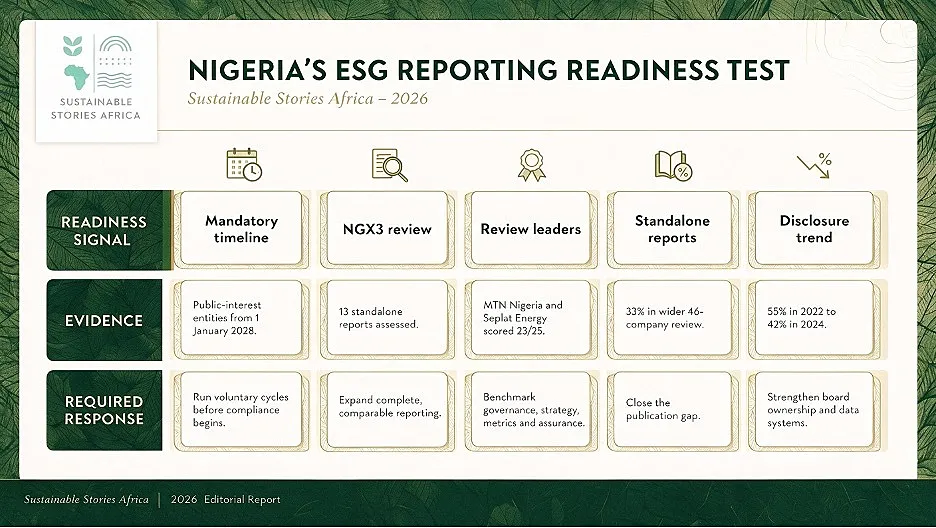
Nigeria has committed to ISSB-aligned reporting through IFRS S1 and IFRS S2, with mandatory requirements for public-interest entities expected from 1 January 2028.
That date may appear distant, but credible reporting depends on controls, data ownership, materiality assessment and board oversight developed over several reporting cycles.
The market evidence is uneven.
- Sustainable Stories Africa's NGX30 Sustainability Report Review assessed 13 standalone reports against a 25-point framework, with MTN Nigeria and Seplat Energy leading at 23 points.
- A wider 2026 sustainability index reviewed 46 large listed companies and found that only 33% had standalone sustainability reports, while overall ESG disclosure across the exchange fell from 55% in 2022 to 42% in 2024.
Credible Data Can Unlock Better Capital
The opportunity is not compliance for its own sake.
- Companies with stronger ESG systems can identify energy waste, workforce risk, supply-chain exposure and governance weaknesses earlier.
- Comparable disclosure can help investors distinguish businesses preparing for climate and social shocks from those relying on generic claims.
The broader index also found that 21 companies scoring at least 72 points accounted for about 67% of NGX market capitalisation and outperformed the broader market in a multi-year back-test.
That does not prove ESG scores alone caused returns; however, it reinforces the commercial relevance of transparency, scale and resilience.
- Better disclosure can support access to capital; poor disclosure can increase uncertainty and invite suspicion of greenwashing.
Quality also matters more than volume.
- A lengthy report can still fail investors if it omits baselines, boundaries, targets or explanations of performance changes.
- Companies should distinguish policies from outcomes and disclose both positive and negative results.
The strongest reports connect material sustainability risks to strategy, financial planning and board decisions, then explain how management will respond.
That makes disclosure useful to lenders and communities, not only a yearly collection of good-news stories.
Boards Must Start Before Rules Harden
Boards should approve an ESG roadmap, assign data owners across finance, operations, human resources, procurement and risk, and run voluntary reporting cycles before 2028.
- Material issues must be identified through evidence and stakeholder engagement, not copied from peers.
- Internal audit and external assurance providers should be involved early enough to test controls and trace claims to source data.
Regulators also have work to do.
- Guidance from the Financial Reporting Council, NGX, SEC and sector agencies should be harmonised, while smaller companies need practical templates and training.
Ahimie's intervention ultimately reframes reporting as infrastructure for better decisions.
Nigeria will not become ESG-ready because a deadline arrives; it will become ready when boards make sustainability information as disciplined as financial information.
Path Forward – Make ESG Evidence Routine
Companies should assign owners, test controls and publish decision-useful sustainability information well before 2028.
Regulators can accelerate readiness by harmonising guidance, building assurance capacity and helping smaller issuers produce credible data without reducing standards.