

Op-Ed By Uade Ahimie
Nigeria’s first Nigerian Corporate Sustainability Report and Sustainability Index show a split market: a small circle of ESG‑ready leaders and a long tail of silent reporters.
The data suggest that transparency and climate ambition are already linked to outperformance.
As global ISSB standards become mandatory and climate risks intensify, Nigeria’s approach could redefine how African and emerging markets price governance, carbon and social inclusion. The question is whether regulators and boards will move fast enough.
Nigeria Finally Prices Sustainability
Nigeria's 2026 Nigerian Corporate Sustainability Report (NCSR) arrives at a defining moment, when ESG has moved from aspirational rhetoric to hard financial and regulatory reality.
Evaluating the sustainability performance of 46 of the country's largest listed companies, the report introduces the Norrenberger Corporate Sustainability Index (NCSI) as a structured, locally grounded benchmark for ESG maturity.
For the first time, investors have a credible framework for identifying which Nigerian corporates are genuinely embedding climate, social inclusion, and governance into strategy, and which are still sheltering behind boilerplate disclosure.
The regulatory backdrop is tightening rapidly. Nigeria has committed to early adoption of the IFRS Sustainability Disclosure Standards (IFRS S1 and S2), underpinned by a Financial Reporting Council (FRC) roadmap that progresses from voluntary uptake in 2024 to mandatory compliance for public-interest entities by 2028 and SMEs by 2030.
At COP27, Nigeria became the first African country to formally signal early adoption of ISSB, earning its place among 30 jurisdictions representing 57% of global GDP and over half of global greenhouse gas emissions, now aligning with the new climate disclosure baseline.
In this context, the NCSR is more than a benchmarking exercise. It is a mirror held up to corporate Nigeria at a moment when sustainability has become a strategic, financial, and reputational imperative, and when markets are beginning to price the difference between leaders and laggards.
A market that rewards transparency
Nigeria now has hard evidence that ESG leadership is a source of real financial returns, not a reputational side story.
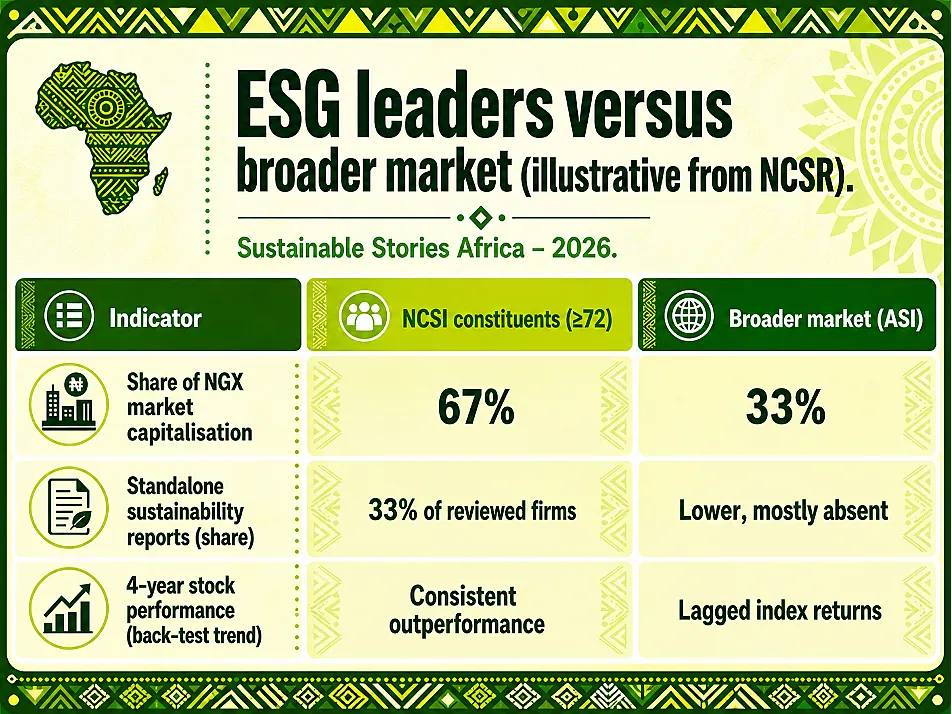
The NCSI's five-year back-test shows that companies scoring at least 72 points on its ESG scale consistently outperformed the broader market over the last four years.
Those 21 companies, just under half of the assessed universe, account for approximately 67% of the Nigerian Exchange's total market capitalisation, confirming that sustainability leaders are already central to the country's capital markets.
However, the report simultaneously exposes a deepening disclosure gap. Only 33% of reviewed companies have published standalone sustainability reports, and ESG disclosure rates across the Nigerian Exchange have fallen, from 55% in 2022 to just 42% in 2024.
The message is unambiguous: companies that continue to treat sustainability as public relations will face consequences from regulators, investors, and consumers alike. Those that treat ESG as a strategic lens for risk, resilience, and innovation are already reaping the returns.
Global rules, local realities
The NCSR anchors its assessment in internationally recognised frameworks, including IFRS S1 and S2, SASB industry standards, and the Global Reporting Initiative (GRI), while aligning them with local guidance from the FRC, the Nigerian Exchange (NGX), and the Securities and Exchange Commission (SEC).
The methodology assigns the highest weighting to environmental factors at 40%, reflecting the urgency of climate and ecological risk within Nigeria's development trajectory.
Nigeria has moved faster than many peers on the regulatory front. The FRC's Adoption Readiness Working Group has charted a phased path to full ISSB implementation, from voluntary adoption in 2024 to mandatory reporting for public-interest entities by 2028 and SMEs by 2030.
The NGX Sustainability Disclosure Guidelines, in operation since 2018, require listed companies to report on the economic, environmental, social, and governance pillars, while the Energy Transition Plan anchors Nigeria's long-term net-zero ambition to 2060.
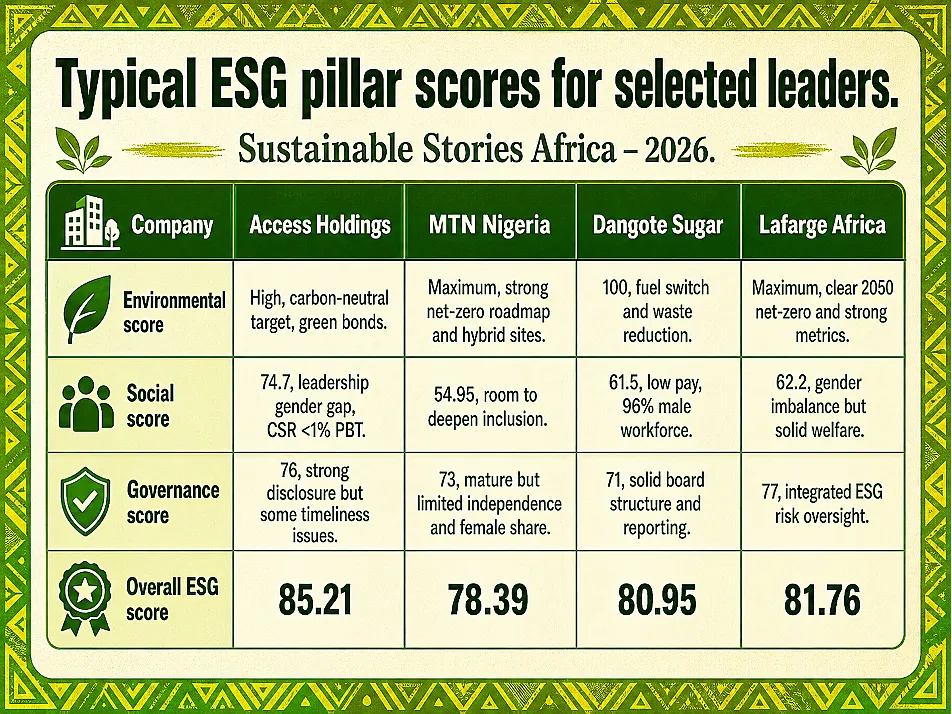
Corporate responses reveal both genuine progress and persistent unevenness. Access Holdings is targeting operational carbon neutrality by 2035, backed by a 7.8% reduction in emissions in 2023.
MTN Nigeria is converting over 5,700 network sites to hybrid and solar systems, aiming for net-zero by 2040. Lafarge Africa and Dangote Sugar are advancing alternative fuels, energy efficiency, and large-scale waste reduction.
However, the social pillar remains the weakest link. Gaps in gender balance at the leadership level, below-benchmark staff remuneration, and CSR spending that frequently falls short of 1% of profit before tax carry a clear message: in Nigeria's context, climate progress cannot be credibly separated from social inclusion and decent work.
What an ESG‑literate market could unlock
The NCSR sketches a compelling vision: a Nigerian capital market where ESG-literate investors, empowered regulators, and data-rich issuers treat sustainability performance as a mainstream price signal.
In that scenario, firms like MTN Nigeria, Access Holdings, and Lafarge Africa are not outliers but the norm, using ISSB-aligned disclosures to secure cheaper funding, deepen international partnerships, and deliver more resilient outcomes for citizens and communities.
For African and emerging-market peers, Nigeria's trajectory offers a replicable proof of concept.
The combination of early adoption of IFRS S1 and S2, sector-specific SASB metrics, and stakeholder-centred GRI reporting has enabled the country to build a coherent architecture that could redirect capital away from extractive, high-carbon models toward ventures aligned with the SDGs and the Paris Agreement.
The alternative is stark: persistent disclosure gaps and neglected social indicators risk producing both stranded assets and stranded communities.
An ESG regime built on climate ambition alone, without social equity and governance integrity, cannot deliver the resilience Nigeria urgently needs.
From report to regulatory and boardroom agenda
The NCSR makes it clear that the building blocks are in place; the next phase is execution. That requires coordinated action from policymakers, regulators, boards, financiers and citizens.
For policymakers and regulators:
- Lock in the ISSB roadmap. The FRC should move decisively from voluntary to mandatory compliance of IFRS S1 and S2 on the timelines already announced, with transitional support but firm enforcement.
- Harmonise rules and reduce noise. Align NGX sustainability guidelines, SEC sustainable finance principles, the Climate Change Act and sector rules into a single, navigable ESG rulebook for corporates and investors.
- Invest in capacity and assurance. Fund training for SMEs and mid‑caps, and phase in limited, then reasonable assurance of sustainability information, as the roadmap already envisages.
For boards and executive teams:
- Treat ESG as strategy, not compliance. Use the NCSR’s methodology to benchmark against peers and build board‑level ESG scorecards linked to remuneration.
- Close the social gap. Set clear targets for gender diversity, inclusion, fair pay and community impact, and report them with the same discipline as climate metrics.
- Fix data and timeliness. Strengthen internal systems so that sustainability reports and audited financials are published within regulatory timelines, avoiding the credibility drag of late disclosures.
For investors and lenders:
- Price ESG into capital. Use the NCSI and similar tools to tilt portfolios toward companies with credible transition and inclusion plans, rewarding transparency and penalising greenwashing.
- Engage, don’t just screen. Using stewardship to push high‑emitting or low‑disclosure firms toward clear, time‑bound improvement paths, especially in systemically important sectors like energy, agriculture and heavy industry.
For citizens and civil society:
- Turn ESG data into accountability. Use public sustainability reports to question boards, regulators and politicians about climate risk, social spending and governance standards that affect everyday life.
Path Forward – From glossy ESG claims to priced risk
Nigeria’s sustainability index is an early blueprint for how African markets can move from ESG promises to measurable, priced performance that shapes capital flows.
The priority now is execution: enforce ISSB‑aligned rules, close social gaps and embed ESG into everyday investment and board decisions before climate and governance shocks do it by force.
Would you like the next iteration to focus on a specific sector from the report, such as banking, telecoms or industrials, for a more targeted, publication‑ready version?