
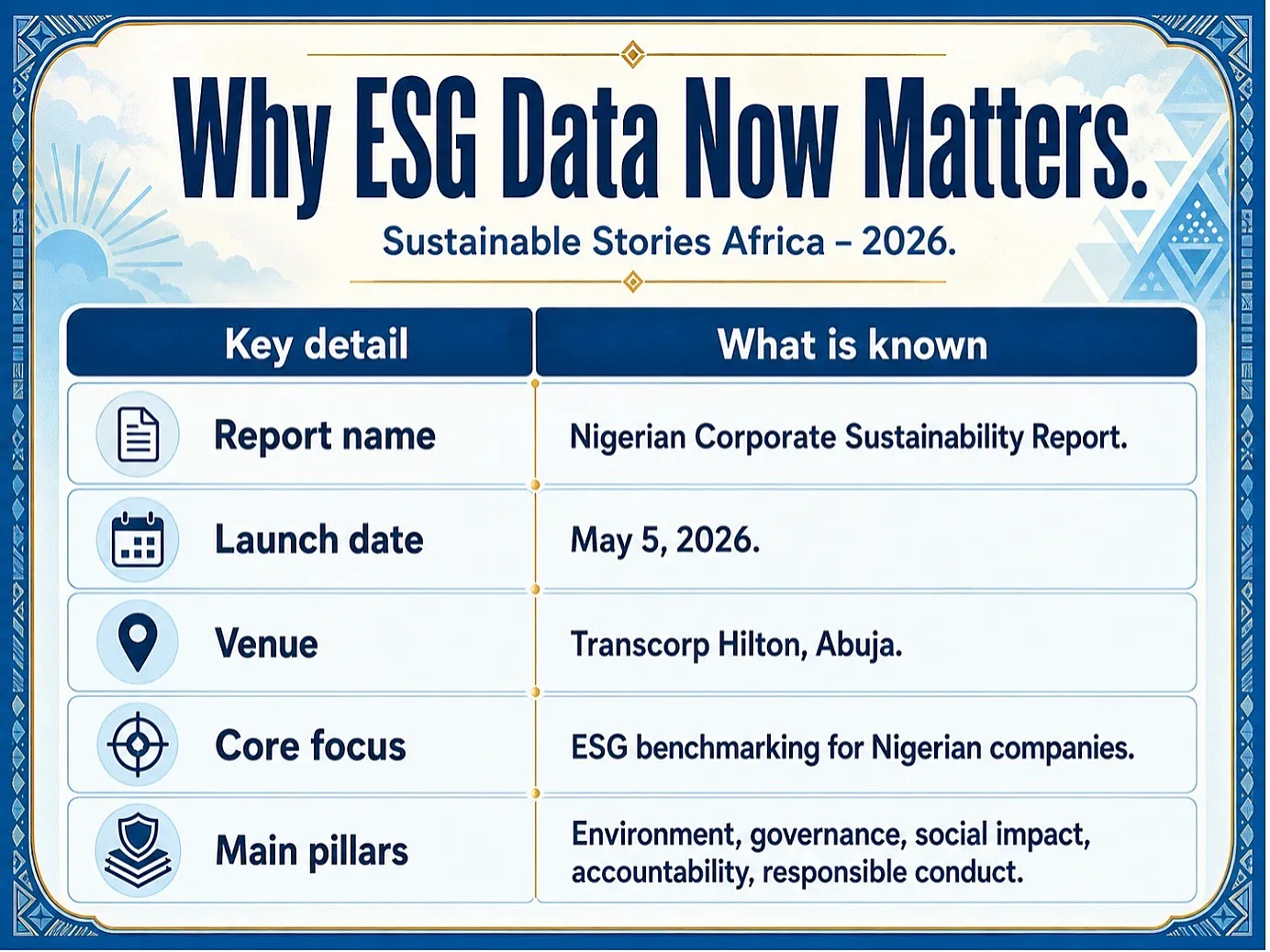
Norrenberger is set to launch the Nigerian Corporate Sustainability Report on May 5, 2026, in Abuja.
The report is positioned as Nigeria’s first ESG benchmark for corporate sustainability, designed to measure companies across environmental, governance, social, accountability and responsible business conduct indicators.
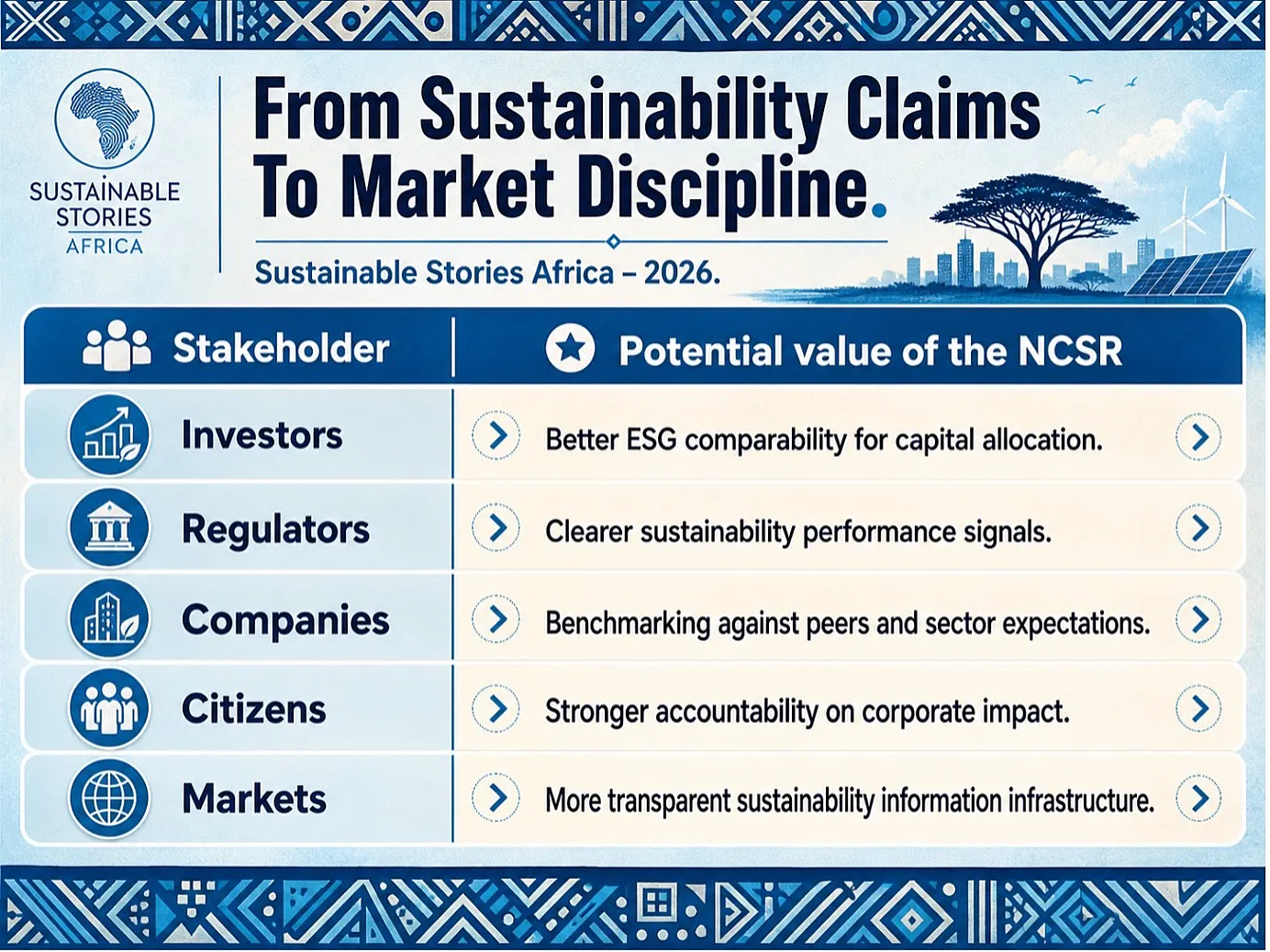
For investors, regulators and companies, the launch could mark a shift from broad sustainability claims to comparable, data-led performance tracking.
A Market Learns To Measure Sustainability
Norrenberger is set to launch the Nigerian Corporate Sustainability Report, a data-driven ESG benchmarking framework designed to assess corporate sustainability performance across Nigerian companies, on May 5, 2026, at Transcorp Hilton, Abuja.
The report, described in the launch brief as a first-of-its-kind benchmark, will evaluate companies across five core pillars: environmental stewardship, corporate governance, social impact, stakeholder accountability and responsible business conduct.
Its stated goal is to develop a baseline for corporate sustainability performance in Nigeria, allowing investors, regulators and companies to compare progress more consistently over time.
The launch will be held under the theme “Strengthening Sustainable Practices in Corporate Nigeria” and is expected to bring together senior executives, investors, regulators and sustainability leaders.
Why ESG Data Now Matters
For years, sustainability reporting in Corporate Nigeria has often depended on company narratives, uneven disclosures and voluntary statements.
The result has been a market where investors may struggle to compare companies, regulators may lack uniform benchmarks, and businesses may face limited pressure to prove sustainability performance beyond annual reporting language.
That is the gap Norrenberger says the NCSR is designed to address.
The framework introduces a structured lens for assessing ESG performance, a comparable dataset for investment decision-making, and a benchmark for identifying leaders and laggards in sustainability execution.
The critical issue is not just what is being announced, but how it will be implemented, why it matters and what wider insight readers need to understand the implications.
In this case, the implementation details beyond the planned launch, event theme and stated benchmarking pillars have not been fully disclosed in the provided brief.
From Sustainability Claims To Market Discipline
If implemented credibly, the NCSR could help move sustainability from a communications exercise into a measurable business discipline.
That matters because ESG performance is increasingly linked to capital access, reputation, operational resilience and investor confidence.
For a pension fund, lender or infrastructure investor, comparable ESG data can help distinguish between companies that merely publish sustainability language and those that build governance, environmental and social resilience into their operations.
Norrenberger’s position across investments, trust, pensions, insurance, infrastructure and lending gives it a close view of how capital moves through the Nigerian economy.
The launch brief frames the NCSR as a response to a changing market in which sustainability is influencing risk assessment and long-term investor confidence.
Companies Must Prepare For Scrutiny
The launch signals a practical challenge for Nigerian companies: ESG reporting may no longer be judged only by ambition, but by evidence.
Boards will need to ask if sustainability data is reliable, governance structures are clear, social impact claims can be verified, and whether environmental performance is tracked consistently.
Investors and regulators, in turn, will need to assess if the benchmark creates genuine comparability or becomes another reporting layer.
The bigger test will come after the unveiling: methodology, sector coverage, scoring transparency, update frequency and how companies respond to being benchmarked.
Path Forward – Build Trust Through Measured Accountability
For Nigeria’s ESG market to mature, sustainability claims must become measurable, comparable and decision-useful.
The NCSR’s promise lies in whether it can enable scattered disclosures into a credible benchmark.
The next priority is transparency: clear methodology, consistent data, sector-by-sector relevance and year-on-year tracking that help companies improve while giving investors and regulators stronger evidence for action.
Press Release - Norrenberger