Renewables overtook coal in global electricity generation in 2025, marking a historic turning point in the power sector.
China and India cut fossil electricity output as solar and wind expanded quickly enough to meet most of the new global demand.
For Africa, the shift comes with a sharper question: whether clean power can become not just climate policy, but cheaper, more secure development infrastructure.
Clean Power Takes The Global Lead
Renewable energy has overtaken coal as the world’s largest source of electricity, a milestone that accelerates years of climate ambition into a measurable power-sector shift.
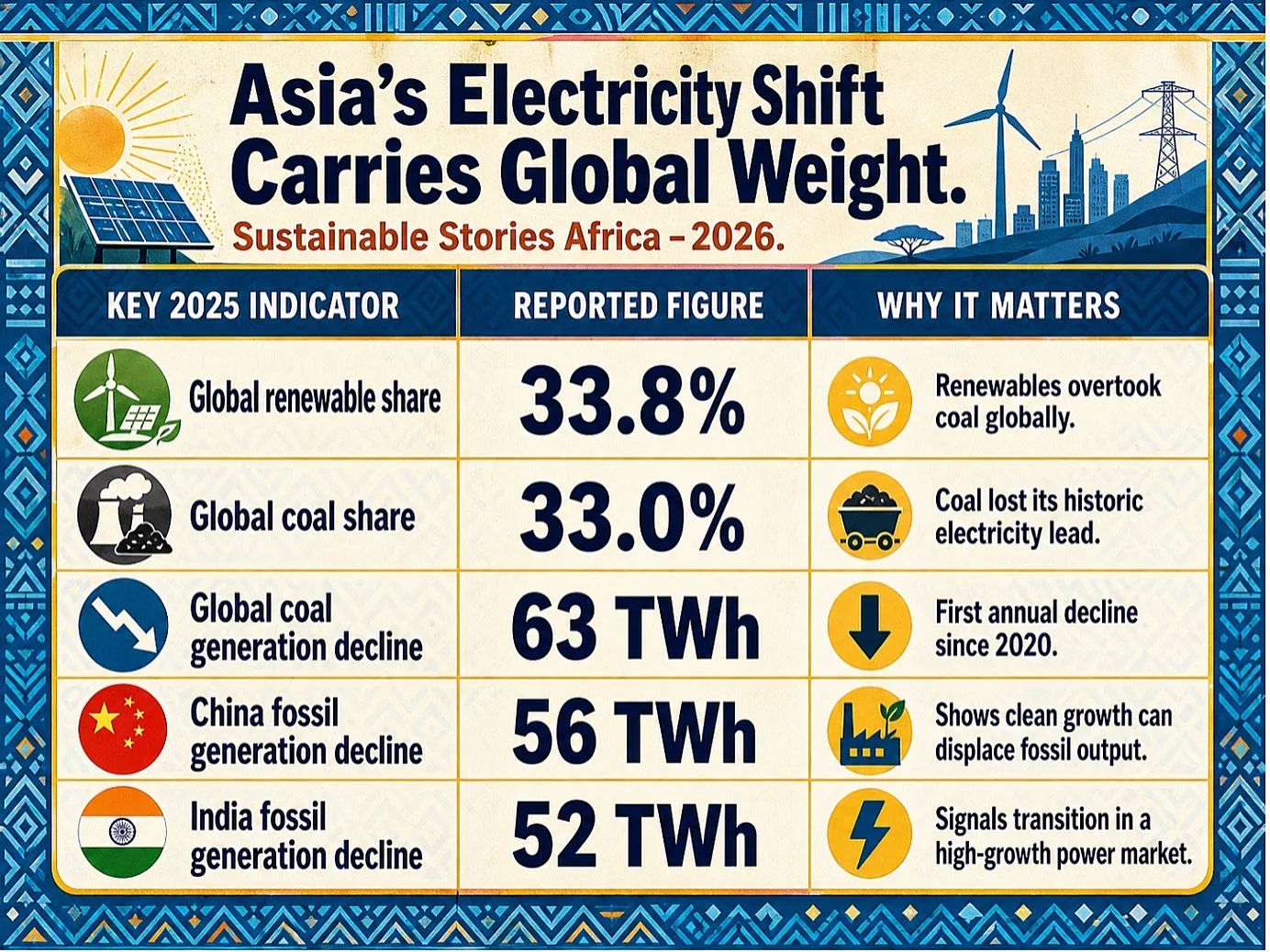
According to Ember’s latest analysis, renewables accounted for 33.8% of global electricity generation in 2025, ahead of coal at 33.0%. Coal generation fell by 63 terawatt-hours, while solar and wind met 99% of global electricity demand growth.
The bigger story is where the shift happened. China’s fossil fuel power generation fell by 0.9%, or 56 TWh, while India’s dropped by 3.3%, or 52 TWh, as clean electricity expanded across both systems.
For African policymakers, utilities and investors, this is not distant news. It is a signal that the economics of electricity are changing, and that the next development race may be decided by who can build reliable, affordable, clean grids fastest.
Asia’s Electricity Shift Carries Global Weight
China and India remain among the world’s largest power producers, which use fossil fuels.
However, their 2025 data shows a crucial transition: clean power is beginning to reduce fossil generation, not merely supplement it.
- In China, solar generation rose by 40%, adding 336 TWh. Solar alone met about two-thirds of the country’s new electricity demand.
- In India, renewable generation increased by 24%, or 98 TWh, helping reduce coal and gas generation despite rising power needs.
For families in Lagos, Nairobi or Accra, this matters because electricity remains both a cost burden and a development constraint. If solar, wind, storage and grids become cheaper and more bankable, clean power can move from conference language into household economics: fewer outages, lower diesel dependence, cleaner air and more resilient small businesses.
However, the transition remains uneven. Fossil fuels still accounted for 58% of China’s electricity mix and 73% of India’s in 2025.
The world has crossed a threshold, not completed a transition.
What Africa Can Gain From The Shift
The opportunity for Africa is not simply to copy China or India. It is to avoid building yesterday’s electricity system at tomorrow’s prices.
If clean electricity is planned well, African markets can use it to power industrial parks, irrigation, cold storage, electric mobility, digital services and cleaner cooking.
The gains are not abstract.
- A stable mini-grid can keep a rural clinic’s vaccine fridge running. A solar-backed factory can reduce diesel exposure.
- A stronger transmission network can connect renewable-rich regions to cities where demand is rising.
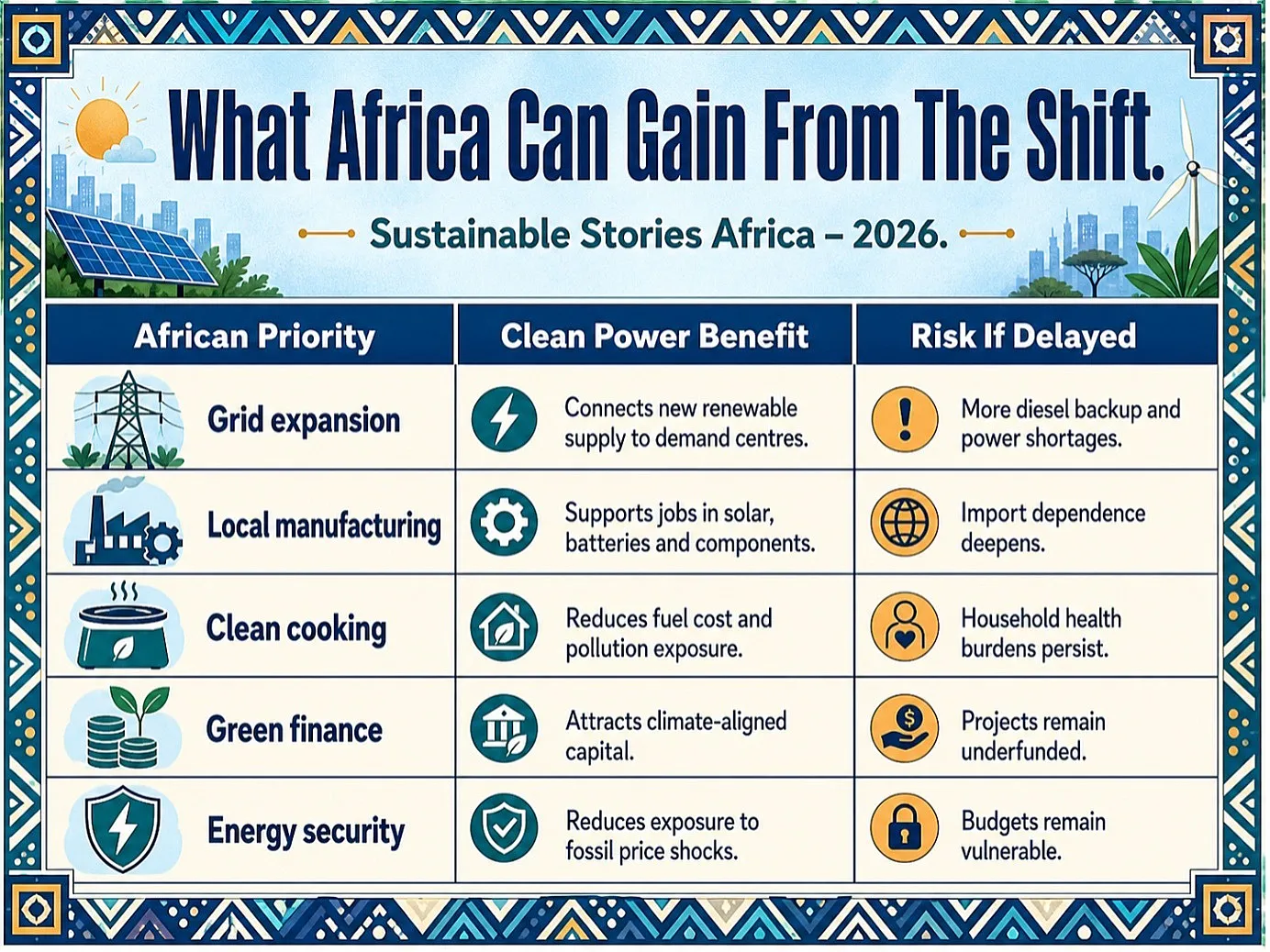
The prize is a power system that supports climate goals without sacrificing development.
The risk is a two-speed transition, where wealthy markets enjoy cheaper clean power while African economies remain locked into expensive backup generation and underbuilt grids.
Investment Must Follow The New Reality
The 2025 milestone should push African governments, regulators and financiers to treat renewables as core infrastructure, not a side category of climate policy.
That means faster permitting, stronger grid planning, transparent procurement, bankable tariffs, credible off-taker arrangements and local skills development.
It also means pairing solar and wind with storage, transmission and demand planning, so clean power becomes dependable power.
- Development finance institutions should move beyond pilot projects and help de-risk full systems, including generation, grids, storage, productive use and consumer affordability.
- Private investors, meanwhile, need policy stability and currency-risk tools to scale capital into markets where demand is real but project risk remains high.
The world’s electricity transition is no longer a forecast. It is visible in the data. The question for Africa is whether policy will move quickly enough to convert that shift into jobs, resilience and inclusive growth.
Path Forward – Build Clean Power With Purpose
Africa’s priority should be clear: scale renewables with grids, storage, finance and local capacity, not isolated projects.
That is how clean power becomes development infrastructure.
The 2025 milestone strengthens the ESG case for credible energy planning, lower emissions and better social outcomes.
The next phase must connect climate ambition to electricity access, industrial growth and household affordability.
Culled From: Renewables Overtake Coal Globally as China and India Cut Fossil Power Generation in 2025