Energy companies are increasingly joining forces to deliver larger African renewable power projects.
The shift matters because solar, wind and battery projects now require deeper finance, stronger grids and local market knowledge.
For African households and industries, partnerships could determine whether clean power becomes reliable electricity or remains a project pipeline.
Partnerships Become The New Power Strategy
Africa’s clean energy market is entering a partnership phase, as developers, manufacturers, and financiers join forces to manage bigger, more complex renewable projects.
The clearest recent example is South Africa, where Dimsum Energy and Goldwind Africa have partnered to develop a 1.5 GW hybrid renewable energy project in the Eastern Cape, combining wind, solar PV and battery storage.
The project is structured around a green energy cluster reportedly valued at about R40 billion, with financial close targeted for 2027.
Renewables Rising frames the trend simply: renewable energy projects are growing in scale and complexity, pushing industry players to pool resources and expertise to meet changing market demands.
Bigger Projects Need Bigger Coalitions
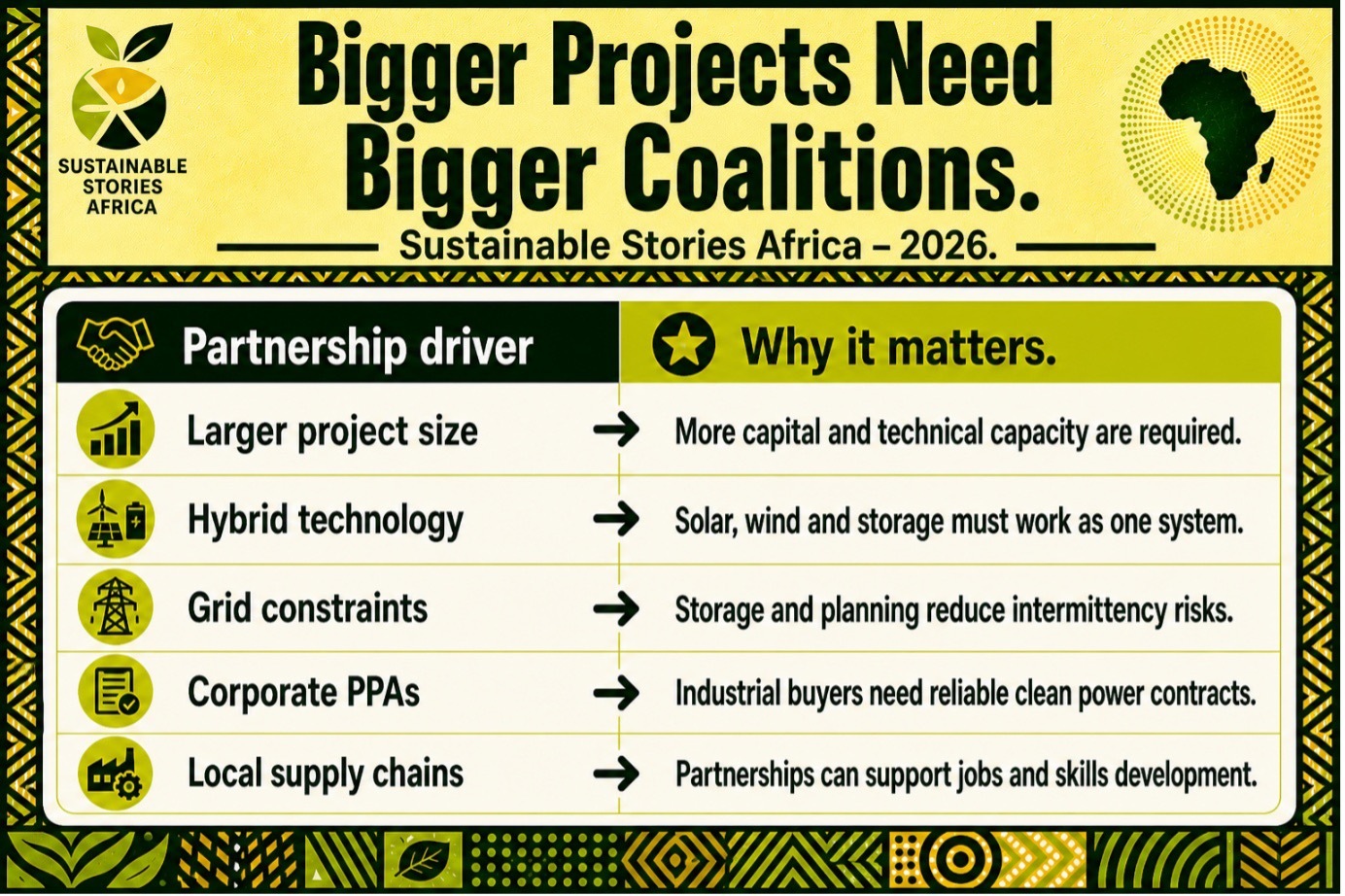
The new wave of African energy partnerships is not accidental. Hybrid projects now require land access, grid studies, permitting, technology integration, long-term offtake agreements, storage expertise, community engagement and large balance sheets.
In the Eastern Cape project, the partners plan to integrate battery energy storage to improve grid stability and dispatchability, while also supporting corporate power purchase agreements for industrial users.
That combination shows why one company rarely brings everything required: developers need local pipelines, technology firms bring equipment expertise, and financiers demand bankable project structures.
The trend is also visible outside South Africa. Renewables Rising cited the partnership between China’s Sinoma
Tech Holding and Morocco’s Marita Group to deliver renewable energy projects in Morocco.
Middle East Online reported that the two groups signed an MoU to develop solar EPC and EPCF projects as well as energy transition initiatives in Morocco and other target markets.
Collaboration Can Turn Projects Into Systems
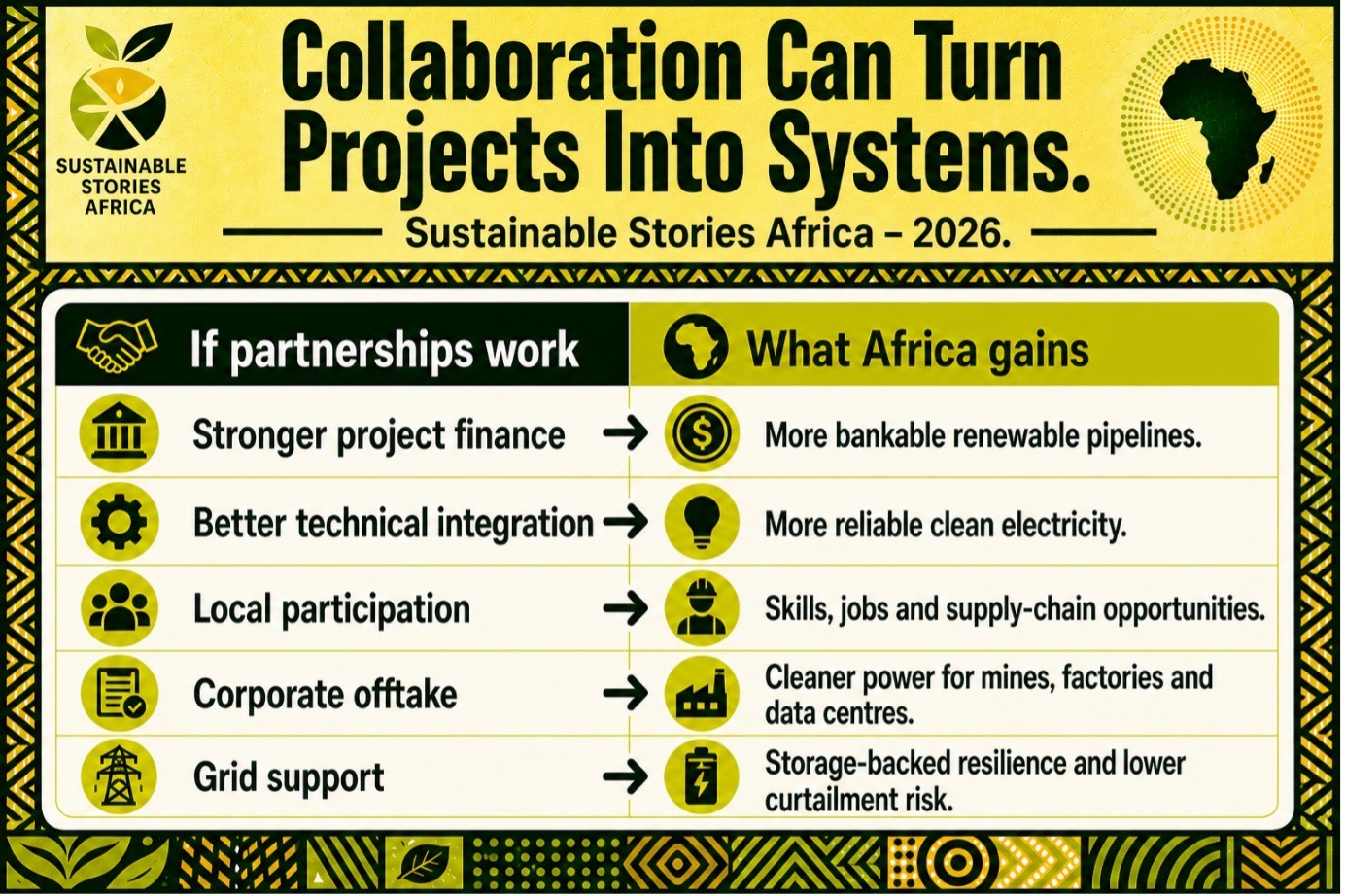
The opportunity is significant. When energy players collaborate well, renewable power becomes more than installed capacity.
It becomes a system: generation, storage, offtake, finance, skills and local economic participation.
For a factory in Johannesburg, a hybrid renewable energy project can mean cleaner and more predictable power.
For a municipality in the Eastern Cape, it can mean jobs, land-leasing revenue and local supplier opportunities. For a bank, it can mean a project with stronger risk-sharing and more credible delivery partners.
However, there is a warning. Partnerships can also become branding exercises if roles are unclear, communities are excluded, or grid investment lags. Africa does not only need more announcements.
It needs projects that reach financial close, connect to the grid, serve real demand and leave durable local value.
Build Partnerships Around Delivery
Energy players should now treat partnership design as a core development issue.
- Governments must create predictable permitting, grid-access and procurement rules.
- Developers should disclose timelines, capacity plans and local content commitments.
- Financiers should back blended structures that reduce risk without shifting all costs to consumers.
For African markets, the next competitive advantage may not be who has the biggest project announcement.
It may be who can assemble the strongest coalition: local developer, global technology provider, credible offtaker, patient capital, community trust and grid-ready execution.
The energy transition is no longer a single-player race. It is a delivery test.
Path Forward – Turn Alliances Into Real Electricity
Africa’s renewable energy partnerships must now move from MoUs and announcements to financed, grid-connected projects.
The priority is disciplined execution: clear contracts, local jobs, stronger grids, storage integration, transparent community benefits and financing structures that make clean power reliable for households, businesses and public services.
Culled From: Why energy players are joining forces