China will implement zero tariffs on 100% of tariff lines for 53 African countries from May 1, 2026.
For Ghana, the opportunity is larger than cheaper market entry; it is a test of export readiness.
Without standards, certification, logistics and value addition, Ghana risks watching a historic trade opening pass by.
Ghana’s Export Door Has Opened Wider
China’s planned zero-tariff policy for African exporters could give Ghana one of its most important trade openings in years, but only if the country moves quickly from raw commodity exports to processed, standards-compliant, market-ready products.
Beginning May 1, 2026, China is expected to implement a zero-tariff policy on 100% of tariff lines for 53 African countries with diplomatic relations with China.
This marks a major expansion of preferential trade under the Forum on China-Africa Cooperation. The policy brief says the move is intended to enhance market access and make African exports more competitive in the Chinese market.
For Ghana, the stakes are clear. The country already trades heavily with China; however, much of the relationship remains structurally imbalanced:
Ghana largely exports commodities such as cocoa, gold, crude oil, timber and cashew, while importing manufactured goods, machinery, electronics, textiles and industrial inputs.
The policy window now asks a harder question: can Ghana sell more value to China, not just more volume?
Tariffs Are Falling, Standards Remain
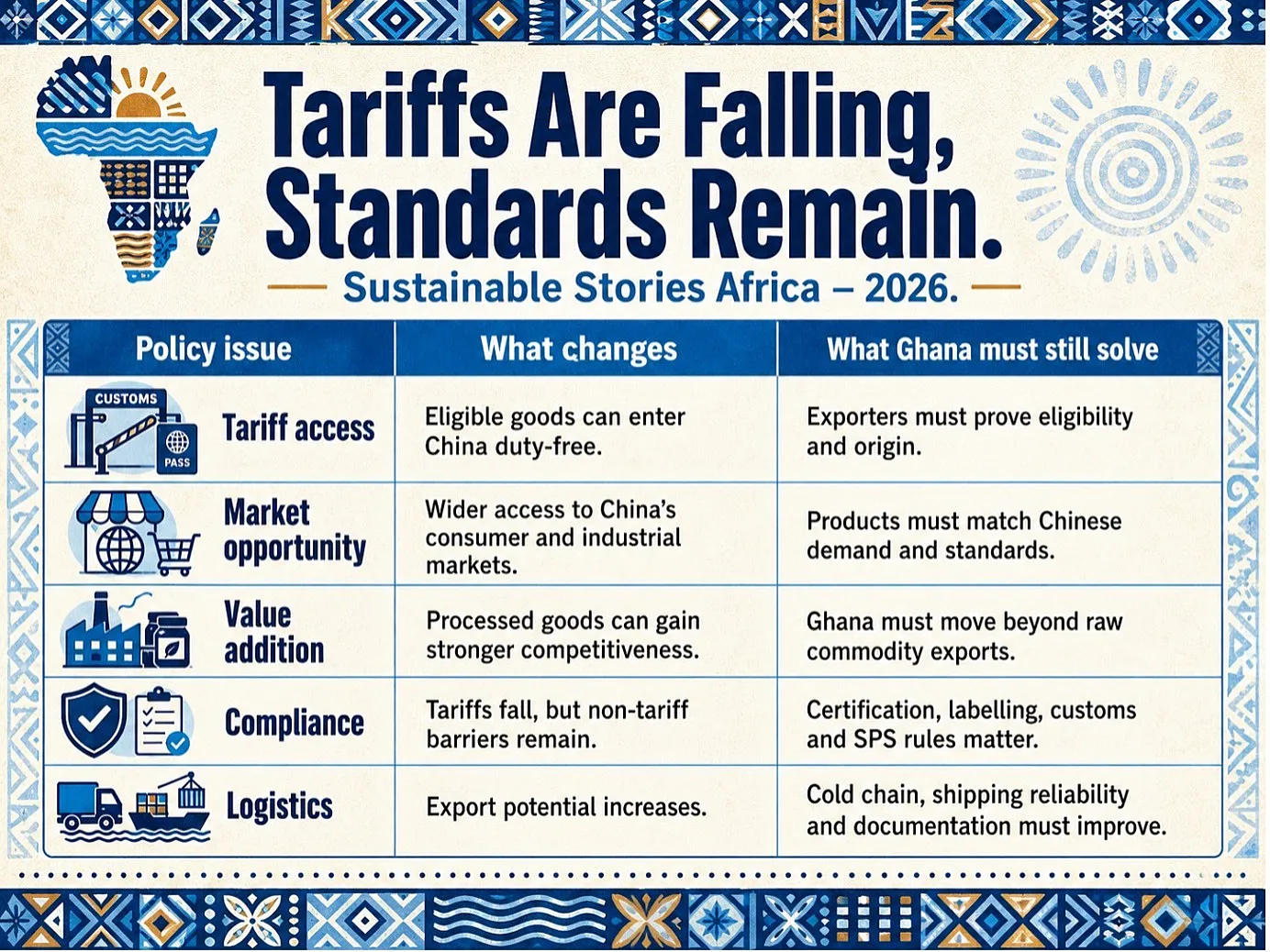
The policy brief’s central warning is direct: zero tariffs do not automatically translate into export success.
Ghanaian exporters must still meet rules of origin, certification requirements, customs procedures, product standards, sanitary and phytosanitary rules, packaging expectations and Chinese regulatory requirements.
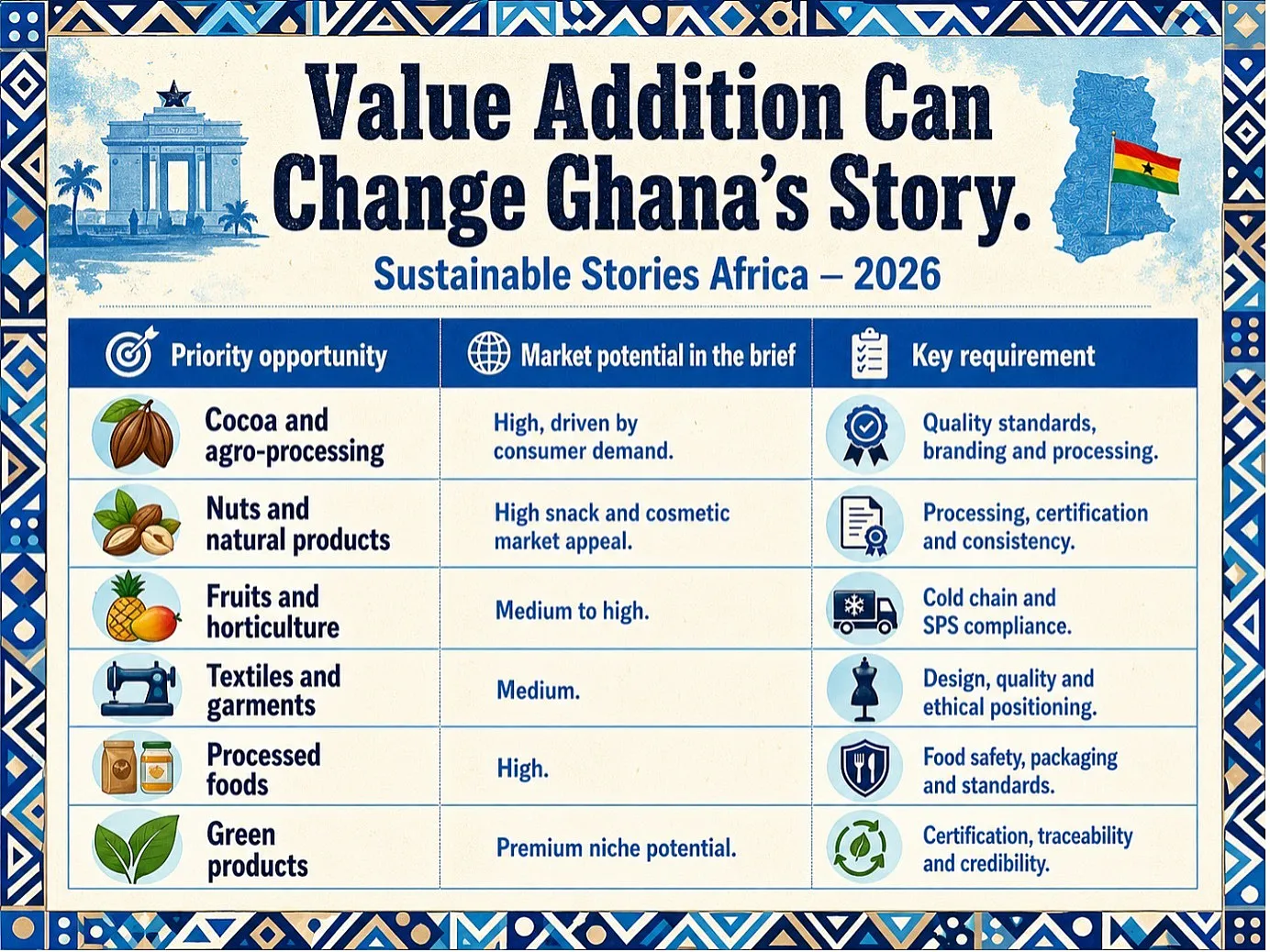
The report identifies opportunities in agro-processed exports, especially cocoa derivatives, cashew, shea-based products and processed foods.
It also points to industrial and manufactured goods, textiles, garments, light manufacturing, cosmetics, green products, and eco-certified goods as areas where Ghanaian businesses could begin repositioning.
This matters for a cocoa processor in Kumasi, a shea cooperative in Tamale, a garment producer in Accra, or a fruit exporter trying to reach Asian buyers.
The tariff barrier may fall at the border, but the real competition begins long before shipment: product design, certification, documentation, packaging, branding and distribution.
Value Addition Can Change Ghana’s Story
The opportunity is not simply to export more. It is to change what Ghana exports.
If Ghana uses the policy well, cocoa can move from beans to butter, powder and chocolate.
Cashews can be processed from raw nuts into kernels and roasted products. Shea can be processed from inputs to branded skincare. Fruits can move from perishables to dried, packaged and cold-chain-supported products.
For Ghana’s development agenda, this is where trade policy meets jobs. Processed exports can support local manufacturing, improve farmer incomes, deepen industrial capacity and create opportunities for small and medium-sized businesses.
The brief argues that Ghana’s success will depend on preparation, not entitlement. Market access alone is not enough; competitiveness, compliance and coordination will determine the result.
Export Readiness Must Become a National Strategy
The action agenda is urgent. Ghana needs a targeted China export strategy focused on priority sectors, product standards, market intelligence and export targets.
The brief recommends stronger certification systems, upgraded testing laboratories, food safety inspection systems and international-standard accreditation.
Trade institutions also need to move closer to exporters. The Ghana Export Promotion Authority, Ghana Standards Authority, Customs Division, Ministry of Trade, Food and Drugs Authority and Ghana Free Zones Authority all have roles to play.
The report notes the need for a dedicated China Export Support Desk to provide advisory services, documentation guidance, inter-importer connections and compliance support.
For the private sector, the next step is investment: better packaging, processing technology, product consistency, export consortia, buyer partnerships and joint ventures with Chinese firms.
Exporters should not wait until a shipment is rejected to learn the rules. They must understand origin requirements, certificates of origin, customs clearance, product labelling and market channels before entering the system.
The policy brief captures the moment clearly: Ghana must move from “opportunity to execution.” That means turning China’s tariff concession into real export growth, industrial transformation and stronger Ghana-China commercial cooperation.
Path Forward – Move From Access To Execution
Ghana’s priority is to build the systems that make zero tariffs usable: standards, certification, export finance, logistics, market intelligence and buyer connections.
If government, trade institutions and businesses coordinate quickly, China’s policy can support value addition, SME growth and industrial upgrading.
If not, Ghana may gain access on paper while losing competitiveness in practice.