Clean Air Task Force’s 2025 Impact Report argues that politics, affordability, industrial competition and energy security test climate progress.
The report highlights action on methane, clean firm power, industrial decarbonisation, transmission and regional technical capacity.
For Africa and other emerging markets, its message is clear: climate ambition must become practical, investable and resilient.
Climate Action Faces A Hard Reality
Climate progress in 2025 was no longer judged only by ambition. It was judged by its ability to survive pressure.
That is the central message of the Clean Air Task Force’s 2025 Impact Report, which frames the year as a stress test for global climate strategy.
Political volatility intensified, economic pressure persisted, geopolitical fragmentation deepened, and public priorities shifted toward affordability, energy security and industrial competitiveness.
In that environment, CATF said durable climate action had to be “technically sound, politically resilient, economically credible” and grounded in how the real world works.
For African markets, that framing matters. The continent is not debating climate policy in isolation.
It is trying to expand electricity access, industrialise, protect public health, attract finance and manage exposure to fossil-fuel volatility, all while facing rising climate risks.
The report’s core argument is that climate action must move beyond slogans into bankable systems, enforceable rules and technologies that can work under pressure.
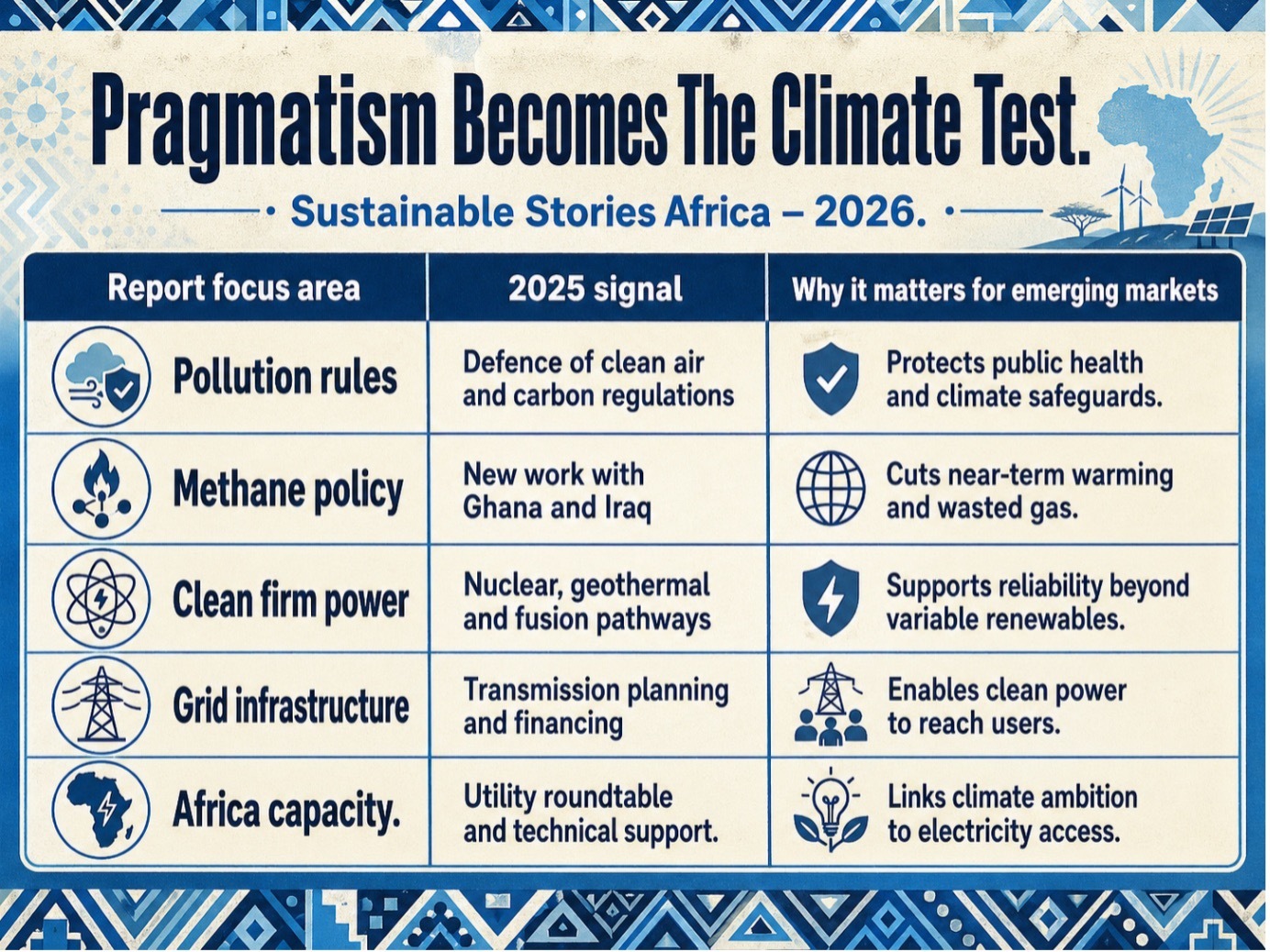
Pragmatism Becomes The Climate Test
Clean Air Task Force positions itself as a pragmatic global climate organisation, advancing scalable solutions across zero-carbon fuels, advanced nuclear energy, superhot rock geothermal and carbon capture, grounded in scientific evidence and built for real-world policy and political environments.
Its latest report documents activity across 46 countries on six continents, with a growing African footprint. CATF convened the West Africa Utilities Roundtable in Accra, bringing together utility executives from eight countries, including regulators and financing institutions.
The aim is to address the challenges of low-carbon power systems. Technical analysis was also provided to utilities in Ghana, Kenya and The Gambia to guide grid upgrades and the integration of variable renewable energy.
For households in Accra, Lagos, Nairobi or Banjul, the stakes of this work are immediate.
Climate policy arrives not as a conference communiqué but as a question of whether electricity stays on after sunset, whether diesel generators remain a daily expense, and whether public budgets can finance cleaner infrastructure without deepening the affordability burden on ordinary people.
Cleaner Systems Can Unlock Development
Clean Air Task Force makes the case that decarbonisation and development are not competing priorities; they are complementary ones.
For African policymakers holding a dual mandate of cutting emissions while delivering power, jobs and growth, that framing carries practical relevance.
Methane stands out as an immediate near-term opportunity.
It traps more than 80 times the carbon dioxide heat of over 20 years; methane reduction offers gas-producing African countries more than regulatory compliance.
It can prevent gas waste, strengthen export credibility and reduce local pollution. CATF has expanded its Fossil Fuel Regulatory Programme in partnership with UNEP and the Climate and Clean Air Coalition, announcing new methane policy initiatives with Ghana and Iraq.
In markets positioning gas as a transition fuel, accountability for methane may increasingly determine whether financiers, regulators and buyers accept that argument.
CATF's Nuclear Scaling Initiative targets 50 or more gigawatts of nuclear capacity annually by the 2030s. Its superhot rock geothermal work advances always-available clean power to complement renewables in deeply decarbonised grids.
Institutions Must Turn Evidence Into Action
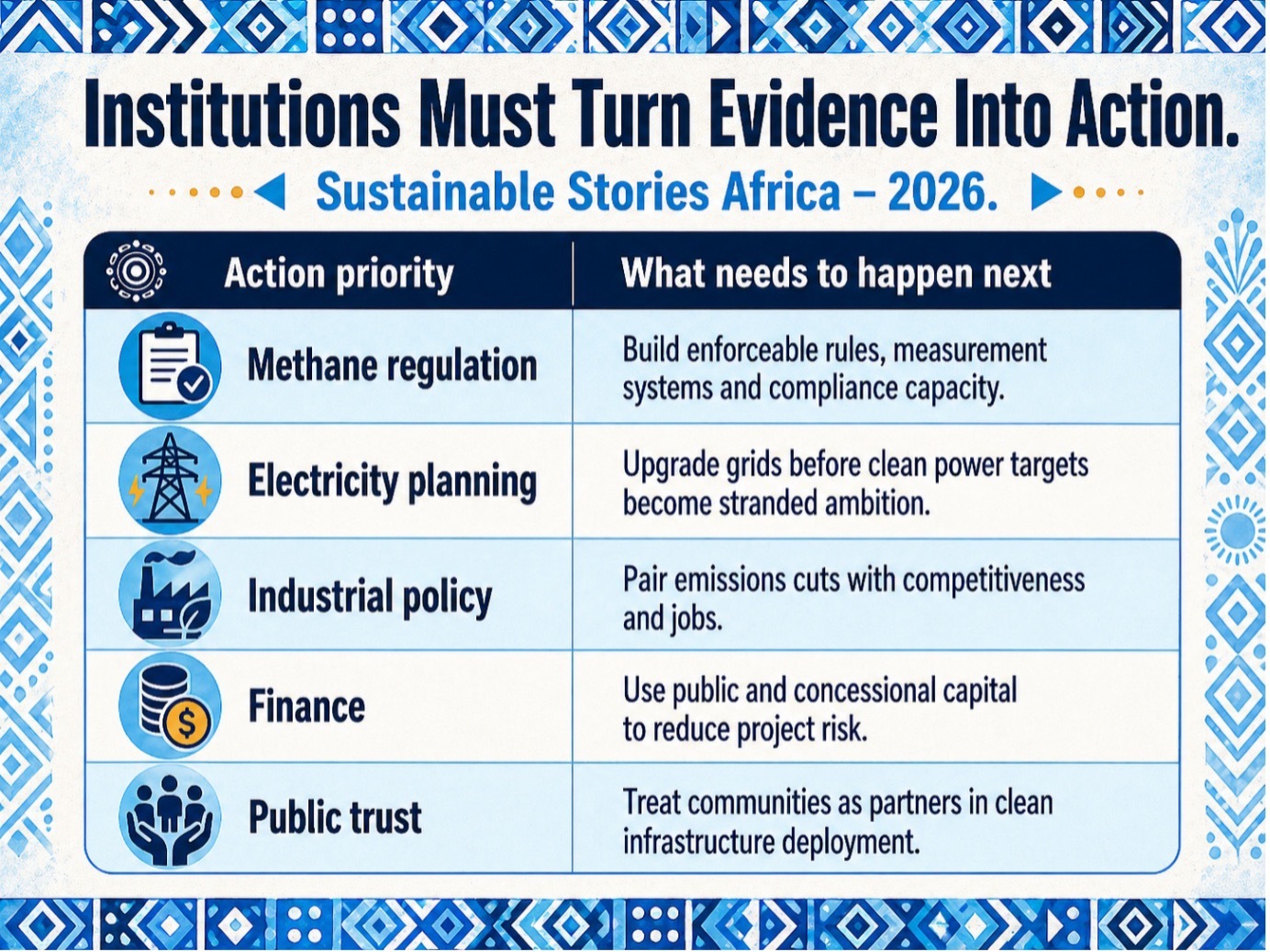
The report’s action message is direct: climate institutions must defend what works, improve what does not, and build the technical infrastructure needed for implementation.
CATF says it defended pollution safeguards, advanced methane accountability, supported industrial decarbonisation, worked on clean firm power and promoted lower-cost transmission financing during a politically difficult year.
For Africa, the takeaway is not that one technology will solve the transition. It is that the climate strategy needs a larger toolkit.
Solar and wind remain vital, but grids, storage, clean fuels, methane rules, carbon management, geothermal, nuclear options, credible standards and institutional capacity will determine whether ambition becomes delivery.
The risk of inaction is also clear. Without implementation capacity, climate targets become declarations.
Without affordability, public support weakens. Without infrastructure, investment slows. And without credible regulation, pollution continues to shape public health, productivity and climate exposure.
Path Forward – Build Practical, Investable Climate Systems
The path forward is to make climate action practical enough to survive politics, finance and public scrutiny.
African markets need stronger utility planning, methane regulation, grid investment, clean industrial policy and financing models that lower risk while protecting affordability.
CATF’s report advances an ESG message that fits the moment: climate progress must be measurable, resilient and useful to people’s daily lives.
The next phase is delivery, not aspiration alone.