Egypt is advancing a sustainable aviation strategy built around sustainable aviation fuel, solar-powered airports and fleet modernisation.
The move matters as aviation faces rising pressure to cut emissions while supporting tourism, trade and regional connectivity.
For Africa, Egypt’s strategy offers a practical test: can greener aviation also deliver jobs, resilience and affordable mobility?
Egypt Places Climate Inside Aviation Growth
Egypt is positioning sustainability at the core of its aviation growth, combining sustainable aviation fuel, airport solar power and fleet modernisation into a strategy designed to make its air transport sector cleaner, more competitive and globally relevant.
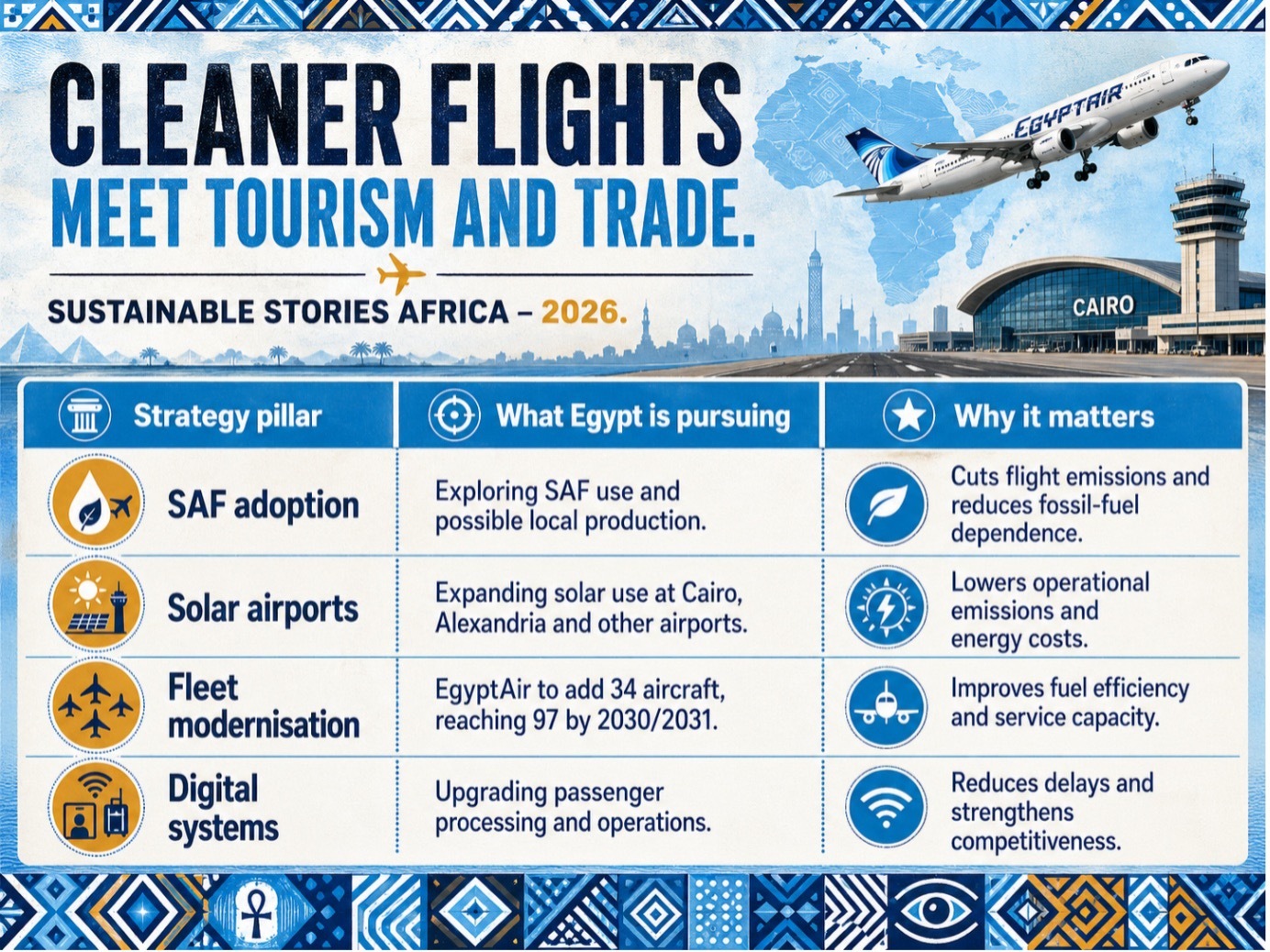
Announced in April 2026, the plan reflects Egypt's ambition to strengthen its role as a regional aviation hub while aligning with the industry's net-zero trajectory. Civil Aviation Minister Sameh El Hefny confirmed that EgyptAir is expanding its fleet from 63 to 97 aircraft by 2030/2031.
Beyond aircraft, solar energy is already operational at Cairo and Alexandria airports, with renewable power set to extend across facilities nationwide. Authorities are also studying domestic SAF production to cut emissions and reduce dependence on conventional jet fuel.
The announcement signals a deliberate shift in direction. For passengers, tourism operators and airport workers, Egypt's message is straightforward: the future of air travel here will be faster, cleaner and more resilient.
Cleaner Flights Meet Tourism and Trade
Aviation is one of Egypt's most strategic economic arteries, connecting North Africa to Europe, the Gulf, and sub-Saharan Africa while supporting tourism, trade and diaspora mobility. Its decarbonisation, therefore, carries continental significance.
Egypt's strategy targets three levers simultaneously:
- Cleaner fuel
- Cleaner airport operations
- More efficient aircraft.
This approach is deliberate. Large-scale electric and hydrogen-powered aircraft remain commercially unready, making sustainable aviation fuel the most viable near-term option for emissions reduction.
IATA estimates SAF could deliver roughly 65% of the reductions needed for aviation to reach net-zero by 2050, a goal formally adopted by ICAO member states.
For African economies, the deeper question is whether sustainability translates into industrial opportunity.
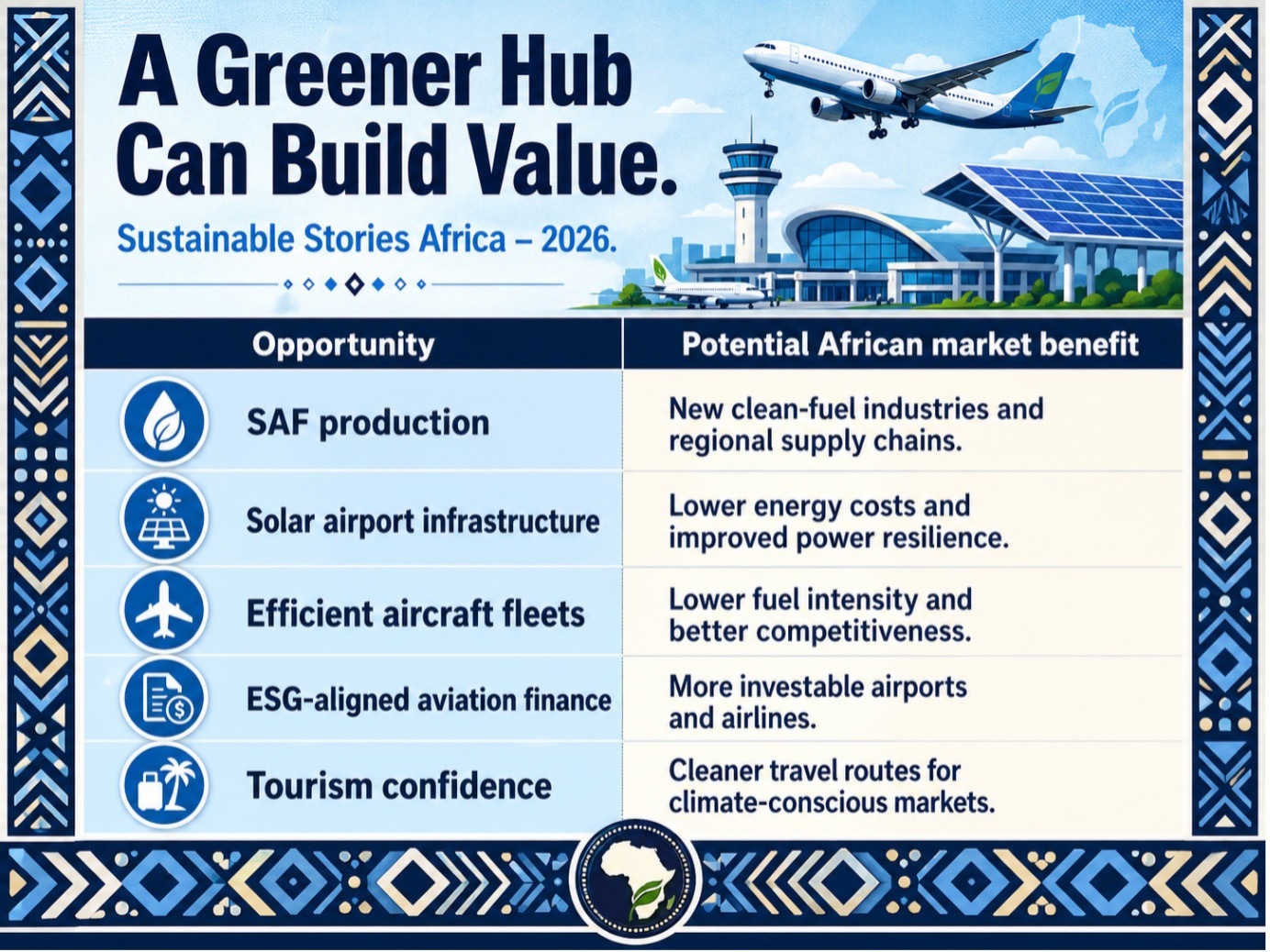
Egypt's potential to develop local SAF feedstock supply chains, renewable-linked production or regional fuel partnerships could set a meaningful precedent.
Across the continent, countries with agricultural, waste, and renewable energy assets have real prospects in the SAF value chain, provided standards, financing and credible safeguards are in place.
A Greener Hub Can Build Value
Egypt's aviation strategy holds promise well beyond emissions reductions. Solar-powered airports can lower exposure to volatile electricity costs, while more efficient aircraft reduce fuel burn and maintenance pressures.
Locally developed SAF production could create industrial value chains spanning agriculture, waste management, refining and clean-energy investment, generating jobs tied to green infrastructure rather than passenger volumes alone.
For African policymakers, the approach demonstrates how aviation decarbonisation can serve economic development, not merely compliance.
However, execution will determine everything. SAF remains costlier than conventional fuel, global supply is constrained, and IATA's director-general warned in February 2026 that aircraft and fuel shortages are already threatening the sector's 2050 net-zero goal.
Egypt's strategy will ultimately be measured by whether ambition translates into verifiable, on-ground results.
Turn Aviation Ambition Into Delivery
Egypt’s next task is to enable aviation sustainability from announcement to measurable transition.
That means publishing clear milestones for SAF adoption, airport renewable energy capacity, fleet efficiency, emissions reporting and financing. It also means building partnerships with airlines, fuel producers, development banks, tourism operators and regional regulators.
African aviation stakeholders should watch closely. Countries including Nigeria, Kenya, Ethiopia, South Africa, Morocco, Ghana and Rwanda face similar choices: how to expand aviation without locking in high-emission infrastructure.
Egypt’s model suggests that the answer lies in integrated planning, including fuel, fleets, airports, digital systems and finance moving together.
- For investors, the opportunity is to back infrastructure that can prove its climate and commercial case.
- For governments, the priority is policy certainty.
- For citizens, the promise is simple: aviation that connects people without ignoring the climate costs of connection.
Path Forward – Make African Aviation Cleaner And Competitive
Egypt’s strategy should reflect a continental learning moment: set SAF standards, finance solar airports, modernise fleets and report emissions transparently.
The promise is a stronger African aviation market, cleaner, more efficient and better prepared for global climate rules. If execution follows ambition,
Egypt could help define how African air transport grows without neglecting sustainability.
Culled From: Egypt Launches Sustainable Aviation Strategy With SAF Adoption, Solar Airports and Fleet Modernisation