
Researchers in Canada have developed a light-driven method for producing metal-organic frameworks under mild, ambient conditions.
The breakthrough matters because conventional synthesis can require high heat, long reaction times and energy-intensive processing.
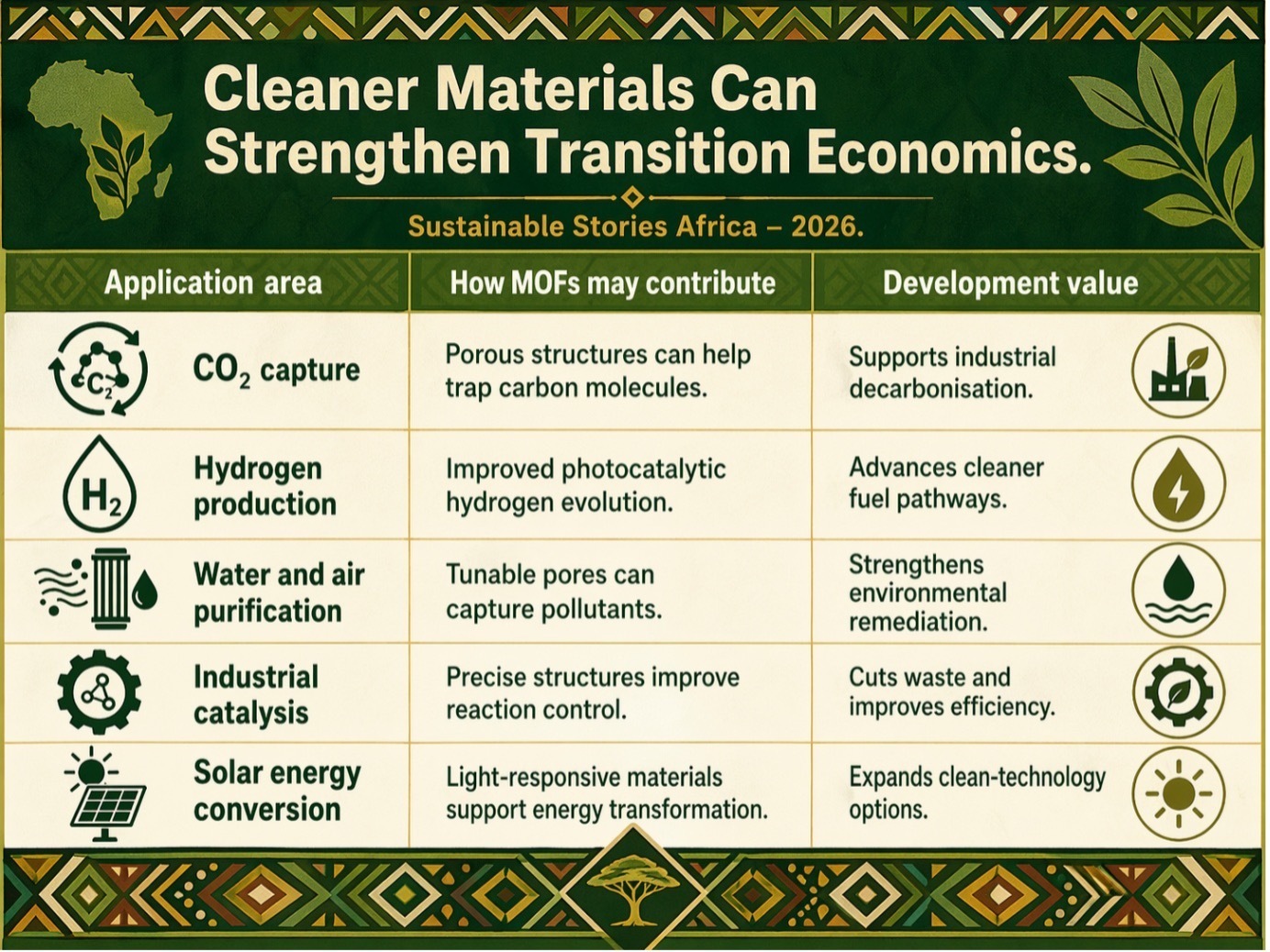
If scaled, the approach could support cleaner hydrogen production, CO₂ capture, environmental remediation and solar energy technologies.
Light Becomes a Manufacturing Tool
A research breakthrough may be quietly reshaping how green materials are manufactured.
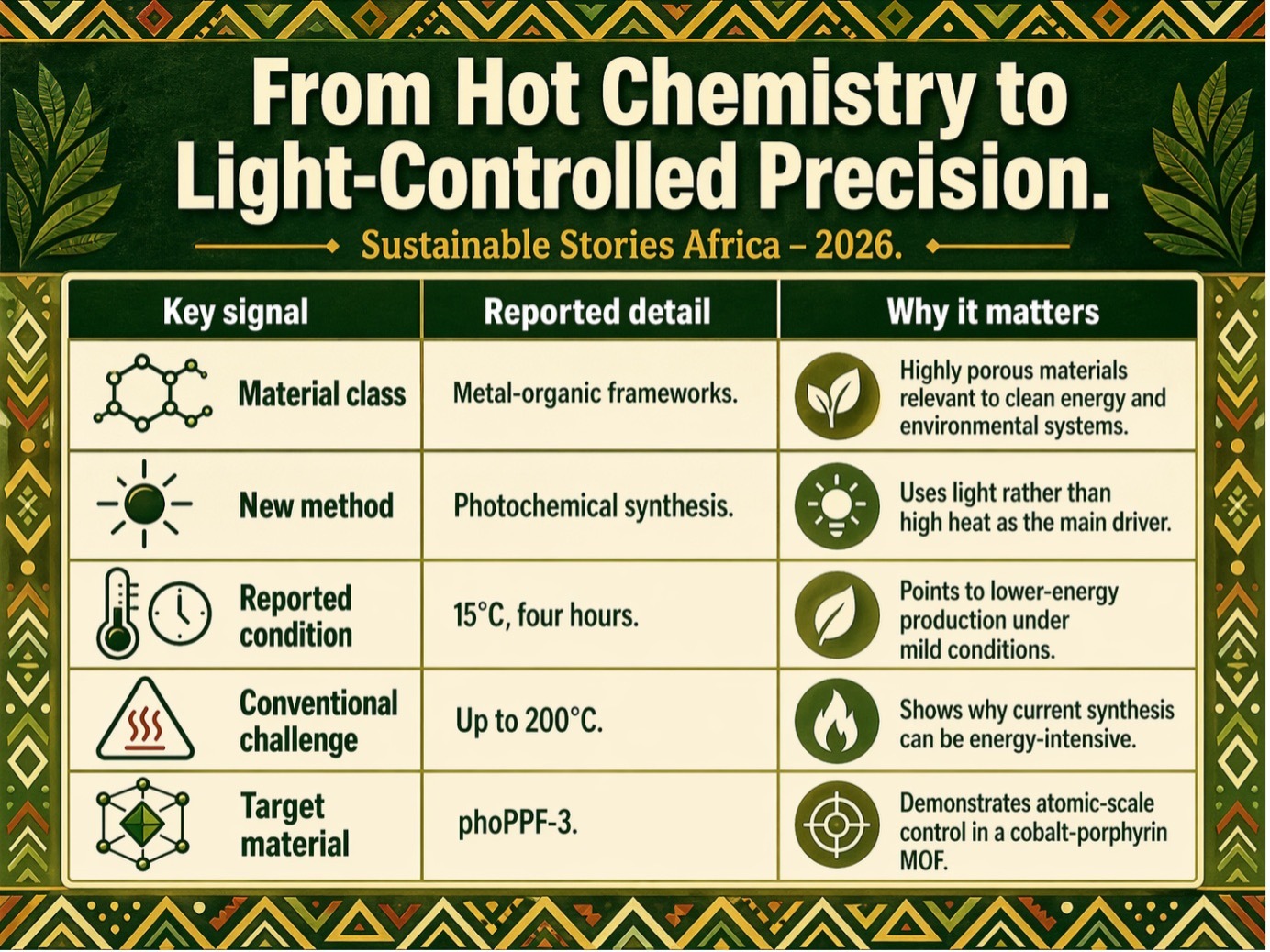
Scientists at the Institut national de la recherche scientifique, in collaboration with McGill University, have developed a photochemical synthesis method that uses light, rather than extreme heat, to produce metal-organic frameworks (MOFs) at room temperature.
The study, published in Nature Communications, demonstrates the technique through a cobalt-porphyrin-based MOF called phoPPF-3.
The significance is practical. MOFs are critical for CO₂ capture, water purification, catalysis, and hydrogen production, but conventional synthesis requires temperatures up to 200°C, creating energy and scalability barriers for clean manufacturing.
For African and Global South economies pursuing industrialisation without high-emission lock-in, the message is simple: the energy transition depends not only on solar panels and batteries but on how the materials behind them are made.
From Hot Chemistry to Light-Controlled Precision
The new method shifts MOF production from heat-driven chemistry to light-guided assembly.
According to the research summary, the team synthesised phoPPF-3 at 15°C over four hours, using photons to initiate and control the assembly process at the atomic scale.
That control produced distinctive two-dimensional, hourglass-like structures and preserved free-base porphyrin cores that conventional solvothermal synthesis could not maintain.
Professor Ma described the finding as proof that photons can do more than start a chemical reaction.
“Our work demonstrates that photons can be used not only to initiate MOF synthesis, but also to guide it with exceptional precision,” she said, adding that the method could reduce energy consumption while opening a more sustainable route for advanced-material engineering.
The research also reported stronger functional performance.
Compared with solvothermally produced analogues, phoPPF-3 demonstrates higher photocatalytic activity in benzyl alcohol oxidation and hydrogen evolution, with performance gains reaching up to 50% in some cases.
That matters because the clean-energy economy is full of hidden material bottlenecks.
A hydrogen project, carbon-capture system, industrial catalyst or solar-conversion technology may look clean at the point of use; however, its supply chain can still require energy-intensive materials processing.
Lower-energy synthesis does not solve every problem, but it can reduce the burden at the front end of green industrialisation.
Cleaner Materials Can Strengthen Transition Economics
The promise of light-made MOFs is practical: better materials, lower energy demand and stronger control over performance.
For policymakers and investors, this is the kind of innovation that can shift clean technology from expensive laboratory promise to scalable industrial platform.
If MOFs can be produced with less heat and greater precision, manufacturers may be able to reduce processing costs, improve durability and design materials more closely around real-world functions.
For African markets, the long-term opportunity is not only to import finished clean technologies.
It is to build scientific and manufacturing capacity around materials innovation. Universities, industrial parks and energy-transition programmes could use such research to strengthen local value chains in green hydrogen, water treatment, clean manufacturing and climate-resilient infrastructure.
The risk of inaction is that Africa remains a consumer of advanced materials rather than a participant in their design and production.
As the world races to decarbonise, the countries that master green manufacturing will shape jobs, patents, exports and strategic supply chains.
Turn Breakthrough Science Into Industrial Strategy
The next step is not to overstate a laboratory breakthrough.
The method still needs validation, scale-up pathways, cost analysis and industrial testing.
However, it should push clean-energy planners to think beyond project finance and generation targets.
- Governments should connect research institutions with manufacturers, energy developers and climate-finance providers.
- Development banks should support pilot facilities that test advanced materials under real operating conditions.
- African universities should deepen partnerships in nanomaterials, catalysis, electrochemistry and process engineering.
- Private investors should also watch the material layer of the energy transition more closely.
The future of clean energy will be shaped not only by who installs infrastructure, but by those who control the materials, processes, and intellectual property that make that infrastructure efficient.
Path Forward – Build Materials Capacity for Transition
Light-driven MOF synthesis shows how clean-energy progress can begin inside the materials lab. The priority now is scale, testing and industry collaboration.
For African markets, the lesson is strategic. Climate competitiveness will depend on research capacity, manufacturing readiness and technology partnerships that help countries move from importing solutions to building the materials.