Supply chain due diligence is moving from a compliance checklist to a boardroom risk discipline.
For African exporters, manufacturers and financial institutions, the shift matters as global buyers tighten expectations around labour, emissions, traceability and environmental harm.
The winners will be companies that can prove not only what they sell, but how responsibly it was sourced, produced and delivered.
Supply Chains Become ESG’s New Frontline
For years, ESG reporting functioned largely as a disclosure exercise, reports, ratings, and polished sustainability statements.
That approach is rapidly narrowing. The central question now is whether companies can demonstrate that their supply chains, including suppliers, contractors, logistics partners, and raw material sources, are not embedding environmental and human rights risks that remain invisible on corporate balance sheets.
This shift underpins ESG’s framing of supply chain due diligence as a systems challenge.
Businesses are expected to move beyond declarations towards structured processes that identify, assess, prevent, and respond to ESG risks across operations and value chains.
Its due diligence academy targets executives, compliance and risk professionals, and legal advisers seeking to strengthen their systems.
The urgency reflects regulatory momentum, including the EU’s Corporate Sustainability Due Diligence Directive and subsequent 2026 updates.
For African firms, the implication is clear: indirect exposure through trade, finance, and procurement is already redefining market access and competitiveness.
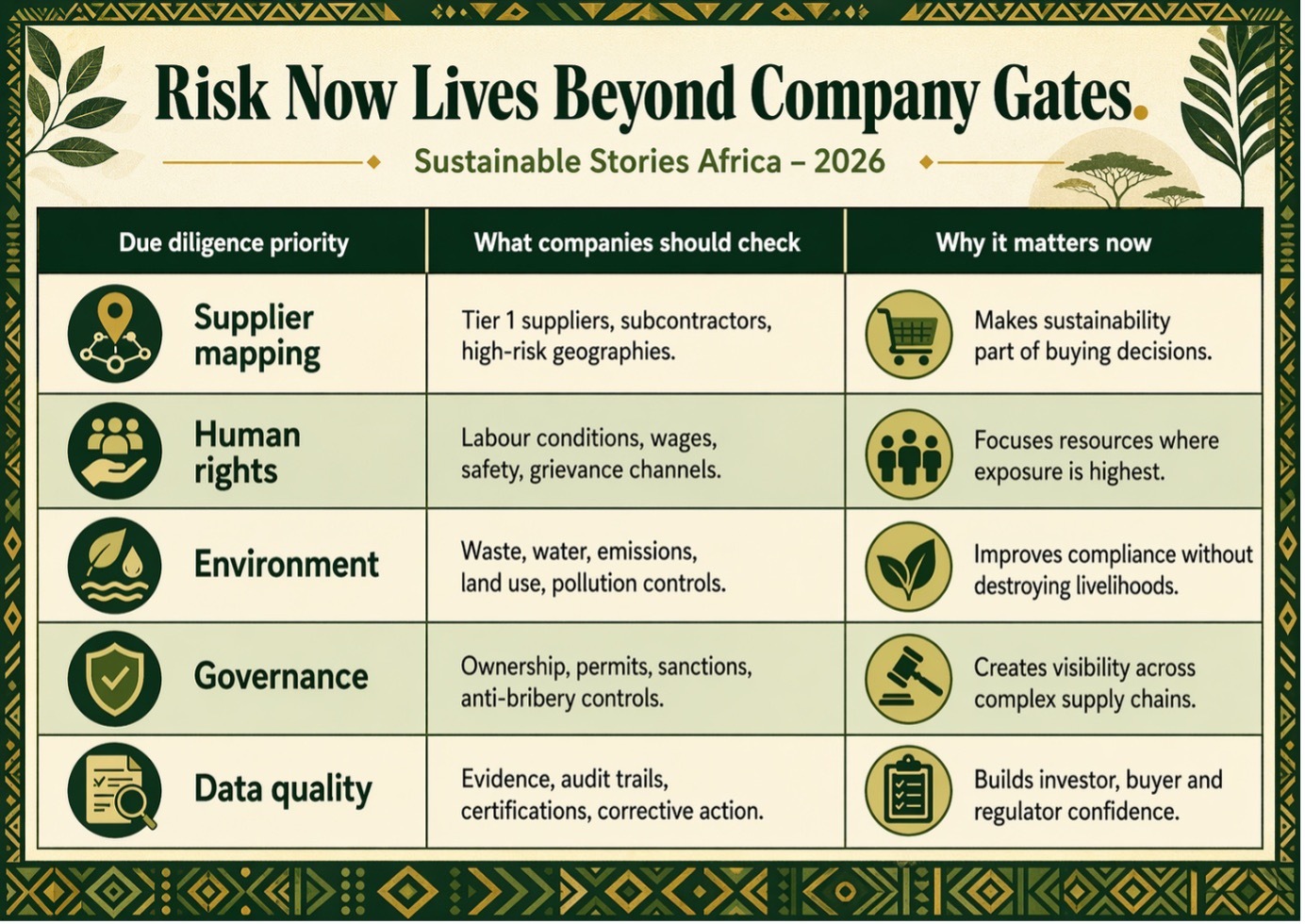
Risk Now Lives Beyond Company Gates
A cocoa processor in Ghana, a textile supplier in Kenya, a logistics operator in Lagos or a mining contractor in the Democratic Republic of Congo may not see itself as part of a global compliance architecture.
However, if its customer sells into Europe, raises international capital or supplies a multinational buyer, its labour practices, emissions data, grievance channels and environmental controls can become commercially material.
The OECD’s due diligence guidance calls for risk-based due diligence across operations, supply chains and business relationships, while the UN Guiding Principles on Business and Human Rights frame due diligence as a process for identifying, preventing, mitigating and accounting for adverse human rights impacts.
That changes the meaning of supplier management. It is no longer enough to ask whether a vendor can deliver at the lowest price.
Companies must ask whether the supplier can demonstrate legal compliance, worker protection, environmental safeguards, anti-corruption controls, emissions performance and credible remediation where harm occurs.
Better Due Diligence Can Unlock Trust
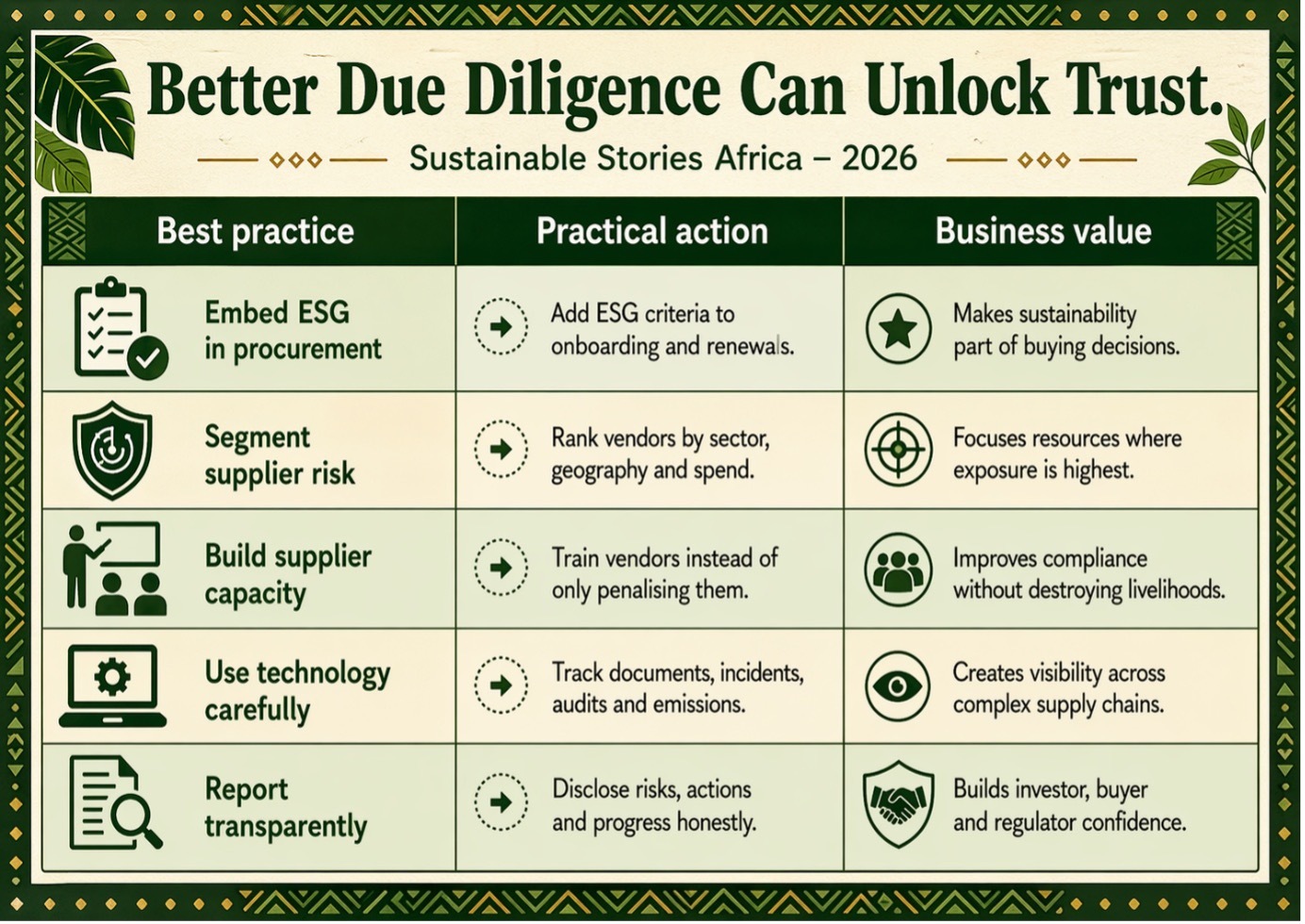
When done properly, ESG supply chain due diligence is not only defensive. It can protect market access, reduce operational disruption, improve supplier quality and help African businesses compete for more demanding buyers.
- For a manufacturer, the benefit may be fewer disruptions from unsafe facilities or weak environmental controls.
- For a bank, it may mean better credit-risk assessment when lending to companies exposed to export markets.
- For a farmer cooperative, it may mean stronger access to premium buyers that need a traceable supply.
- For communities, it can mean safer workplaces, cleaner water, better grievance systems and more accountable corporate behaviour.
The strongest due diligence systems share a simple logic: know the supplier, assess the risk, prioritise the most severe impacts, act before harm escalates, and document the response.
That makes ESG less abstract. It turns sustainability into procurement discipline, risk governance and market readiness.
African Firms Need Proof-Ready Systems
The action point for African companies is urgent but manageable: start with the suppliers that matter most.
Not every business can audit every vendor immediately; however, every serious company can create a supplier register, identify high-risk categories, request basic evidence of compliance, assign internal responsibility and set escalation rules for serious concerns.
- Boards should treat due diligence as enterprise risk management, not as a side task for sustainability teams.
- Procurement officers should be trained to recognise ESG red flags. Finance teams should link supplier risk to cost, continuity and credit exposure.
- Regulators and industry associations should develop practical templates that help small and medium-sized enterprises meet buyer expectations without drowning in paperwork.
The danger is that African suppliers become excluded from global value chains because they cannot produce credible ESG evidence.
The opportunity is that better due diligence can turn responsible sourcing into a competitive advantage, especially in agriculture, manufacturing, logistics, energy, construction and extractives.
Path Forward – Turn Supplier Risk Into Shared Resilience
The path forward is not paperwork for its own sake. It is risk visibility, supplier improvement, credible evidence and fair accountability across the value chain.
African firms that invest early in ESG due diligence will be better placed to win contracts, attract finance, protect communities and withstand the next wave of global sustainability scrutiny.
Culled From: ESG Supply Chain Due Diligence Best Practices | OneStop ESG