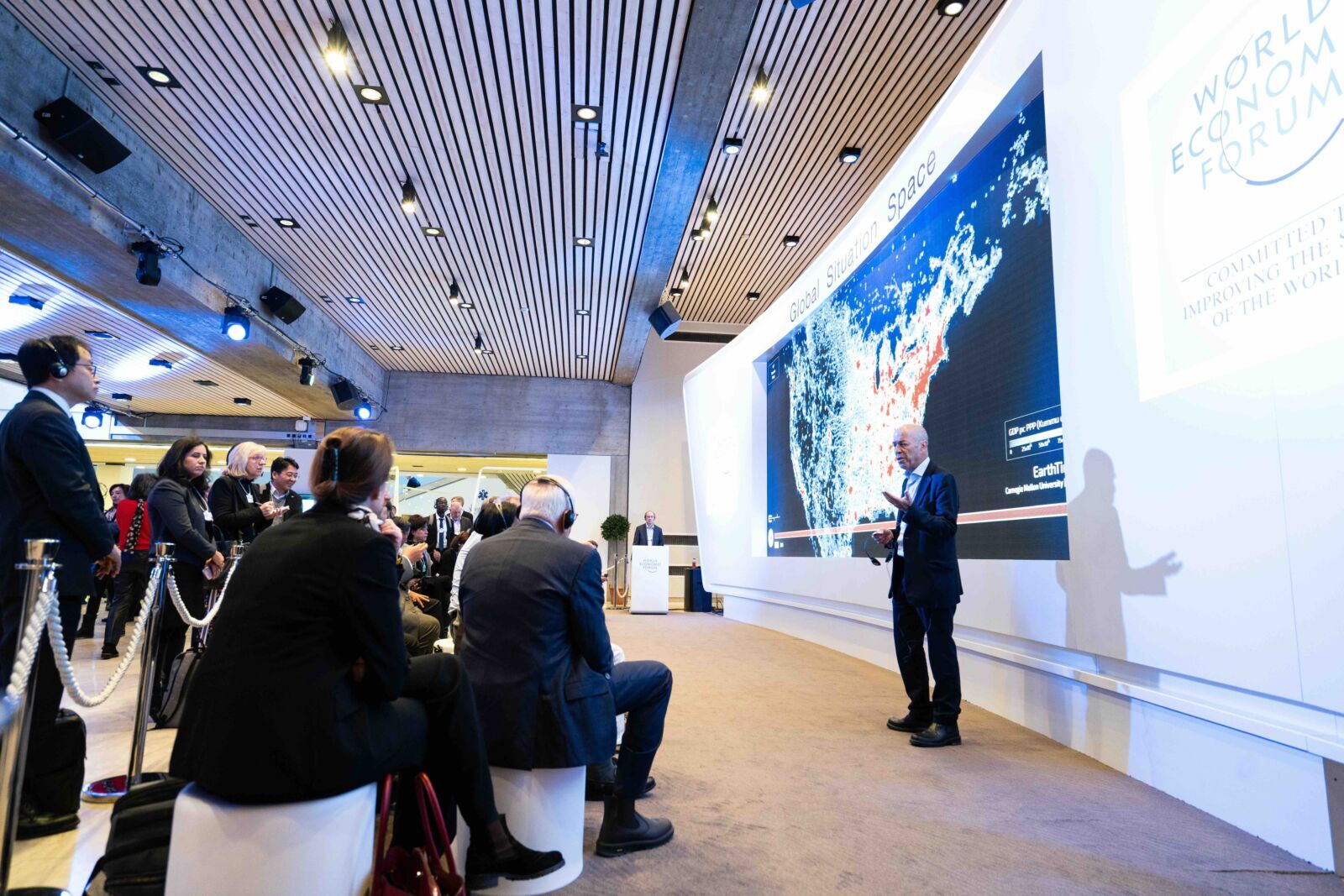
Artificial intelligence has moved beyond experimentation, but the World Economic Forum says most organisations still capture only fragmented gains because AI remains trapped in pilots and isolated functions.
For African and emerging markets, the challenge is urgent: AI can improve service delivery, manufacturing, finance, talent and strategy, but only if institutions redesign workflows, governance and accountability around human-led, AI-supported systems.
AI Value Needs Organisational Redesign
Artificial intelligence is entering a decisive phase in which the central question is no longer whether the technology works; however, whether organisations can change how work, decisions and accountability are structured to unlock its full value, according to the World Economic Forum’s March 2026 white paper, Organisational Transformation in the Age of AI: How Organisations Maximise AI’s Potential.
The report, published in collaboration with Accenture under the WEF’s Industries in the Intelligent Age series, argues that many organisations have demonstrated measurable AI gains; however, most of these remain fragmented because they come from isolated use cases rather than enterprise-wide redesign.
The paper draws on consultations with the Forum’s AI Transformation of Industries community, comprising more than 450 executives across sectors.
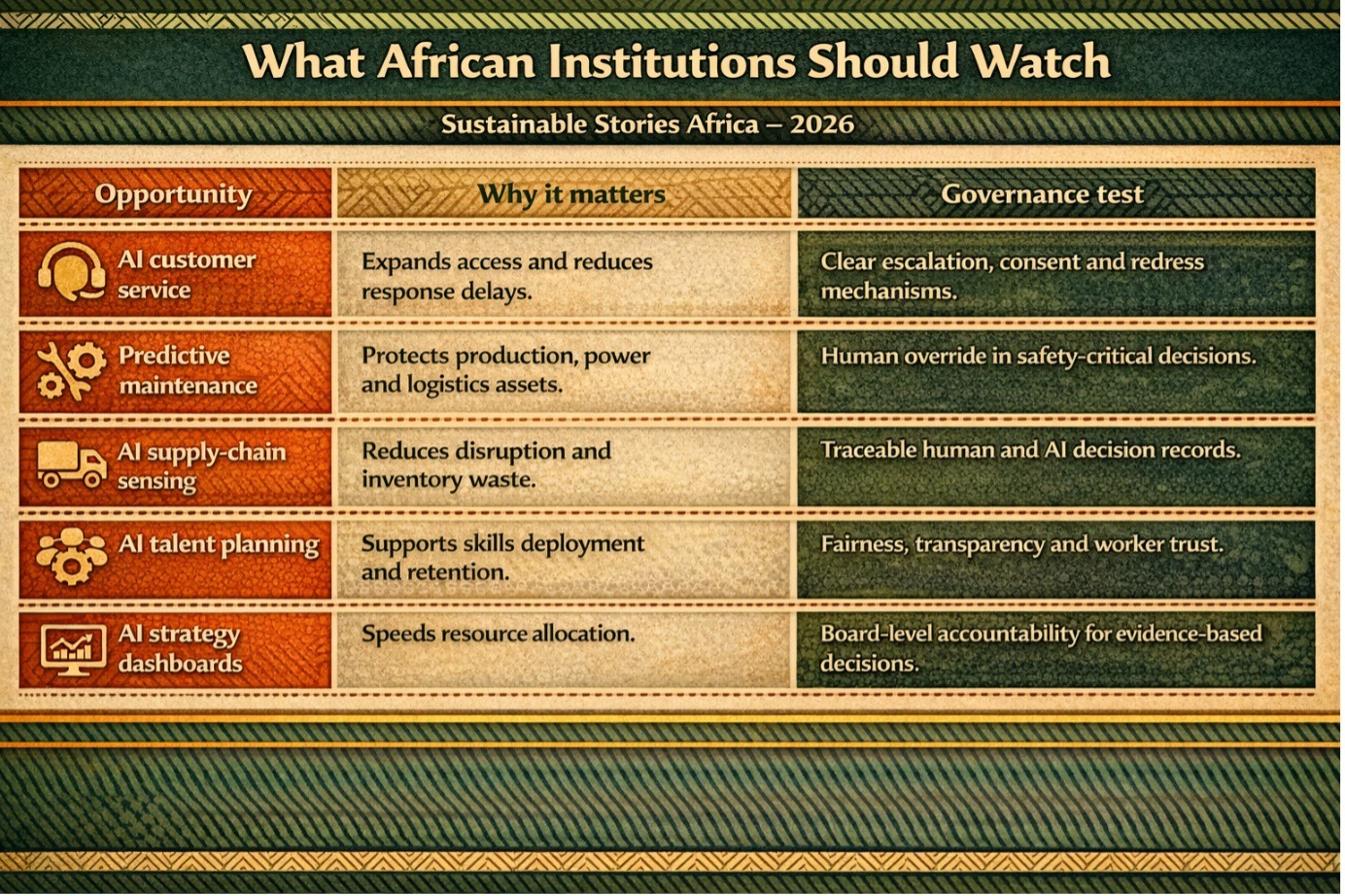
For African markets, the message is practical. Banks deploying AI chatbots, manufacturers testing predictive maintenance, hospitals digitising diagnostics, and governments using AI for planning will not capture durable value through tools alone.
They need operating models in which people remain accountable, AI systems support execution, and data flows across customer experience, operations, R&D, strategy and workforce planning.
Attention: AI Pilots Are Not Enough
Only about 15% of organizations are using AI to fundamentally redesign how work is performed, according to the WEF paper. That statistic captures the gap between AI ambition and institutional readiness: many firms have proven the technology can help, but fewer have rebuilt the enterprise around it.
The report frames the next phase of AI adoption as an organizational challenge rather than a technology procurement race. Early AI value has often come from narrow applications: automating reports, improving customer targeting, accelerating document review or supporting code generation. These gains matter, but the WEF warns that task-level productivity does not automatically become enterprise value.
For African and Global South institutions, this is where the stakes become developmental. AI could reduce cost-to-serve in banks, improve energy efficiency in factories, support climate-smart logistics, shorten health diagnostics, and make public services more responsive. But without redesigned decision rights, governance and skills, AI can also deepen fragmentation, bias, cybersecurity exposure and institutional dependency.
Five Enterprise Systems Are Changing
The WEF identifies five focus areas in which leading organisations are embedding AI into core workflows:
- Real-time customer experience
- Adaptive operations
- Accelerated R&D
- Predictive strategic planning
- Personalised talent systems.
Across these areas, the common shift is from episodic work to continuous sensing, decision-making and learning.
In customer experience, AI changes service from a static journey into a live relationship. The WEF estimates that AI-enabled customer systems can deliver up to 25% higher consumer conversion rates, reduce churn by 21%, lower cost-to-serve by 20% – 30%, and improve productivity by 15% – 30%.
In plain terms, a bank can detect when a customer is out of place, a telecom provider can personalise support before churn, and a public utility can route complaints faster with human escalation where trust or risk requires it.
In operations and supply chains, the potential is even more structural. AI-enabled systems can cut defect rates by 20 – 50%, reduce scrap and rework by 10% – 30%, reduce order lead time by up to 27%, lower inventory by 20% – 30%, and improve fill rates by 5% – 8%.
The WEF also points to potential 40–60% reductions in energy consumption and emissions through optimised energy use and early risk detection.
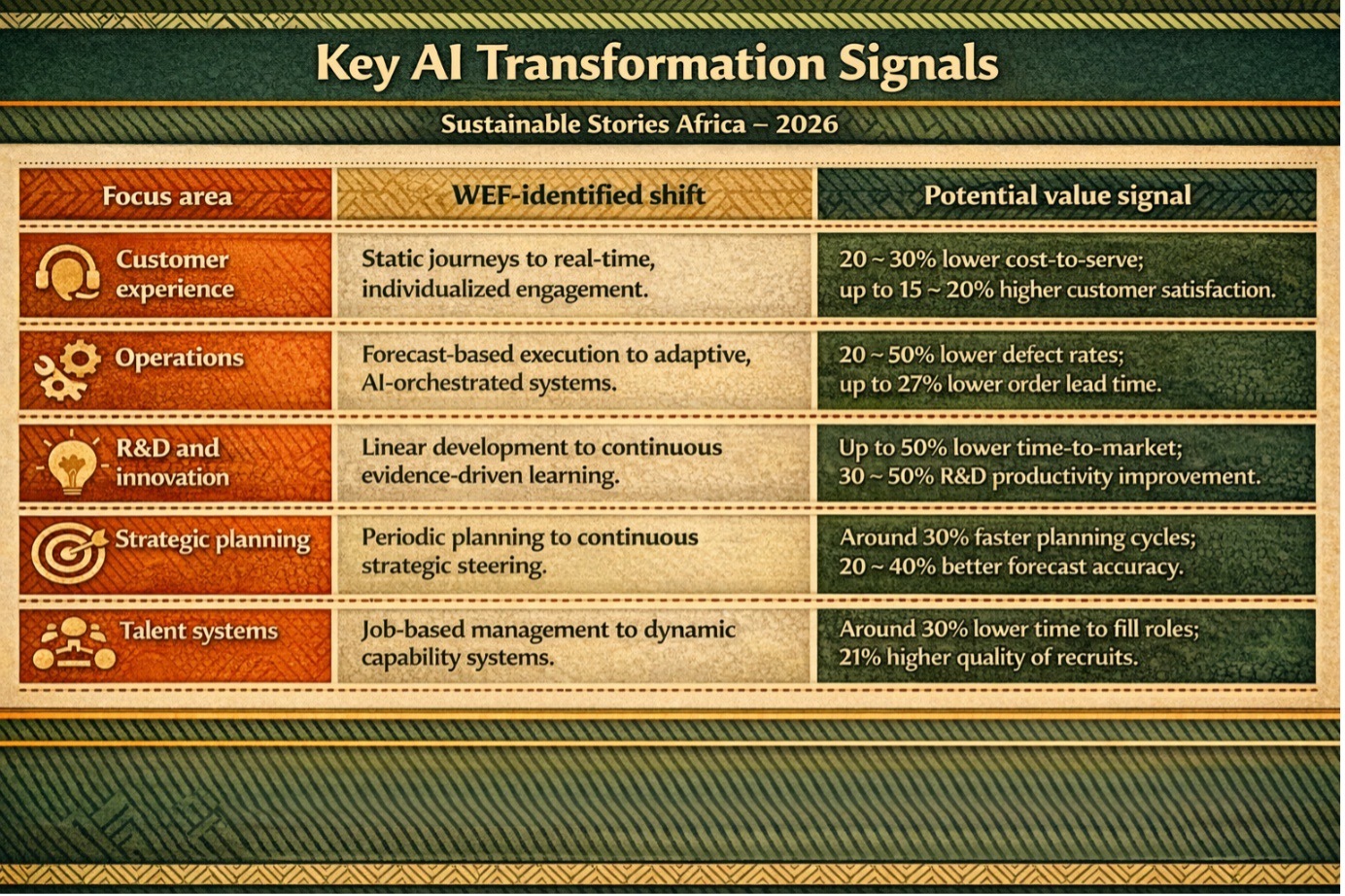
The paper’s visual frameworks on pages 8, 14, 20, 26 and 31 reinforce the same pattern: AI does not simply automate work; it changes the operating logic of work. Customer engagement becomes adaptive, supply chains become real-time, R&D becomes iterative, strategy becomes a living system, and talent planning becomes capability-based.
Human-Led AI Can Build Resilience
The strongest opportunity is not replacing people. It is moving people into higher-value roles: judgement, oversight, empathy, strategy, creativity, escalation and accountability. The WEF’s executive summary describes a shift from task automation to human value creation, in which AI accelerates insight and execution with the understanding that people remain responsible for direction, trade-offs and outcomes.
For Africa’s private sector, that matters because productivity gaps are often tied to infrastructure constraints, talent shortages, fragmented data and manual processes. A manufacturer in Ogun or Tema could use AI to detect machine anomalies before downtime. A logistics firm moving goods across West Africa could rebalance routes as fuel, border and demand signals change. A health network could use digital triage to extend specialist capacity beyond urban centres.
The development upside is also tied to ESG. AI-enabled operations can reduce waste, energy intensity and emissions. AI-enabled workforce systems can improve skills visibility and internal mobility. An AI-supported strategy can help boards act on evidence rather than waiting for annual planning cycles. But this only becomes credible if governance is strong enough to address bias, consent, privacy, explainability and accountability.
Leaders Must Redesign Work Itself
The World Economic Forum warns that AI cannot be layered onto old structures. Scaling it requires ownership, governance and operating models that embed systems into core execution, rather than treating them as side projects.
- Boards and executives should begin with business ownership: define which outcomes AI should improve, who is accountable, what risks are acceptable, and where humans remain in control, especially in regulated sectors such as banking, healthcare, power and public administration.
- Governments and regulators should create rules for responsible adoption, covering data protection, cyber resilience, procurement standards, auditability and model-risk management.
- Public institutions using AI should also publish rules on consent, appeal, redress and human review where services are affected.
- Businesses should move beyond pilots to workflow redesign, building teams and measuring outcomes such as lower downtime, faster diagnostics and productivity gains.
Together, the WEF’s five principles frame AI transformation as a leadership discipline, not simply an IT programme.
Path Forward – Put Humans In Lead
African organisations should treat AI as a systems agenda: align it with governance, productivity, skills, customer trust, climate efficiency and service delivery.
The aim is not more pilots, but measurable improvements in how institutions work.
The priority is clear: keep humans accountable, redesign workflows end-to-end, invest in talent, and build transparent governance.
When done well, AI can strengthen ESG outcomes by improving efficiency, inclusion, resilience and institutional trust.