Land reform is often treated as a political issue, but the World Bank’s guidance note shows why it is also an economic investment question.
For African markets, the lesson is urgent: land administration projects must prove how they reduce conflict, unlock credit, improve taxation, protect public assets, and deliver measurable value for citizens, governments, and investors.
Land Reform Must Prove Its Value
Across Africa, land is more than a physical asset. It is collateral, identity, inheritance, political power, community memory, public revenue, climate resilience, and, in many cases, the difference between informality and economic participation.
A World Bank guidance note on the economic analysis of land administration projects argues that land reforms are complex, sensitive, and difficult to implement because they can involve new laws, digital land systems, title registration, public land demarcation, customary rights recognition, geospatial data, dispute-resolution systems, and capacity-building across government levels.
For African governments, the core issue is no longer whether land administration matters. It is about proving which reforms enable the highest social and economic returns, especially when public budgets are stretched, and citizens are demanding more accountable development outcomes.
Africa’s Land Problem Is Economic
The World Bank note makes a blunt point: countries have limited capital, labour, and land, and every public investment choice involves trade-offs.
Money spent on roads may reduce resources available for property registration; money spent on land administration may compete with schools, hospitals, power, or water systems.
That framing matters deeply for Africa. Land reform is often debated in the context of politics, history, ethnicity, urban expansion, farmer-herder conflict, housing pressure, and investor access.
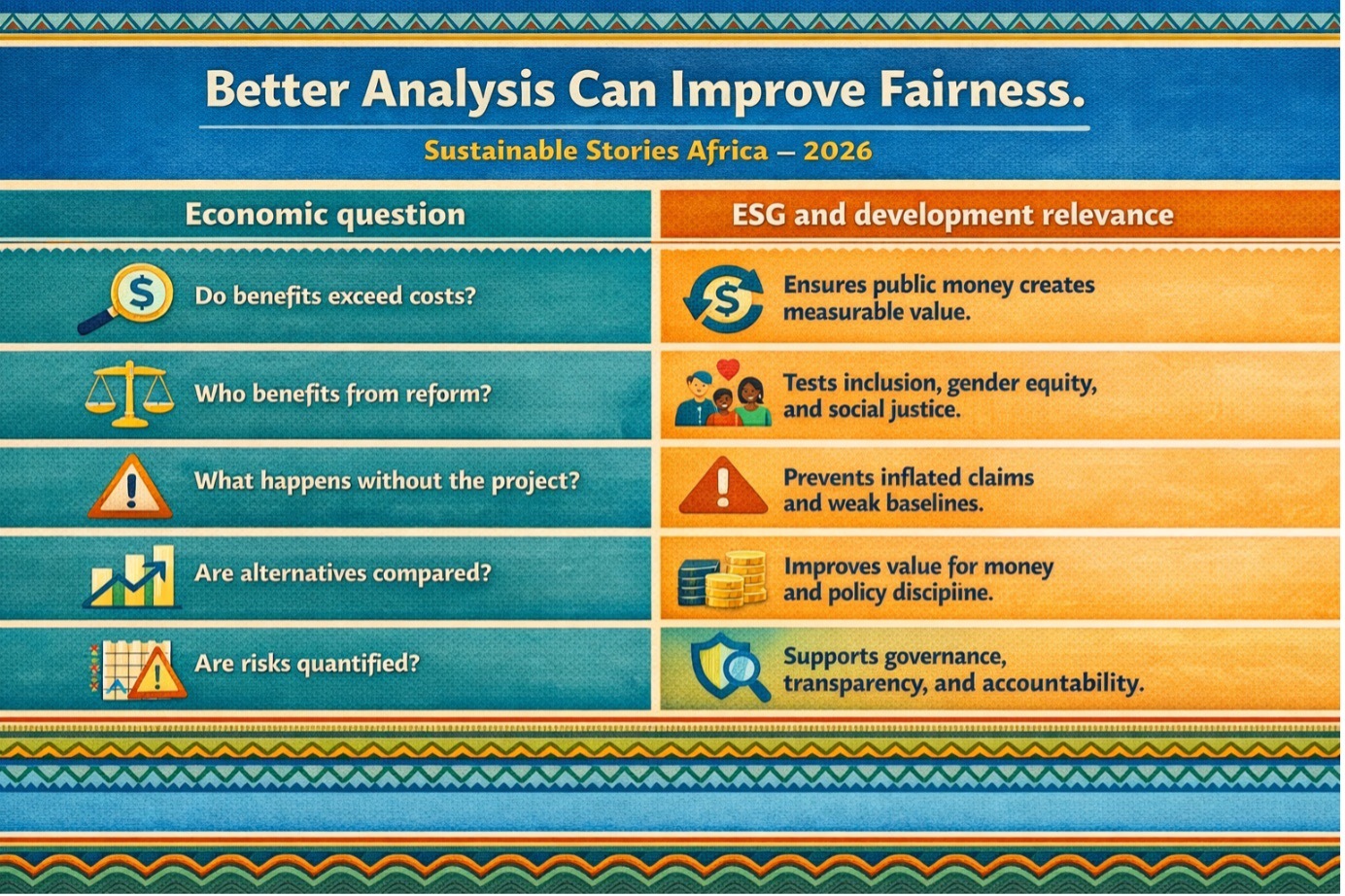
But the economic question is equally important: what public value does a land project create, who benefits, who may lose, and whether the benefits exceed the costs?
The World Bank’s answer is economic analysis. It describes economic analysis as the tool used to estimate whether a project will have a positive impact on beneficiaries and whether governments and financiers should invest in it.
The note stresses that economic analysis is not just a compliance exercise; it can improve project design, results frameworks, risk identification, implementation, monitoring, and evaluation.
What Land Projects Actually Change
Land administration projects can take several forms. Some focus on legal and policy reforms. Others map, adjudicate, survey, and register land. Some build digital land information systems. Others improve property valuation, taxation, or public land management.
The World Bank classifies these as building blocks that are often combined in a single reform programme.
For African countries, that classification is useful because land problems rarely have one cause.
In a city like Lagos, Nairobi, Accra, or Kinshasa, the problem may include insecure titles, overlapping claims, informal settlements, weak cadastral records, slow registries, poor valuation systems, and opaque public land allocation.
In rural areas, it may include customary tenure, gender exclusion, weak dispute resolution, unclear forest boundaries, or land-use conflicts.
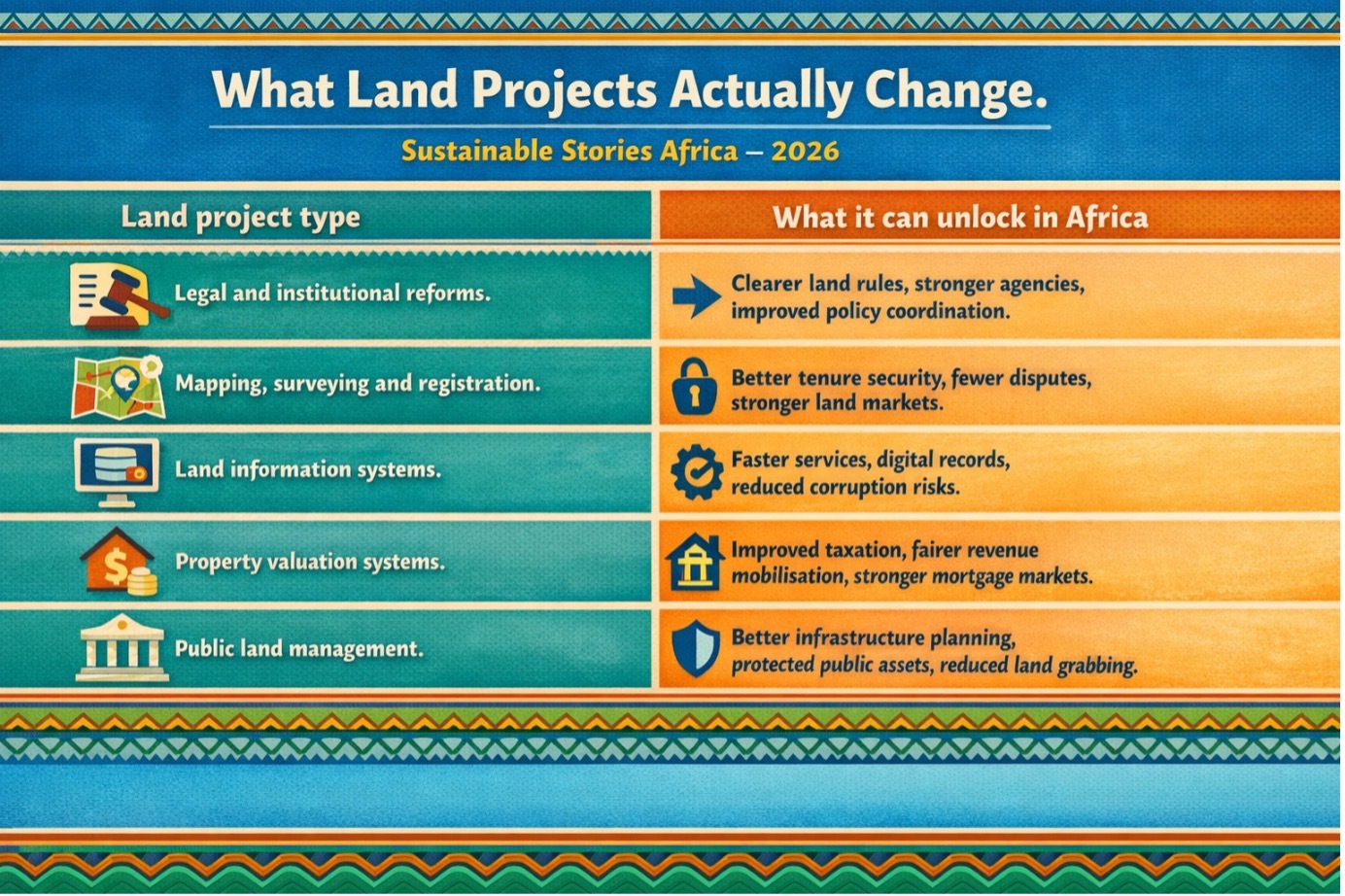
The document also highlights why the theory of change matters. Before estimating benefits, project teams must identify the problem, the causal pathway, the project development objective, the expected outputs and outcomes, and the assumptions that could affect success.
In African terms, a digital cadastre is not the outcome. The real outcome may be faster registration, fewer boundary disputes, stronger collateral value, improved planning, more reliable taxation, or reduced conflict.
The Benefits Are Broader Than Titles
The World Bank note identifies several channels through which land projects can generate economic benefits. These include stronger tenure security, higher investment, greater access to credit, more efficient land markets, labour mobility, land liquidity, cheaper service delivery, and improved public infrastructure planning.
That is the missing link in many debates on African land. A title is not valuable only because it is a document.
It is valuable because it can reduce uncertainty, encourage investment, support mortgage markets, lower transaction costs, improve land taxation, and protect vulnerable households from arbitrary displacement.
For smallholder farmers, secure rights can support longer-term investment in soil, irrigation, trees, or storage. For women, joint registration can reduce exclusion from inheritance and household assets.
For cities, better land records can support planning, roads, drainage, housing, and climate adaptation. For governments, improved valuation systems can widen local revenue without simply raising tax rates.
Better Analysis Can Improve Fairness
The strongest opportunity for Africa is not just faster land registration. It is a fairer development.
The World Bank note recognises that land projects may require distributional analysis when they target vulnerable groups, including economically disadvantaged racial, sexual, gender, and ethnic minorities.
The question is not only whether a project creates net value, but who benefits and who may be harmed.
That is central to African sustainability and ESG debates. Land reforms can support inclusive growth, but they can also deepen exclusion if they formalise unequal claims, ignore customary systems, displace informal communities, or make registration too expensive for poorer households.
A strong African land reform programme should therefore measure more than registered parcels. It should track gender inclusion, dispute reduction, service delivery time, affordability, public trust, community consent, tax fairness, and safeguards for customary and communal land.
Governments Must Build Evidence Early
The World Bank guidance proposes a four-step economic analysis process: identify the problem, select the economic analysis method, estimate benefits and costs, and calculate monetary impact using tools such as discounted cash flow, net present value, and internal rate of return.
African governments and development partners should apply this discipline before project approval, not after money has already been committed.
Too often, land projects begin with technology procurement, donor enthusiasm, or political announcements. The better sequence is diagnosis first, economic logic second, institutional design third, and implementation fourth.
The document notes that cost-benefit analysis is generally the preferred method when benefits can be monetised. Where benefits cannot be sensibly expressed in money, cost-effectiveness analysis may be used to compare which option delivers the desired outcome at the lowest cost.
That distinction matters. If a project aims to increase tenure security and investment, cost-benefit analysis may be appropriate. If the goal is to demarcate ancestral land or protect a culturally significant area, cost-effectiveness or distributional analysis may better capture the value.
Africa Needs Land Data Systems
The practical next step is stronger land data. The World Bank warns that cost-benefit analysis is data-driven and can create poor decisions when model variables and parameters are incomplete or unreliable.
African land agencies, therefore, need modern registries, transparent service records, geospatial systems, gender-disaggregated data, valuation databases, dispute records, and public dashboards. Without this infrastructure, governments cannot credibly estimate whether reforms are reducing registration time, lowering costs, improving credit access, or expanding tax capacity.
The economic analysis must also compare “with project” and “without project” scenarios. This is critical because the baseline is not always static. Without a systematic registration project, for example, an agency may continue sporadic registration for decades, leaving poorer households outside formal systems.
For Africa, that counterfactual is powerful. Delay has a cost: unresolved disputes, informal settlements, lower municipal revenue, weaker mortgage markets, underinvestment in farms, and higher risks around infrastructure projects.
Land Reform Can Strengthen Climate Resilience
Land administration also has a climate dimension. The World Bank note gives the example of forest and non-forest demarcation, where benefits can include reduced deforestation and lower greenhouse gas emissions.
In Africa, this connects land reform to climate finance, biodiversity protection, carbon markets, urban resilience, and food security. Clearer land and forest boundaries can reduce encroachment.
Better public land inventories can protect wetlands and flood zones. Stronger geospatial systems can help governments plan roads, energy corridors, housing, and nature-based solutions with fewer conflicts.
This is where land administration becomes an ESG issue. It is about governance, social protection, environmental management, and long-term economic resilience.
Path Forward – Make Land Reform Measurable
Africa’s land reform agenda should move from promises to proof. Governments should use economic analysis to test project value, compare alternatives, identify winners and losers, and design safeguards before implementation begins.
The priority is clear: build land systems that are legally credible, digitally reliable, socially inclusive, and economically justified. Done well, land administration can unlock credit, reduce conflict, improve revenue, protect ecosystems, and make development more accountable.