Digital identity systems are becoming gateways to public services, finance, education and social protection. But for stateless people, the same systems can either unlock recognition or harden exclusion.
A new World Bank guidance note urges governments and development partners to design ID systems that include stateless people safely, protect sensitive data, strengthen due process and support legal identity for all.
Identity Systems Must Include Everyone
Digital ID is becoming one of the most important pieces of public infrastructure in the modern economy.
It determines who can receive government support, open a bank account, register a SIM card, access health systems, sit examinations, cross-check benefits, or prove eligibility for public services.
A World Bank publication, Building Statelessness-Sensitive ID Systems, warns that rapid digital transformation could leave millions of stateless people and people at risk of statelessness further behind if governments do not build inclusion, privacy and due process into identity systems from the start.
The report, published under the World Bank’s Identification for Development initiative, provides practical guidance for policymakers, practitioners and development partners designing foundational ID systems.
For African markets, the lesson is immediate. As countries expand digital public infrastructure, national ID systems, social registries and biometric platforms, identity is no longer just an administrative issue.
It is a development, governance and human-rights test.
Digital ID Can Exclude Quietly
The World Bank warns that inclusive, trusted ID systems are vital to sustainable development, yet stateless people face barriers to services, rights and participation because they lack recognised nationality or proof of identity.
Without a statelessness-sensitive approach, digital transformation can deepen exclusion as interoperable databases and automated eligibility checks harden inequality.
UNHCR reports about 4.4 million stateless people globally, though the number is likely higher.
The World Bank estimates 850 million people lack official ID, more than half unregistered children, with concentrations in Sub-Saharan
Africa and South Asia. Being undocumented is not the same as being stateless, but documentation gaps linked to minority status, displacement, discrimination or borderland residence can stop people from proving nationality and leave them as outsiders.
Statelessness Is A Development Issue
The World Bank defines a stateless person, following international law, as someone “not considered as a national by any State under the operation of its law.” In simple terms, a stateless person is a person without citizenship. Many are not migrants or refugees; they are “in situ” stateless people who have never crossed a border and live in the country of their birth or long-term residence.
The consequences are deeply practical. The report notes that people whose citizenship is lacking or in question can face barriers to education, healthcare, employment, property ownership, financial services, government support and even SIM card access. Some may attend school but be unable to sit exams or receive graduation credentials. Others are pushed into informal work, making them more vulnerable to exploitation.
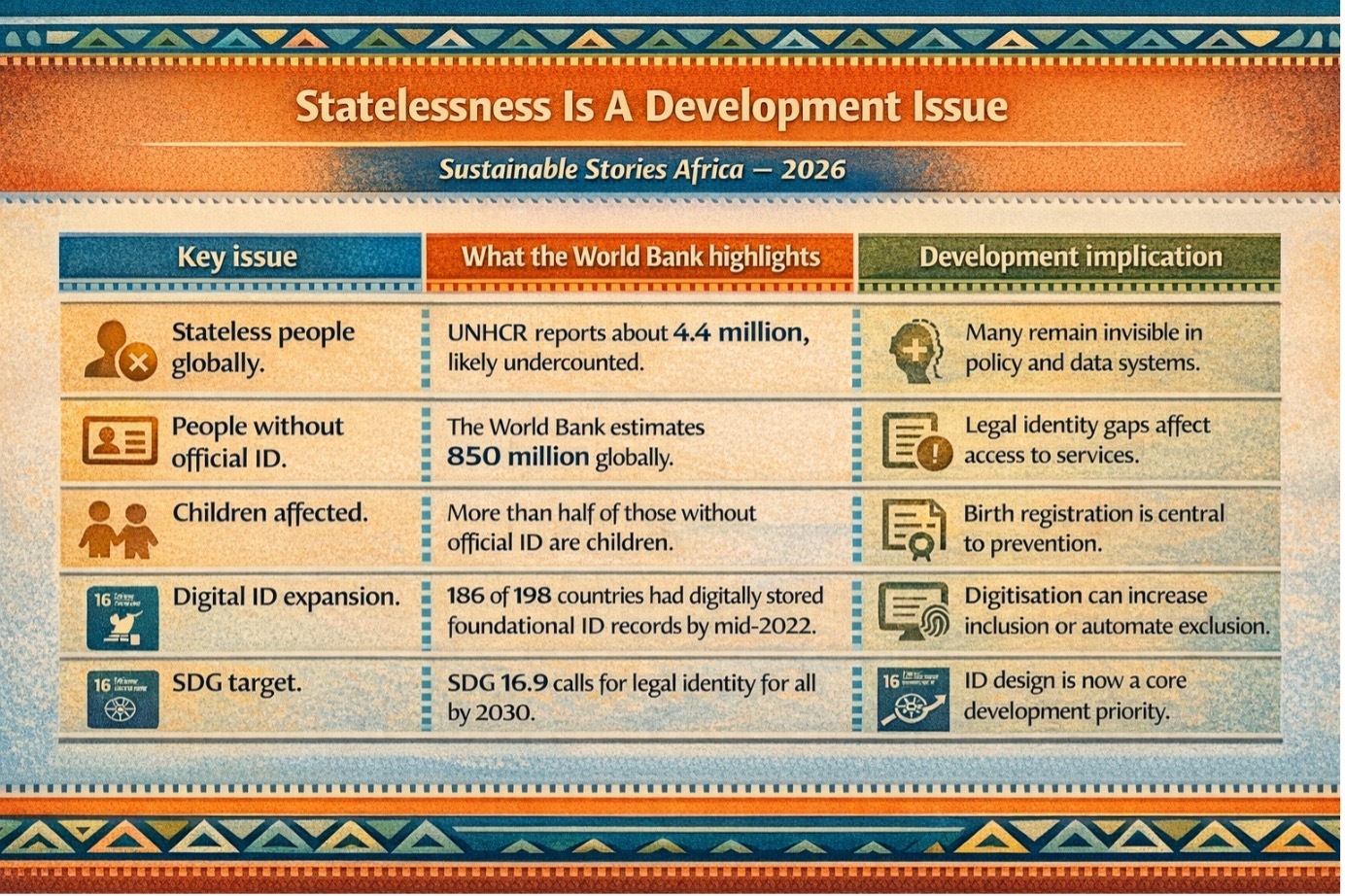
The report also shows why these matters for the Sustainable Development Goals. SDG 16.9 calls for legal identity for all, including birth registration, by 2030. Birth registration is often the first proof of legal identity and may contain the details needed to determine nationality, including parents’ identity, place of birth and date of birth.
For Africa, where many countries are scaling up digital identity and social protection systems, this is more than a technical design question. It affects whether digital transformation reduces poverty or reproduces exclusion at a higher speed.
Desire: Inclusive ID Can Open Opportunity
The World Bank’s message is clear: digital ID is not the problem; exclusion is. Well-designed ID systems can help stateless people access services, prove identity, strengthen birth registration and support pathways to nationality, while making development programmes more effective.
As digital infrastructure expands, the guidance urges governments to embed inclusion by design, so people are recognised and counted from the start. Stronger ID ecosystems can widen access to education, health, finance and civic participation, while reinforcing state legitimacy through fairer, transparent access to rights.
The report points to evidence that progress is possible. More than 600,000 stateless people and people of undetermined nationality have acquired citizenship over the past decade.
It cites Kyrgyzstan, Kenya and Turkmenistan as examples of reform. Kenya shows how recognition, documentation and legal pathways can move communities from invisibility to participation, with paralegals in Kwale County underscoring that trusted intermediaries remain as vital as technology today.
Build Safeguards Into ID Design
The report offers practical, system-focused recommendations.
Before designing projects:
- Governments and partners should assess statelessness risks
- Engage affected communities safely
- Understand legal and protection concerns
- Adapt enrolment processes to ease documentation barriers.
It recommends enrolment without proof of nationality where possible, using residence-based approaches, optional nationality fields and clear procedures for frontline officials.
The report also cautions against credentials that label people as stateless or nationality unknown, urging neutral documentation and careful decisions on whether such data should be recorded, protected or omitted to prevent exclusion and potential harm.
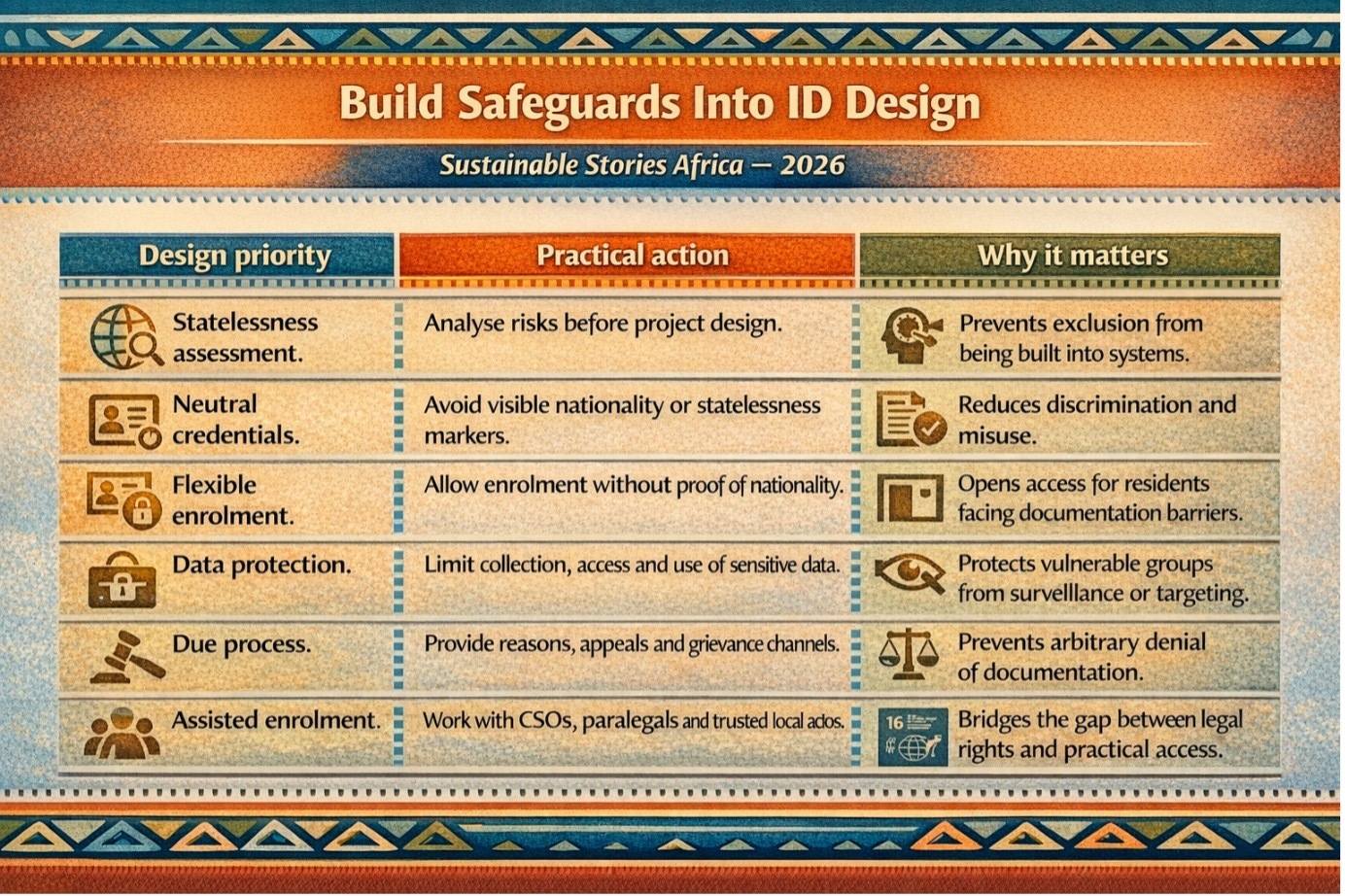
Due process is central to any inclusive ID system. The report warns that when parents seeking birth certificates or adults applying for ID are turned away without reasons or access to appeal, exclusion can deepen across generations, leaving children unable to prove identity or nationality.
For policymakers and development partners, the response is practical: train civil registrars and ID officials, expand grievance mechanisms, support legal aid and paralegal services, strengthen birth registration, and align national systems with the 1954 and 1961 Statelessness Conventions and wider human-rights standards.
Success should be measured not only by enrolment totals or biometric coverage, but by whether those previously excluded can now access recognition safely and fairly.
Path Forward – Identity Must Not Exclude
Digital ID systems should be built around resident inclusion, neutral credentials, privacy safeguards, birth registration, due process and safe pathways to nationality.
For African countries expanding digital public infrastructure, the core test is simple: identity systems must help people access rights and services, not quietly lock them out.
Inclusion by design is now a development policy, not a technical afterthought.