AI may not transform labour markets in one single way. The World Economic Forum’s latest scenarios paper argues that the real fault line lies at the intersection of technological progress and workforce readiness: whether economies can build the talent, trust and institutional capacity to absorb AI before disruption outruns adaptation.
That is especially consequential for African markets. The same global shifts now shaping the AI economy are also colliding with tighter fiscal space, persistent skills gaps, fragile safety nets and urgent pressures for inclusion, growth and resilience.
The future of work, in this framing, is not just a technology story. It is a governance, education and competitiveness story.
AI, jobs and Africa’s readiness gap
The World Economic Forum’s Four Futures for Jobs in the New Economy: AI and Talent in 2030 arrives with a blunt warning: businesses and governments should stop debating whether AI will matter and start planning for how different combinations of AI progress and workforce readiness could reshape jobs, productivity and social stability by 2030.
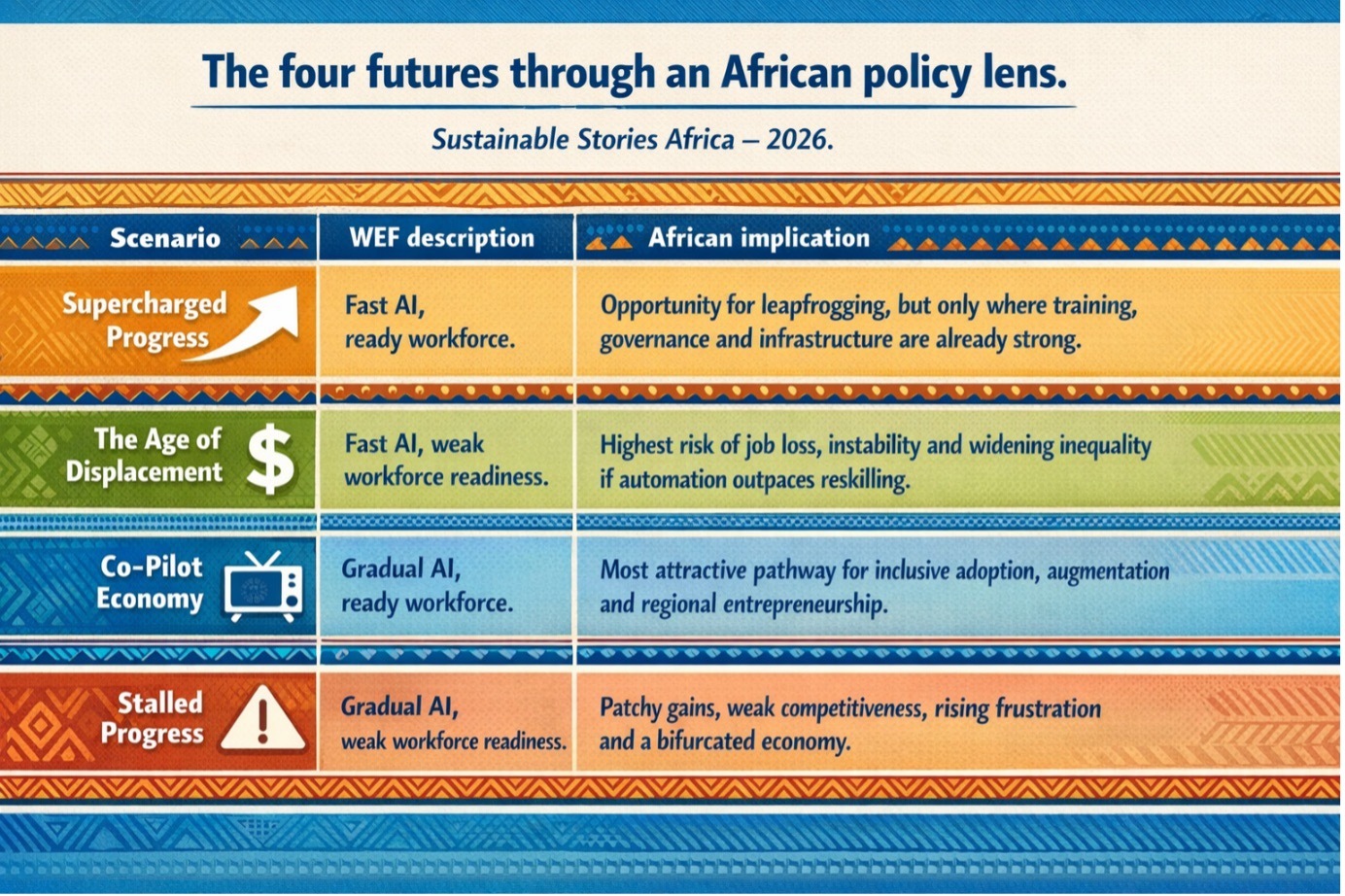
The paper maps four scenarios:
- Supercharged Progress
- The Age of Displacement
- Co-Pilot Economy
- Stalled Progress
These are built around two variables: the pace of AI advancement and the spread of AI-ready skills across the workforce.
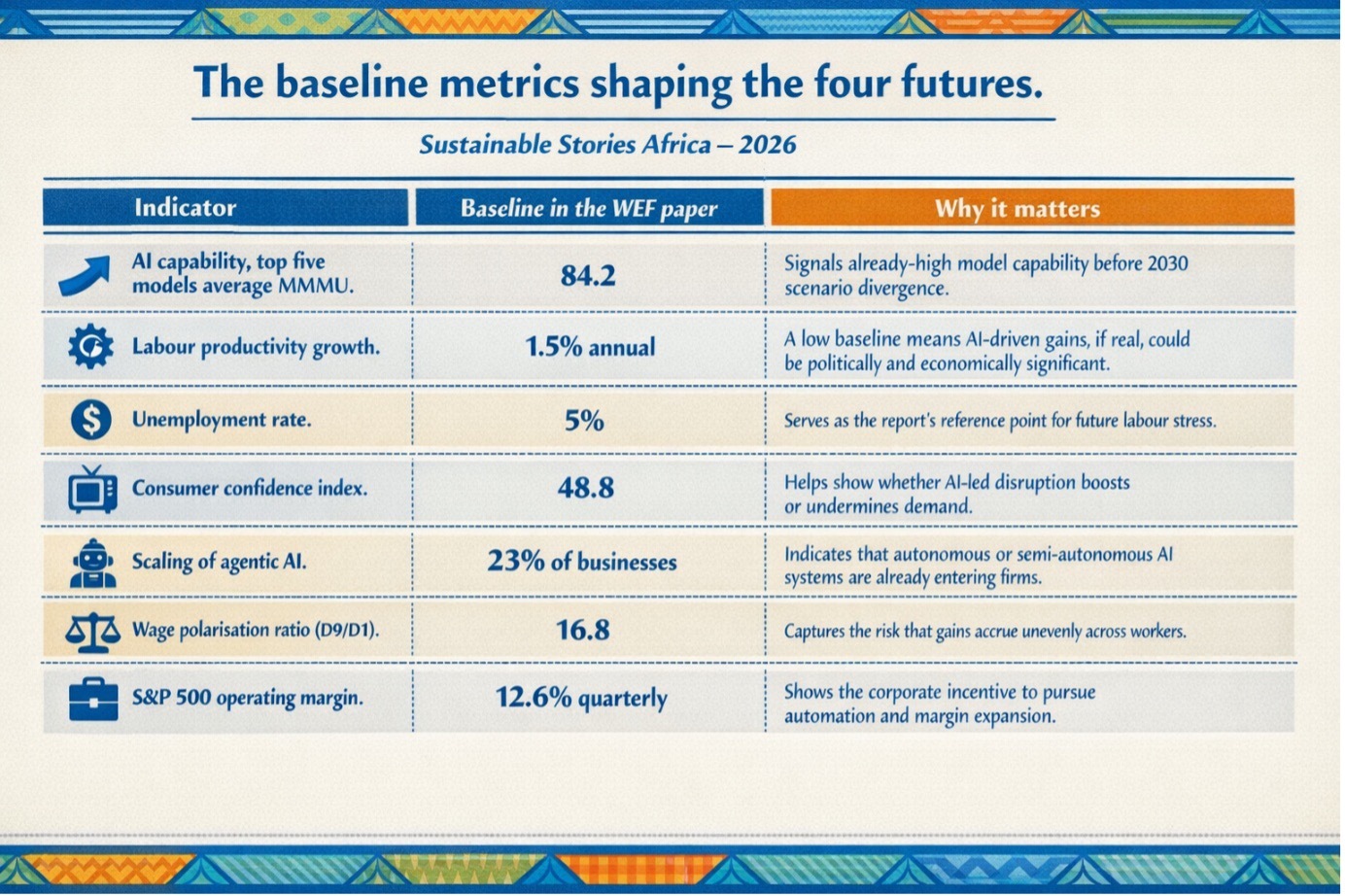
According to the WEF’s cited survey of more than 10,000 executives, 54.3% expect AI to displace a large number of existing jobs, while only 23.5% expect it to create a large number of new jobs.
Another 44.6% expect AI to increase profit margins; however, only 12.1% think it will lead to higher wages. On page 5, the report’s chart makes the asymmetry plain: business leaders largely expect AI to lift profits faster than it will pay.
For African economies, where youth employment, informal work, digital infrastructure gaps and human capital constraints already weigh heavily on growth, that imbalance is not theoretical. It raises a harder question: when AI scales, who captures the market?
Why the labour-market debate just changed
The WEF’s starting point is that broader macrotrends could create around 170 million new jobs by 2030 while displacing about 92 million existing ones.
However, AI, autonomous systems and robotics are accelerating uncertainties within that transition. The paper notes that business use of AI in at least one function rose from 55% in 2022 to 88% in the latest estimates.
It also cites LinkedIn’s estimate that demand for AI literacy skills rose 70% between 2024 and 2025.
That combination, such as fast technology uptake and increasing skills demand, is exactly what makes the WEF’s four-scenario model useful.
It moves the discussion beyond a stale binary of “AI will create jobs” versus “AI will destroy jobs” and instead asks what happens when AI moves quickly, but skills do not, or when talent readiness improves even if AI progress is less dramatic.
Four futures, one central tension
Supercharged Progress estimates exponential AI breakthroughs matched by broad workforce readiness, in which humans act as “agent orchestrators” managing portfolios of AI tools and digital workers.
Productivity surges and new occupations scale; however, many jobs still disappear, governance falls behind the pace of change, and inequality widens as wage premiums for AI-ready workers are projected to nearly double from the mid-2020s.
At the other extreme, the Age of Displacement shows rapid AI advances outpacing education and reskilling.
Automation becomes cheaper than retraining, whole occupational families shrink, and technology takes over more than 50% of tasks, approaching 90% in highly exposed sectors. Consumer confidence falls below the historical low of 44, and the scenario grid on page 10 underlines how productivity can rise even as societies fracture.
Between these poles, Co‑Pilot Economy and Stalled Progress highlight more incremental change: either human‑AI augmentation, where tasks fall by up to 80% and over 40% of skills change by 2030, or uneven gains that deepen existing divides.
What this means for African markets
The WEF paper does not centre Africa, but its logic lands squarely on the continent’s labour markets and policy choices.
Africa’s most plausible risk is not missing the latest frontier model, but sliding into Stalled Progress or The Age of Displacement: firms automate narrow functions to cope with scarce skills, with large segments of the workforce lacking pathways into higher-value, AI‑complementary roles.
This danger is amplified by tightening fiscal space, fragile safety nets, already shifting skills needs and widening gaps between AI‑ready economies and everyone else.
Where digital infrastructure is weak, energy is expensive, and training systems are slow to adapt, AI adoption is likely to be shallow and fragmented, eroding routine jobs without building enough new ladders into better work.
However, the Co-Pilot Economy scenario points to a different arc: remote work, entrepreneurship and AI‑enabled augmentation expand options for peripheral and marginalised communities. If countries invest in broad literacy, managerial adaptation, trusted digital systems and mobility into hybrid, AI‑fluent roles.
The better future is still buildable
The strongest part of the report is its insistence that the future of jobs will not be defined by technology alone. Human capital strategies and investments made now will determine how well societies and businesses adapt to, and lead in, the new economy.
For African countries, that means the most valuable AI policy may not begin with a foundation-model ambition.
It may begin with workforce readiness at scale
- Practical AI literacy
- Faster curriculum redesign
- Stronger technical and vocational systems
- Trusted digital identity and payments infrastructure
- Better data governance
- Support for firms redesigning work around augmentation rather than blind substitution.
The WEF’s own business guidance leans this way. Its “no-regret” moves include:
- Aligning technology and talent strategies
- Investing in human-AI collaboration
- Agentic workflows – strengthening data governance and infrastructure, anticipating talent needs, building trust in emerging technologies, and preparing for different implications across occupations, tasks and markets.
These recommendations are not glamorous. They are useful.
What governments, firms, and financiers should do now?
African policymakers need to treat AI labour-market planning simultaneously as industrial, education and social policy.
- National AI‑readiness strategies should link curriculum reform, digital public infrastructure, labour market intelligence and adaptive social protection, rather than tackling each in isolation.
- Regulators also need to move earlier on data governance, platform standards and transparency, especially as AI‑generated content begins to overtake human content and amplify trust and misinformation risks.
- For businesses, waiting for complete regulatory clarity is itself a strategic risk. The WEF argues that choices prioritised now will determine which firms adapt to and lead in the new economy. That means redesigning workflows for augmentation, ring‑fencing uniquely human processes, investing in upskilling, diversifying AI providers and infrastructure, and resisting over‑reliance on autonomous systems without human oversight.
- Financiers and development institutions must underwrite the transition with patient capital for connectivity, cloud access, reliable power, reskilling platforms and SME‑focused adoption tools, so AI productivity gains do not simply deepen existing inequalities.
Path Forward – Build readiness before disruption hits
The core choice is now visible: chase AI adoption for margin gains alone, or build the talent, trust and institutions that turn automation into broader productivity agents.
The WEF paper suggests the second path is slower at first, but more durable by 2030.
For African markets, that may be the clearest lesson of all. The decisive competitive edge in the AI economy may not belong to the place with the fastest model. It may belong to the place with the most people ready to work well with it.