Two forces run through the World Economic Forum’s Top 10 Emerging Technologies of 2025: the race to scale breakthrough science, and the harder question of who is institutionally ready to benefit first.
For African markets, that makes the report less a catalogue of inventions than a strategy document about readiness, regulation and relevance.
From energy and health to industrial decarbonisation and digital trust, the report argues that emerging technologies matter most when they move from novelty to deployment.
For African governments, investors and firms scaling to build resilience under tighter fiscal, climate and infrastructure constraints.
Ten signals shaping Africa’s next decade
The World Economic Forum’s 2025 technology shortlist lands at a useful time for Africa. Growth sectors across the continent are being asked to do more with less: build reliable power systems, improve access to health care, cut industrial emissions, secure digital ecosystems and modernise agriculture without repeating the highest-carbon path taken elsewhere.
The report’s central message is that the technologies most worth watching are not necessarily the loudest, but the ones approaching an “inflexion point where scientific achievement meets practical potential.”
That matters because the WEF is not presenting science fiction. The report says more than 250 valid technology nominations were screened in 2025 through expert surveys, AI analysis, readiness assessment and strategic evaluation before a shortlist was established based on novelty, impact and depth.
It also introduces ecosystem readiness maps that rate each technology across social, technological, environmental, economic and policy conditions. In other words, the real story is not just an invention. It is whether societies are ready to absorb the invention.
For African markets, that distinction is decisive. The continent does not need to lead every laboratory race. It does need to identify where these technologies can solve real bottlenecks in energy access, food systems, healthcare delivery, climate adaptation and information integrity.
Why this list matters now
The WEF groups this year’s breakthroughs into four broad arcs:
- Energy and materials
- Biotechnology and health
- Industrial sustainability
- Trust in connected systems.
This mirrors some of Africa’s most urgent system pressures.
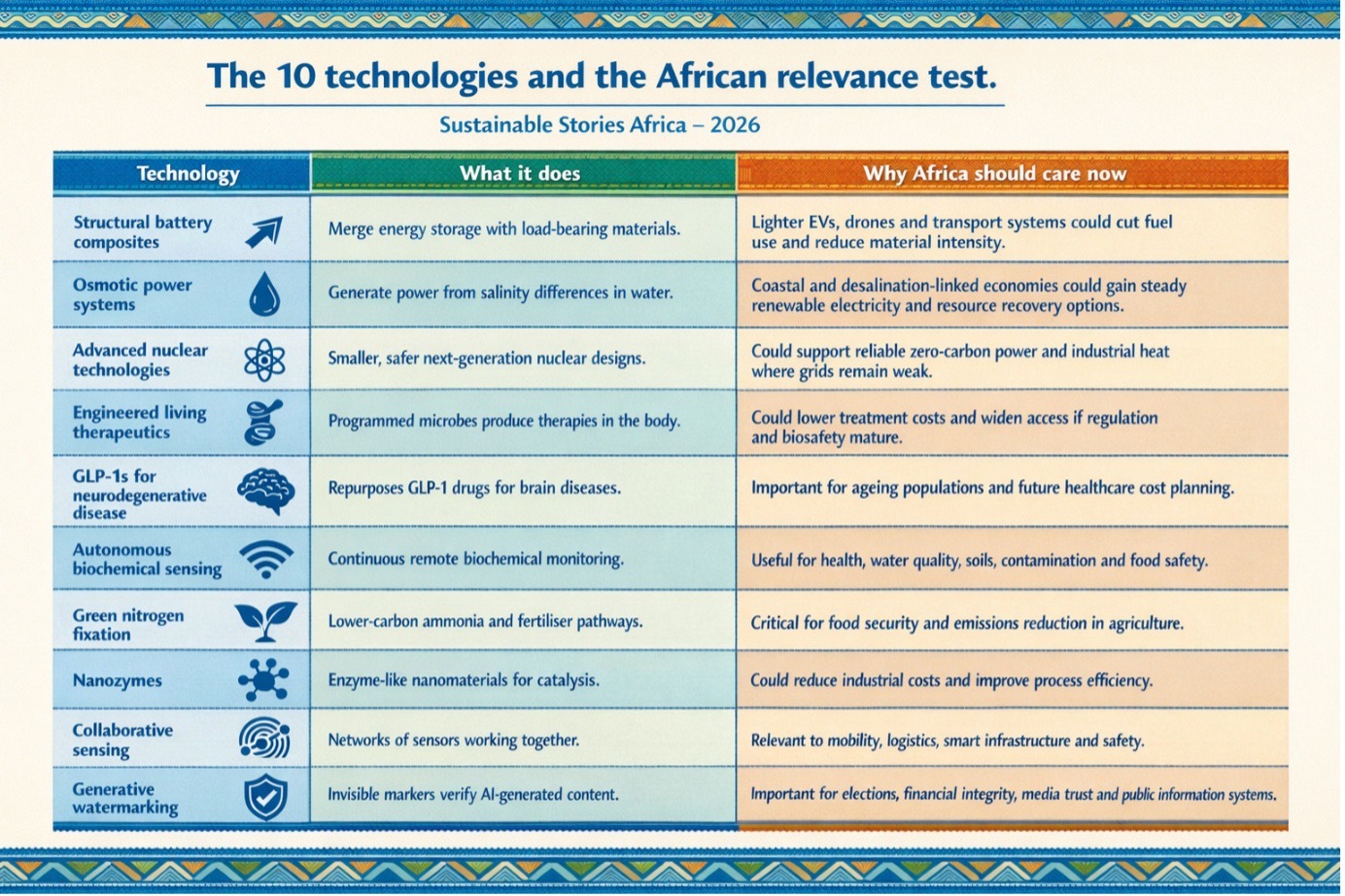
- Structural battery composites
- Osmotic power systems
- Advanced nuclear technologies
All speak to the challenges encountered in power, transport and industrial competitiveness. Engineered living therapeutics, GLP-1s for neurodegenerative disease and autonomous biochemical sensing point to a health future that could become more decentralised and more preventive.
Green nitrogen fixation and nanozymes are used for cleaner industrial and agricultural production. Collaborative sensing and generative watermarking that confronts increasing governance challenges caused by connected environments and synthetic content.
The report emphasises that these technologies are being chosen not just for novelty, but for their capacity to help societies “adapt and thrive” under complex pressures. That phrasing is especially resonant in African contexts where resilience is not an abstract concept.
It is about whether hospitals have medicines, whether grids can hold, whether farmers can access lower-carbon fertiliser, and whether digital systems can still be trusted.
The metrics behind the promise
Structural battery composites are presented less as futuristic hardware and more as a practical efficiency tool.
A 10% reduction in vehicle weight can raise fuel efficiency by 6% – 8% and increase EV range by 70%, while aviation could see 15% fuel-efficiency gains over a 1,500‑kilometre flight.
For African aviation, logistics and e‑mobility operators trying to stretch limited infrastructure, those margins quickly become system-level advantages.
Osmotic power systems are framed as even more quietly disruptive, with a theoretical output of 5,177 terawatt-hours a year, almost a fifth of global electricity demand.
Their ability to combine energy generation, water treatment and mineral recovery makes them especially relevant for coastal, island and desalination-dependent African economies.
Advanced nuclear options, including factory-built small modular reactors and gas-cooled reactors that deliver between 600 – 950°C process heat, are treated as tools for industrialisation without locking in high emissions.
On health, engineered living therapeutics target the 70% of biopharmaceutical costs tied to downstream processing, while autonomous biochemical sensing promises continuous, remote monitoring for health, soil, water, food safety and environmental surveillance in hard-to-reach
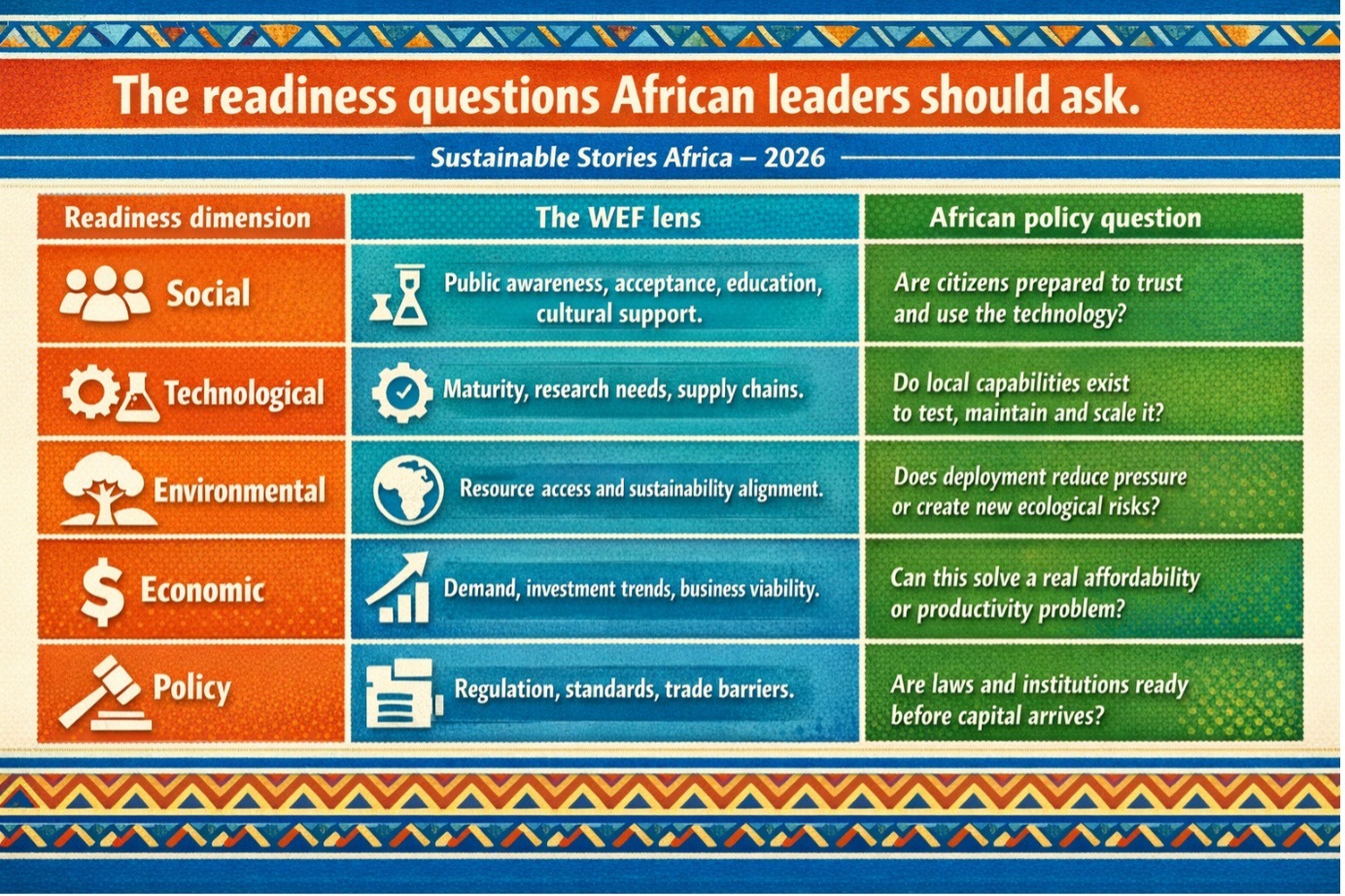
Move from fascination to preparedness
The clearest lesson from the report is that Africa should not approach emerging technologies with a spectatorship. It should approach them as part of statecraft.
- Governments need horizon-scanning units that connect science ministries, regulators, industrial policy teams and investment agencies.
- Universities need stronger translational research pipelines.
- Development finance institutions need to fund demonstration projects, not just pilots that die at conference stage.
- Regulators need sandbox approaches, particularly in health, biosensing, AI integrity and novel energy systems.
- Businesses also have work to do.
This is the time to map which of the 10 technologies intersect with mining, agriculture, healthcare, logistics, utilities, manufacturing and financial integrity.
- For investors, the opportunity is not only in backing technology developers, but in financing enabling systems: testing facilities, certification capacity, grid upgrades, biosafety protocols, data infrastructure and workforce training.
These technologies are not presented as endpoints. They are presented as signals of wider transformations and as catalysts for collaboration.
African markets that build readiness early may not invent every platform, but they can capture disproportionate value from adoption.
Path forward – through selective readiness
African policymakers and firms should treat the WEF list as a readiness agenda: pick the technologies closest to local bottlenecks, build regulatory and demonstration capacity, and align capital with adoption pathways rather than hype cycles.
The real competitive edge will not come from fascination with breakthrough science alone, but from building the institutions that can absorb it.