
The African governance debates often sound urgent, but too many still circle around familiar lines that explain away failure, flatten complexity, and excuse delay.
That matters because fresh evidence shows governance progress has stalled in parts of the continent, even as citizens’ trust in political institutions weakens, the delivery of frustrating services increases, and investors increasingly reward countries that make rules clearer rather than murkier.
When bad language blocks reform
The most dangerous governance problem in African public life may not be corruption, or weak implementation, or even state fragility.
It may also be the language used to discuss them. Across ministries, boardrooms, TV panels and policy conferences, certain phrases now pertain less to analysis and more to intellectual exit ramps: tidy, familiar lines that shut down scrutiny just when scrutiny is needed most.
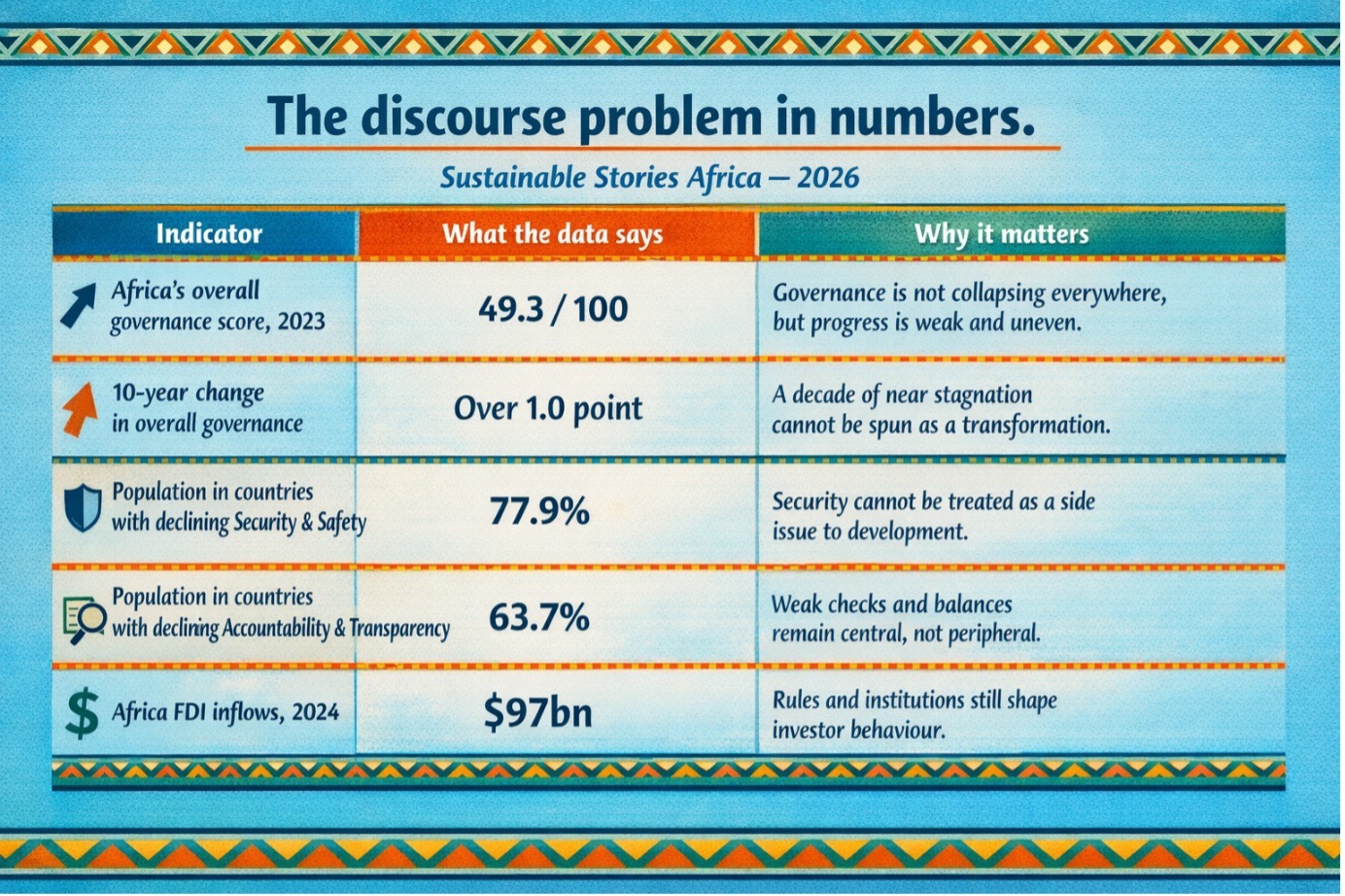
That is costly. The 2024 Ibrahim Index of African Governance shows continental progress effectively stopped in 2022, with nearly half of Africans living in countries where overall governance in 2023 was worse than in 2014.
Afrobarometer, meanwhile, reports weakening trust in key political institutions across 39 countries.
So, this is not a semantic complaint. It is a systems issue. When lazy clichés dominate governance discourse, they distort incentives, reduce accountability, and make poor performance sound natural rather than political.
The phrases are doing real damage
The data no longer supports the old comfort lines. The Ibrahim Index shows Africa’s overall governance score at 49.3 out of 100 in 2023, up just 1 point over a decade, with Security and Rule of Law the worst-performing major category.
Approximately 77.9% of Africans live in countries where Security and Safety declined between 2014 and 2023, while 63.7% live in countries where Accountability and Transparency deteriorated over the same period.
At the same time, this is not a story of inevitable failure. The same index records gains in Human Development and Foundations for Economic Opportunity, including better public records disclosure in some countries. OECD revenue data also show that the average tax-to-GDP ratio across 36 African countries rose by 1.1 percentage points between 2013 and 2022, while UNCTAD reported Africa’s FDI hit a record $97 billion in 2024, partly supported by investment facilitation and liberalisation.
That is precisely why the clichés need to die. They misdescribe a continent that is neither uniformly broken nor automatically improving.
Ten lazy lines, carefully unpacked
- Africa’s problem is corruption – Corruption is a problem, but reducing governance failure to corruption alone is analytically thin. It sidelines weak institutions, low state capacity, deteriorating security, poor service delivery, tax weakness and shallow checks and balances. The Ibrahim Index splits governance into 16 sub-categories for a reason: governance failure is multidimensional.
- We have good policies; implementation is the issue – Sometimes real. Often evasive. Policy design, sequencing, budgeting, procurement, incentives, and monitoring are part of implementation, not separate from it. The World Bank’s 2025 CPIA summary for Sub-Saharan Africa says the region’s average score stayed at 3.1 out of 6 in 2024, with governance weaknesses offsetting gains elsewhere.
- Institutions take time – Yes, but that phrase is often used to avoid discussing whether institutions are actually improving. Some African countries have improved faster than others over the past decade, showing that the speed of reform varies with political choices, not destiny. Seychelles, for example, recorded the largest 10-year improvement in the 2024 IIAG key findings.
- This is just our political culture – This cliché naturalises dysfunction. It turns patronage, opacity, or impunity into something inherited rather than designed and sustained by incentives. Afrobarometer’s findings instead point to specific drivers of democratic frustration, including rising corruption in local government, poor-quality elections and weak presidential accountability.
- Western standards do not fit African realities – Many times, global frameworks are clumsy. However, this line is often used to duck legitimate demands for disclosure, due process, procurement integrity, or independent oversight. Local relevance matters; impunity does not. African institutions themselves are producing comparable governance metrics, not simply importing foreign lectures.
- Investors only care about returns – Investors care about returns, but rules shape returns. UNCTAD said Africa’s record 2024 FDI performance was bolstered by investment facilitation and liberalisation efforts. That is a governance story. Predictable regulation, cleaner approvals, and credible institutions are not moral luxuries; they are market variables.
- Citizens do not care about governance – A great fallacy. They do, often through the language of daily life: electricity, water, safety, justice, prices, jobs. Afrobarometer finds trust in political institutions has weakened, not because people do not care, but because governance failures are felt directly. The World Bank’s CPIA framing also ties public protests and dissatisfaction to service delivery and social justice concerns.
- The private sector will fix what the state cannot – Private capital can help, but governance cannot be outsourced. Contracts, competition policy, grid regulation, tax administration, judicial certainty, and land systems still require capable public institutions. Even strong FDI numbers do not erase the need for the state; they increase the premium on state competence. “A good living example of the housing infrastructure project under the Lateef Jakande leadership in Lagos State, it opened new opportunities for lower and middle-class citizens in Lagos, through PPPs at long-term, manageable costs for citizens”
- There is no money – There is often not enough fiscal space, but “no money” can close weak revenue systems, leakages and poor prioritisation. OECD data show that African tax systems have improved in many countries over the past decade, while UNECA continues to cite annual illicit financial flow losses from Africa of at least $50 billion, with more recent estimates pointing to around $40 billion annually in the extractive sector alone.
- At least we are stable – Stability without accountability can be a pause, not progress. Security deterioration across much of the continent shows that order is not the same as resilience. When checks and balances weaken, trust falls, and social protection or justice systems erode, apparent calm can conceal institutional decay.
What better language can unlock
The prize for abandoning these clichés is not cosmetic sophistication. It is better diagnosis. Better diagnosis can improve fiscal reform, procurement design, decentralisation, anti-corruption enforcement, social service delivery and ESG compliance.
This matters especially as African governments and firms face stricter disclosure rules, higher capital costs, and a sharper investor focus on integrity, traceability and execution.
A more serious discourse would ask harder questions.
- Which institutions are failing, exactly?
- Which incentives are producing leakage?
- Which reforms improved disclosure but not enforcement?
- Which service failures are killing trust?
- Which regions are building regulatory credibility faster, and why?
Those questions do not flatter anyone, but they produce reformable facts.
Why sharper discourse creates demand
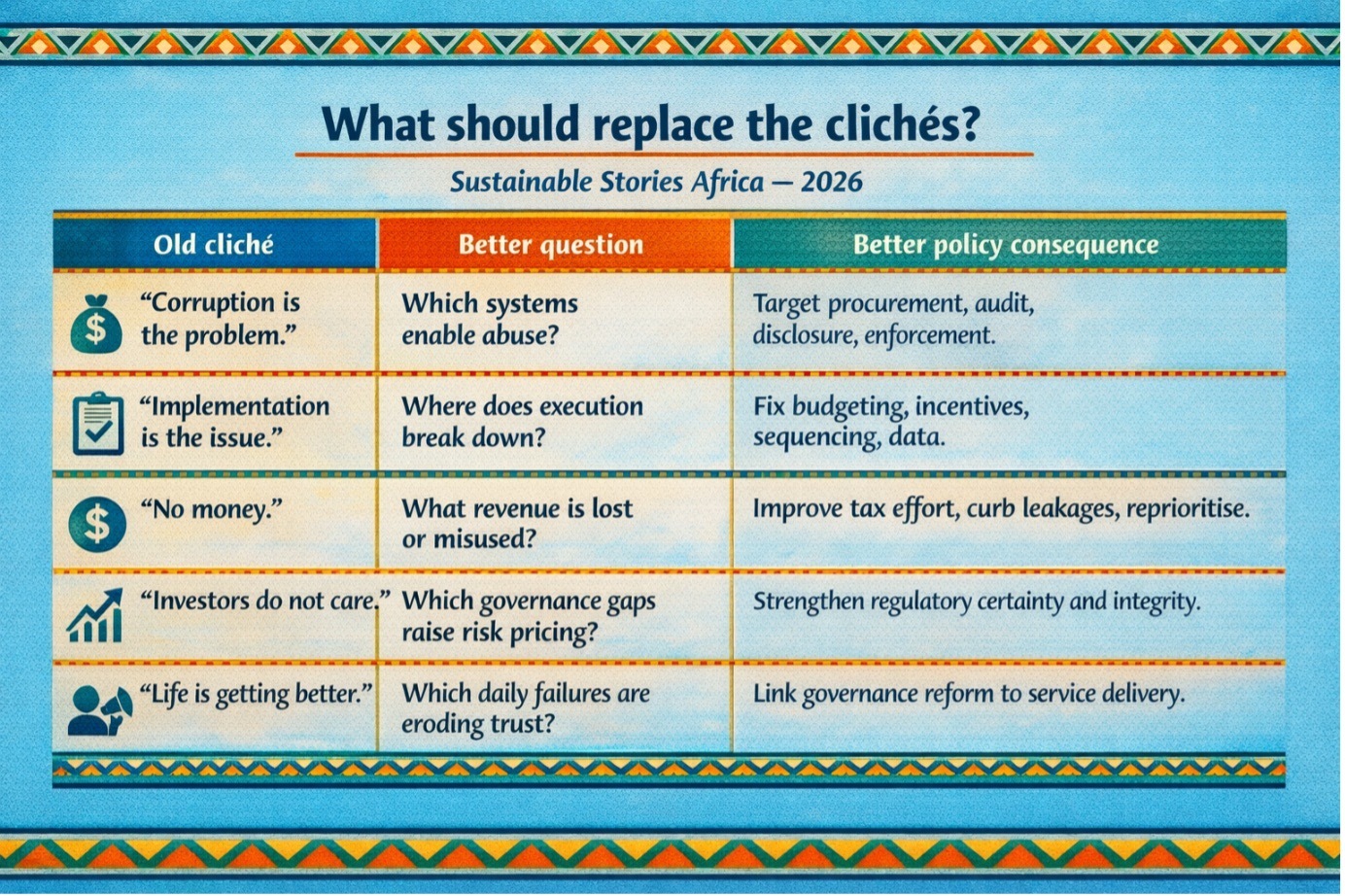
This is where the argument becomes practical. Once thought-terminating clichés are stripped away, governance debate gets more specific and therefore more useful.
It becomes easier for citizens to trace failure, for investors to price risk more accurately, for reformers to defend institutional change, and for journalists to ask better questions.
The alternative is costly familiarity: endless panels, glossy strategies, and reform speeches built on phrases that make everybody sound experienced while changing very little.
Africa does not need rhetoric. It has a challenge of public language that is precise enough to force a choice.
Retire the phrases, raise standards
- Policymakers should stop hiding behind umbrella explanations and publish more disaggregated performance data.
- Regulators should tie reform claims to measurable delivery outcomes.
- Business leaders should treat governance quality as part of operating risk, not as conference language.
- Civil society and newsrooms should become more hostile to cliché-driven analysis masquerading as realism.
The next leap in African governance may begin with something modest but overdue: refusing to let lazy phrases do the work of evidence.
Path forward – after the clichés
The priority now is to replace slogan-heavy governance debate with institution-level diagnosis, measurable service-delivery targets, and clearer public reporting.
That means fewer umbrella explanations and more evidence on where state capacity, accountability, revenue systems and rule-of-law protections are actually breaking down.
For African markets, the promise is practical: better discourse can support.
- Better regulation.
- Stronger investor confidence.
- More credible ESG and governance reform.
The point is not to import orthodoxy. It is local seriousness, backed by data, public scrutiny and institutional follow-through.
Culled From: 10 thought-terminating clichés in African governance discourse that need to die