
Europe’s new ESG reporting regime is often framed as a disclosure issue. It is also a board issue.
A 2024 paper on public companies in Europe argues that ESG oversight is now firmly part of the board's responsibilities, from materiality and climate risk to supplier conduct, whistle-blower protection and data assurance.
For African public companies tied to global capital and export markets, that shift carries a direct lesson.
Why African boards should care
The most important message in Europe’s new ESG era is not that companies must publish more data.
Boards are now expected to treat sustainability reporting as part of core governance, control and accountability. A 2024 paper on Board Oversight: Required ESG for Public Companies in Europe argues that boards of directors now have powerful guidance from the European Sustainability Reporting Standards, or ESRS, to assess whether companies are delivering real ESG performance or simply repackaging promises.
That matters for African public companies even if they are not directly listed in Europe. Many African issuers operate in supply chains, export markets, funding relationships and investor ecosystems that are increasingly shaped by European standards.
Banks, telecoms groups, manufacturers, energy firms and consumer businesses are already facing stronger questions on climate exposure, workforce conditions, governance quality, supplier conduct and community impacts.
From an African public company perspective, the issue is no longer whether ESG belongs in the boardroom. It is whether boards are ready to supervise it with the same seriousness as financial reporting, risk and strategy.
ESG has become a board duty
The paper’s core argument is straightforward: the CSRD and ESRS effectively extend corporate control to cover sustainability and ESG, placing boards and management directly on the hook for a far more demanding disclosure regime.
Sustainability reporting is no longer treated as a voluntary responsibility exercise; it is becoming part of the core internal control framework.
The numbers underscored this. EU authorities estimate that over 50,000 European public companies must publish ESRS‑aligned reports for the 2024 financial year, alongside about 10,400 foreign companies with EU listings, with non‑compliant listed firms facing fines calculated as a share of their EU revenue.
For African boards, the signal is less about Europe’s company count and more about trajectory: sustainability data is being drawn into the same governed, assured and decision‑grade discipline as financial data.
What boards are actually expected to oversee
The paper argues that ESRS pushes board oversight far beyond climate targets into corporate governance.
Under ESRS 1, companies must disclose governance, strategy, impact risk, opportunity management, metrics, targets, materiality, and audits, while meeting tests of relevance, faithful representation, comparability, verifiability and understandability.
For boards, the issue is no longer whether an ESG policy exists, but whether the company can show how sustainability issues directly affect financial performance and position, and how operations affect people and the environment.
Double materiality is the key shift: an issue is material if it matters financially or through its impacts on society and nature.
For African companies, this widens board focus beyond immediate earnings to impacts that can quickly become legal, reputational or financial risks
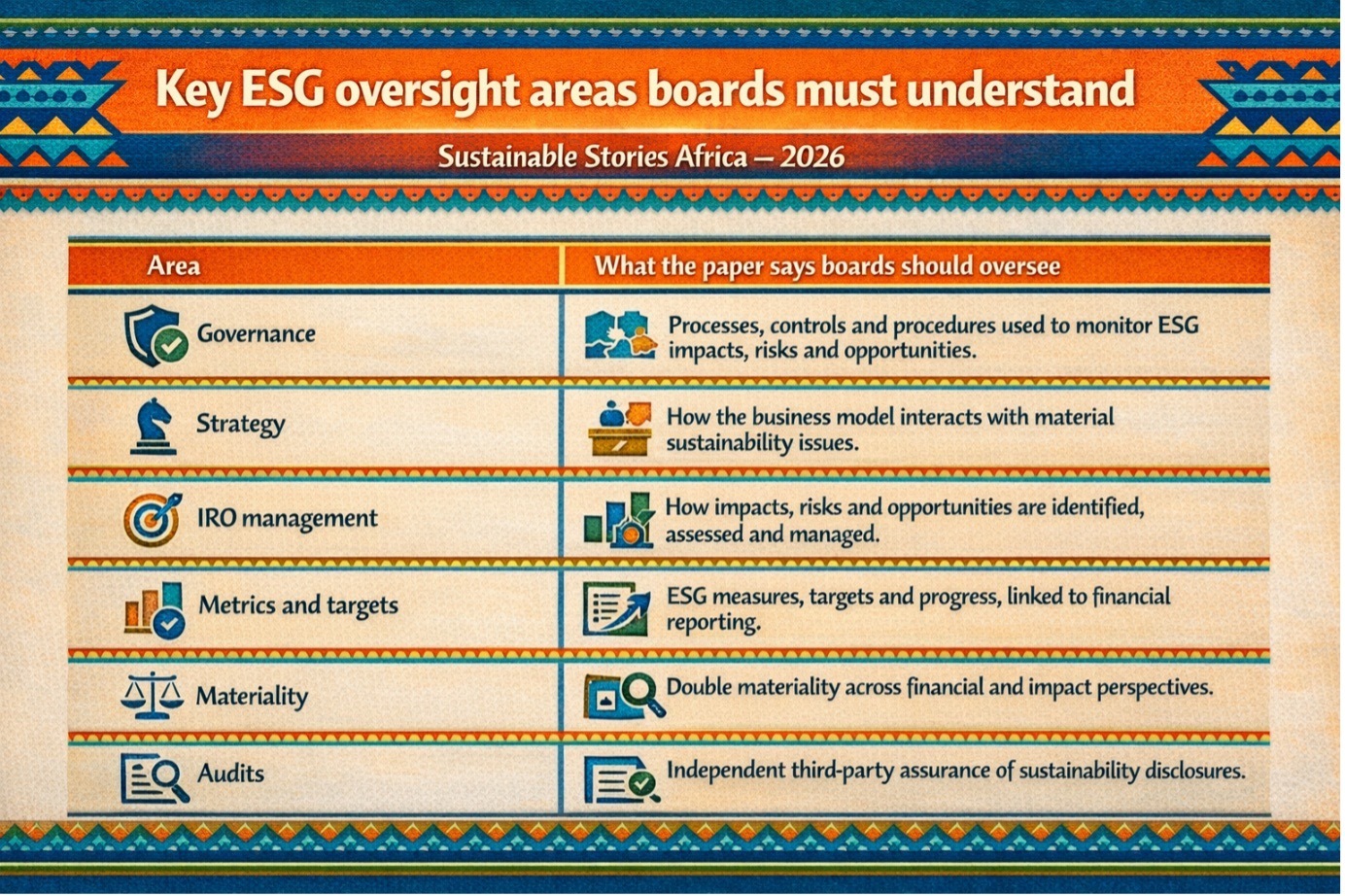
The paper shows that ESRS defines ESG far more broadly than many companies still assume. It spans 10 topics:
- Five environmental
- Four social
- One governance
They cover climate, pollution, water, biodiversity, circular economy, workers, communities, consumers and business conduct.
For African issuers, that breadth is the governance message. ESG can no longer stop at carbon and philanthropy; boards must oversee labour rights, anti-bribery, data privacy, supplier practices, indigenous rights, water use, pollution and incentives as risk, compliance and strategy issues.
What stronger oversight can unlock
There is a strong upside to this shift if boards take it seriously. Better ESG oversight can improve internal communication, risk management and accountability.
The paper argues for integrating financial metrics with non-financial disclosure across governance, risk management and ESG strategy.
For African public companies, that could produce three gains.
- First, it can improve market credibility. Investors and lenders increasingly want structured evidence, not aspirational language.
- Second, it can reduce the risk of greenwashing, which the paper explicitly identifies as a concern for the board. Boards can now test whether commitments are followed by performance.
- Third, it can help companies anticipate global buyer and regulator expectations before those demands hit more forcefully through value chains or financing conditions.
The paper also cites evidence that ESG quality may matter financially. It references Kroll research covering 13,000 companies globally from 2013 – 2021, where ESG leaders generated an average return of 12.9%, compared with 8.6% for laggards; in the US, leaders returned 20.3% against 13.9% for laggards.
What African boards should do now
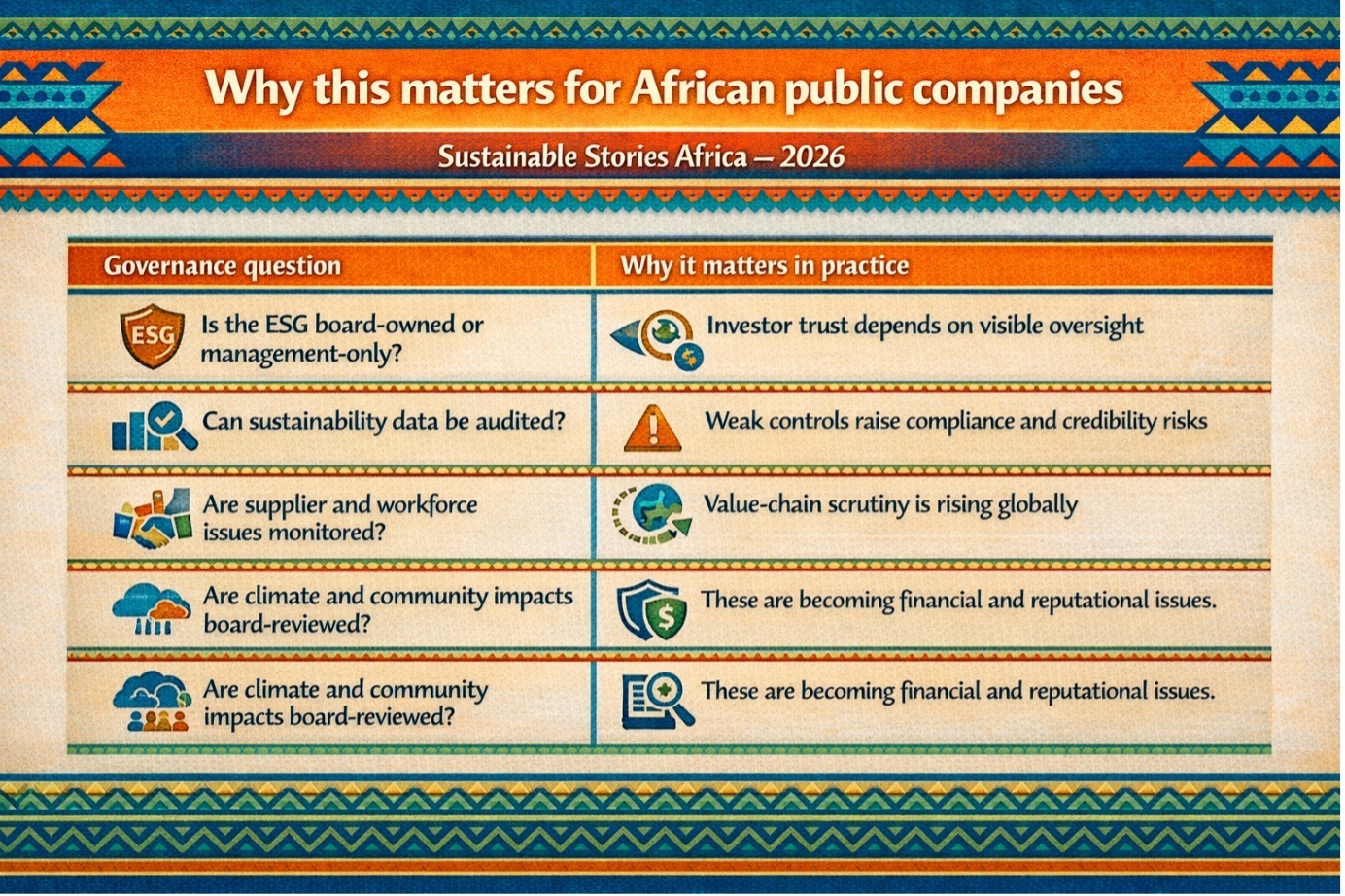
The paper offers a practical governance direction that African boards can adapt. It suggests boards could create a review checklist of key ESG items based on the topical ESRS, much like an auditor’s internal control questionnaire, and either assign the responsibility to the audit committee or establish a separate ESG board committee.
From an African public company perspective, five actions stand out.
- Boards should first define ESG oversight formally: who owns it, how often it is reviewed, and which committee carries responsibility.
- Second, they should insist on a materiality process that looks beyond immediate financial effects to people, communities and the environment.
- Third, they should demand data systems that can withstand assurance, because the paper stresses the need for controls, validation and completeness similar to financial reporting.
- Fourth, they should focus on business conduct, especially anti-bribery, supplier management, whistle-blower protection, lobbying and payment practices.
- Fifth, they should use ESG oversight to challenge both greenwashing and “greenhushing”, saying too much without evidence, or saying too little to avoid scrutiny.
This is particularly important in African markets where governance quality often differentiates companies more sharply than disclosure volume alone. A thin sustainability brochure will not substitute for board-level scrutiny of workforce safety, pollution exposure, community harm, corruption risk or supplier behaviour.
Path forward – Europe’s ESG Turn Signals Board Accountability
African public company boards should treat Europe’s ESG reporting turn as an early governance signal, not a distant European compliance story.
The real lesson is that sustainability is moving into the architecture of control, assurance and board accountability.
The next step is practical:
- Clearly assign oversight
- Build auditable ESG data systems
- Use double materiality to guide board questions
- Test whether the company's claims are matched by measurable performance.
In the new market environment, ESG maturity will increasingly be judged by how boards govern it.