Nature is moving from the margins of sustainability reporting into the centre of corporate risk management.
Norges Bank Investment Management says companies must show how land, water and ocean risks affect strategy, supply chains, targets and long-term value.
For African companies, the signal is direct: biodiversity, water stress, deforestation, pollution and community consent are becoming investor-facing business issues, not optional ESG language.
Nature Risk Enters Corporate Finance
Nature is no longer just an environmental concern for companies. It is becoming a governance, capital allocation and investor confidence issue.
Norges Bank Investment Management, manager of Norway’s Government Pension Fund Global, has set out expectations for companies on nature-related risks and opportunities, warning that degradation of land, freshwater systems and marine environments can affect the long-term value of companies in its portfolio.
The investor says companies face risks when natural resources become scarce or degraded, or when environmental impacts trigger regulation, liability, operational restrictions and reputational damage.
For African and emerging-market businesses, the message is timely. Banks, insurers, manufacturers, miners, food processors, retailers, infrastructure companies and exporters are increasingly exposed to nature-related scrutiny through supply chains, water access, land use, community relations and disclosure expectations.
The new investor question is no longer only whether a company emits carbon. It is whether its business model can operate responsibly within nature’s limits.
Nature Loss Now Hits Valuations
The headline figure in Norges Bank’s expectations document is stark: seven out of nine planetary boundaries have now been crossed, signalling pressure on the natural systems that support life and economic activity.
The investor also points to a global review that found more than 600 examples of nature-related financial risks, from food-price inflation and water-related supply disruptions to pollution liability
In its survey, 48% of companies said nature’s risks are already financially material today.
That shifts the nature conversation from philanthropy to finance. A beverage company that cannot secure reliable water, a miner facing community opposition over land contamination, a food company tied to deforestation, or a port operator exposed to ocean pollution rules may all face direct business consequences.
Norges Bank’s expectations are primarily directed at company boards. Boards are expected to understand the broader environmental and social consequences of operations, consider relevant stakeholders, set priorities, account for outcomes, and ensure material information is reported to investors.
This is a significant governance signal. Nature risk is being framed as a board-level duty, not a sustainability department side project.
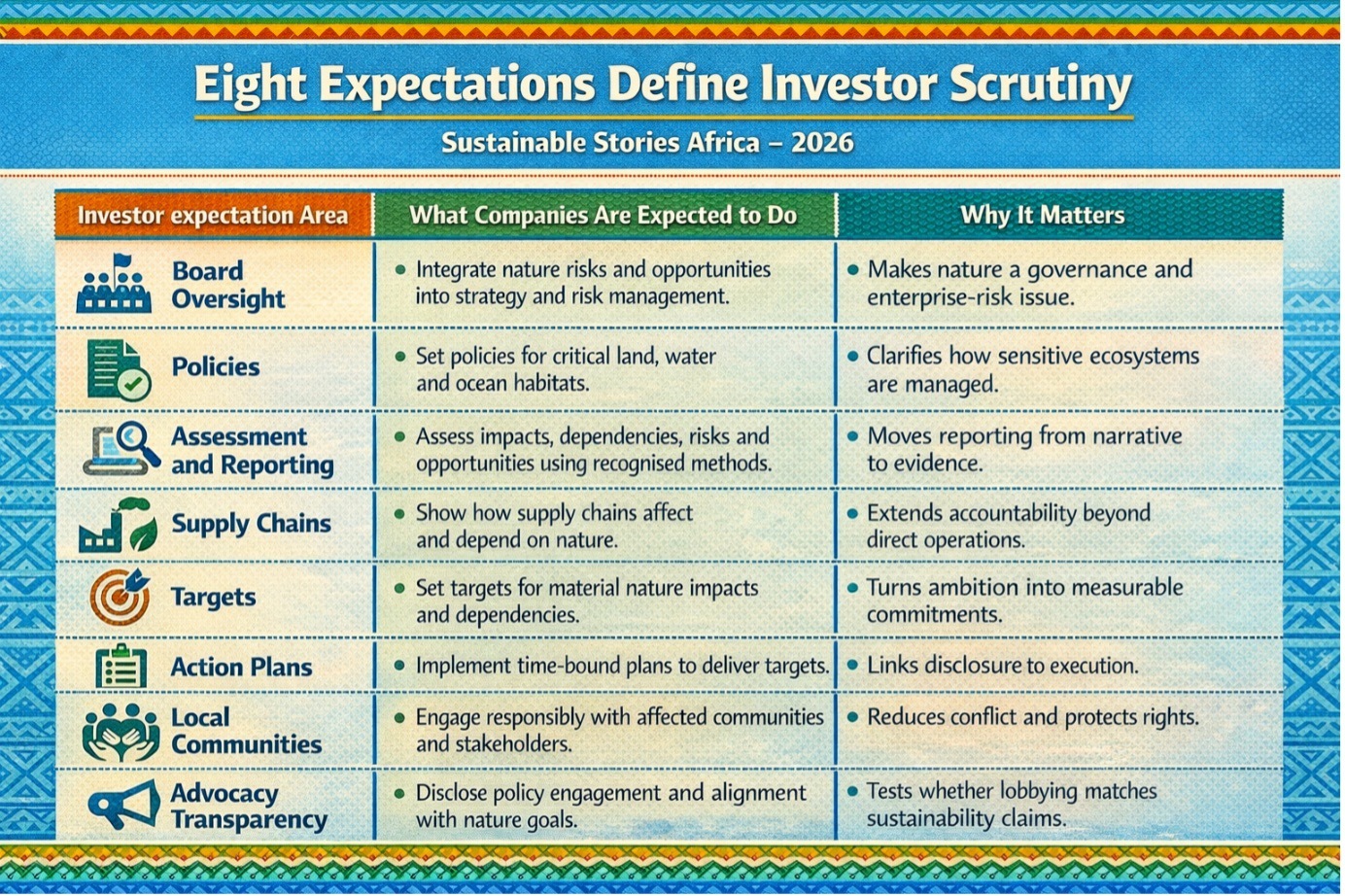
Interest: Eight Expectations Define Investor Scrutiny
The expectations document is structured around eight core expectations that apply across companies, followed by practical guidance on land, water and ocean ecosystems. The core logic runs from oversight to disclosure, targets and responsible engagement.
The document specifically references recognised frameworks and standards, including the Taskforce on Nature-related Financial Disclosures and the International Sustainability Standards Board.
It says companies should disclose financially material nature-related issues using recognised methods and metrics.
For African companies, this is important because global capital is becoming more disciplined about comparability.
A Nigerian agribusiness, Kenyan tea exporter, South African miner or Ghanaian cocoa-linked processor may increasingly need to show where it sources materials, how much of its supply chain is traceable, whether it has a certification, and how it manages impacts on land, water and communities.
Better Nature Strategy Can Unlock Trust
The opportunity is not only risk avoidance. Norges Bank notes that evolving consumer demand and the availability of natural resources can create opportunities as new markets emerge.
Companies that manage nature well can strengthen resilience, protect supply chains, improve investor trust and position themselves for emerging sustainability-linked markets.
In African markets, this could be commercially significant. Regenerative agriculture can improve soil health and farmer productivity. Water efficiency can reduce production disruptions in stressed basins.
Circular packaging can cut waste-management exposure. Responsible mining practices can reduce conflict and improve licence-to-operate. Seafood traceability can protect access to premium export markets.
The expectations also connect nature and climate. Norges Bank says nature-related risks are closely interconnected with climate risks and should be treated as integrated challenges requiring coordinated responses.
Companies are expected to explain synergies and trade-offs, such as carbon sequestration from nature-based solutions, land-use impacts from low-carbon infrastructure, and material sourcing for clean technologies that may affect ecosystems.
That is especially relevant for Africa’s transition economy. Solar farms, transmission corridors, hydropower, mining for transition minerals, bioenergy, reforestation and carbon projects can all support climate goals.
However, without biodiversity safeguards, land rights protections and community consent, they can also create new ESG risks.
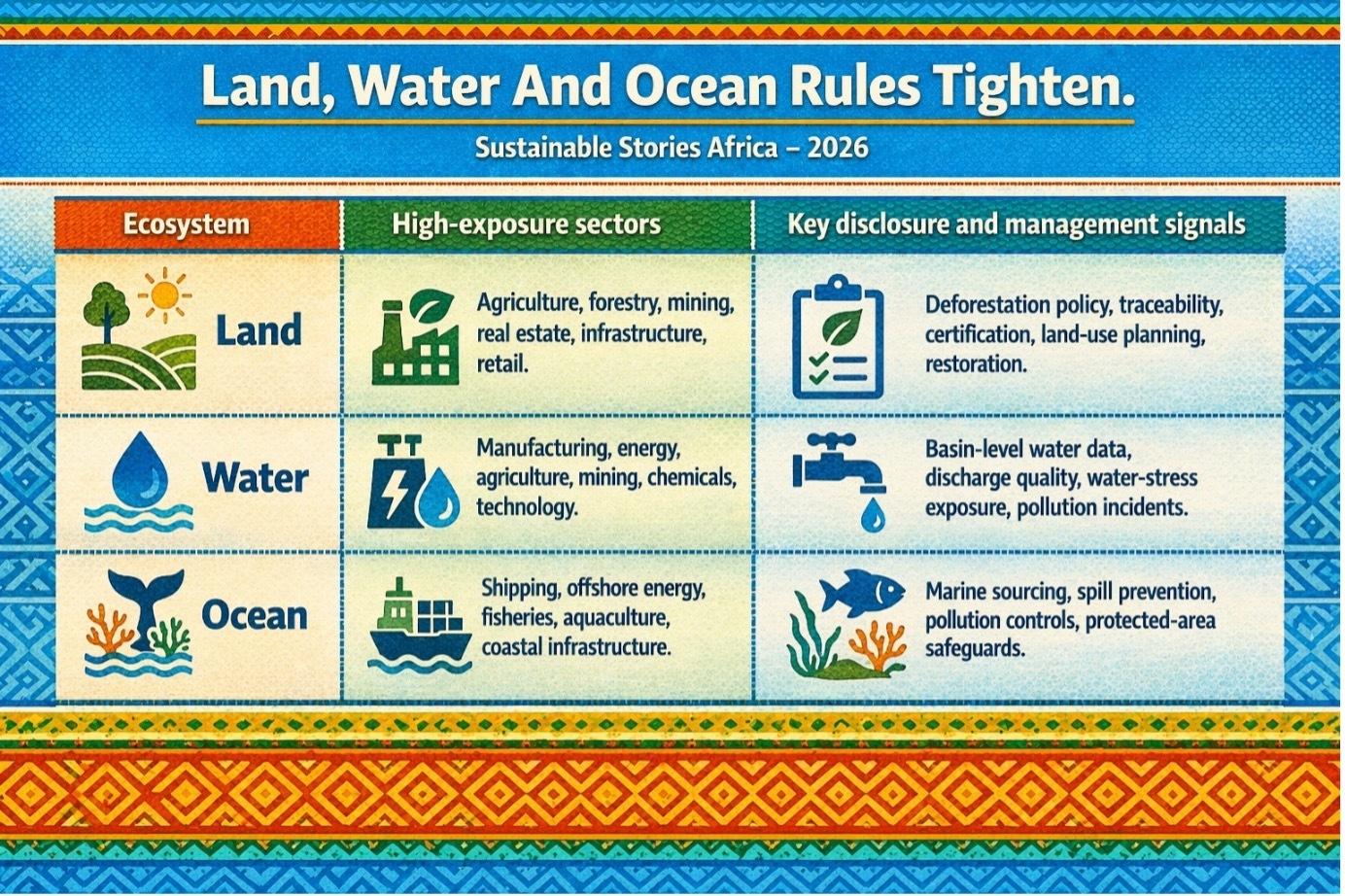
Land, Water, and Ocean Rules Tighten
Norges Bank’s ecosystem-specific guidance shows where companies are likely to face more direct investor questions.
- Companies interacting with terrestrial ecosystems, including agriculture, forestry, mining, real estate and infrastructure, are expected to assess land-related dependencies and impacts, avoid unnecessary land conversion, prioritise the degradation of land, and support restoration.
- Agricultural value-chain actors must implement sustainable or regenerative farming practices. The guidance strengthens deforestation requirements, urging companies to demonstrate the elimination of deforestation and peatland loss through clear policies, traceability and certification, while committing to halting the conversion of all natural ecosystems by 2030.
- For water, expectations target high-dependency sectors such as manufacturing, energy and agriculture, particularly in water-stressed regions. Companies must prioritise efficient water use, pollution control, basin-level data and collective watershed stewardship.
- Ocean-related guidance covers shipping, offshore energy and coastal activities, requiring companies to safeguard marine ecosystems by minimising pollution, preventing invasive species, disclosing sourcing practices, and addressing marine contamination from plastics, chemicals and other pollutants.
The practical action for companies is clear. Boards need to ask management for nature-risk maps, supply-chain exposure data, priority locations, measurable targets, investment needs and evidence of community engagement.
Investors will increasingly distinguish between companies with general sustainability claims and companies with decision-useful data.
Path Forward – Nature Needs Board Accountability
African companies should treat nature as enterprise risk: map dependencies, disclose impacts, set measurable targets, and align land, water and ocean practices with recognised frameworks.
The next phase of ESG will test whether companies can prove resilience beyond carbon.
Boards that act early can protect value, strengthen community trust and remain credible as investors connect nature, climate and financial performance.