Many impact projects are not rejected because the ideas are weak. They fail because they are poorly structured, difficult to measure, and disconnected from funder priorities.
For African organisations chasing climate, ESG, education, health, and community-development capital, the funding test is shifting from passion to proof: strategy, execution systems, measurable impact, visibility, and aligned partnerships.
Good Ideas Still Need Structure
Across Africa’s social-impact landscape, a quiet funding gap is becoming harder to ignore: many organisations have urgent missions, credible intentions and strong community roots, yet still struggle to attract grants, donor partnerships, ESG-linked finance or catalytic capital.
The core problem is no longer only the scarcity of funding. It is fundability. A recent EOB Consults visual brief, Why Your Impact Projects Don’t Get Funded, identifies five recurring barriers:
- Weak strategy
- Poor execution systems
- No measurable impact
- Low visibility
- Positioning and misaligned partnerships.
Its central message is direct: most organisations get stuck not because they lack passion, but because they lack structure.
That diagnosis matters now because African organisations are competing in a tighter, more evidence-led funding environment.
Donors, foundations, DFIs, ESG teams and corporate partners increasingly want more than a compelling mission.
They want defined outcomes, delivery systems, credible data, and proof that a project can scale without losing accountability.
Funders Are Buying Proof, Not Passion
The most important funding lesson for impact builders is also the hardest one: good intentions do not automatically become investable projects.
The EOB Consults brief opens with a sharp framing, “Why Your Impact Projects Don’t Get Funded”, before listing the structural gaps that often weaken otherwise promising initiatives.
The first is a weak strategy: no clear structure, no defined outcomes, and no fundable framework. In funding language, that means the project may sound meaningful but still leave reviewers asking basic questions:
What exactly will change? Who benefits? How will progress be tracked? What happens after the first grant cycle?
This is where many grassroots, NGO, social enterprise and ESG-linked projects lose momentum. A clean proposal may describe a problem well but fail to show the pathway from activity to outcome.
A climate-awareness campaign may plan workshops without defining behaviour change. A youth-employment project may promise empowerment without mapping job placement, retention, income growth or employer demand.
A waste-management initiative may describe community clean-ups without showing waste diverted, workers formalised, emissions reduced or revenue generated.
For funders, that difference is decisive. They are not only funding efforts. They are underwriting delivery risk.
Five Gaps Blocking Impact Capital
The EOB Consults framework is useful because it turns the funding problem into an operational checklist. It does not blame organisations for lacking ambition. It shows where ambition often fails to translate into a bankable or grant-ready proposition.
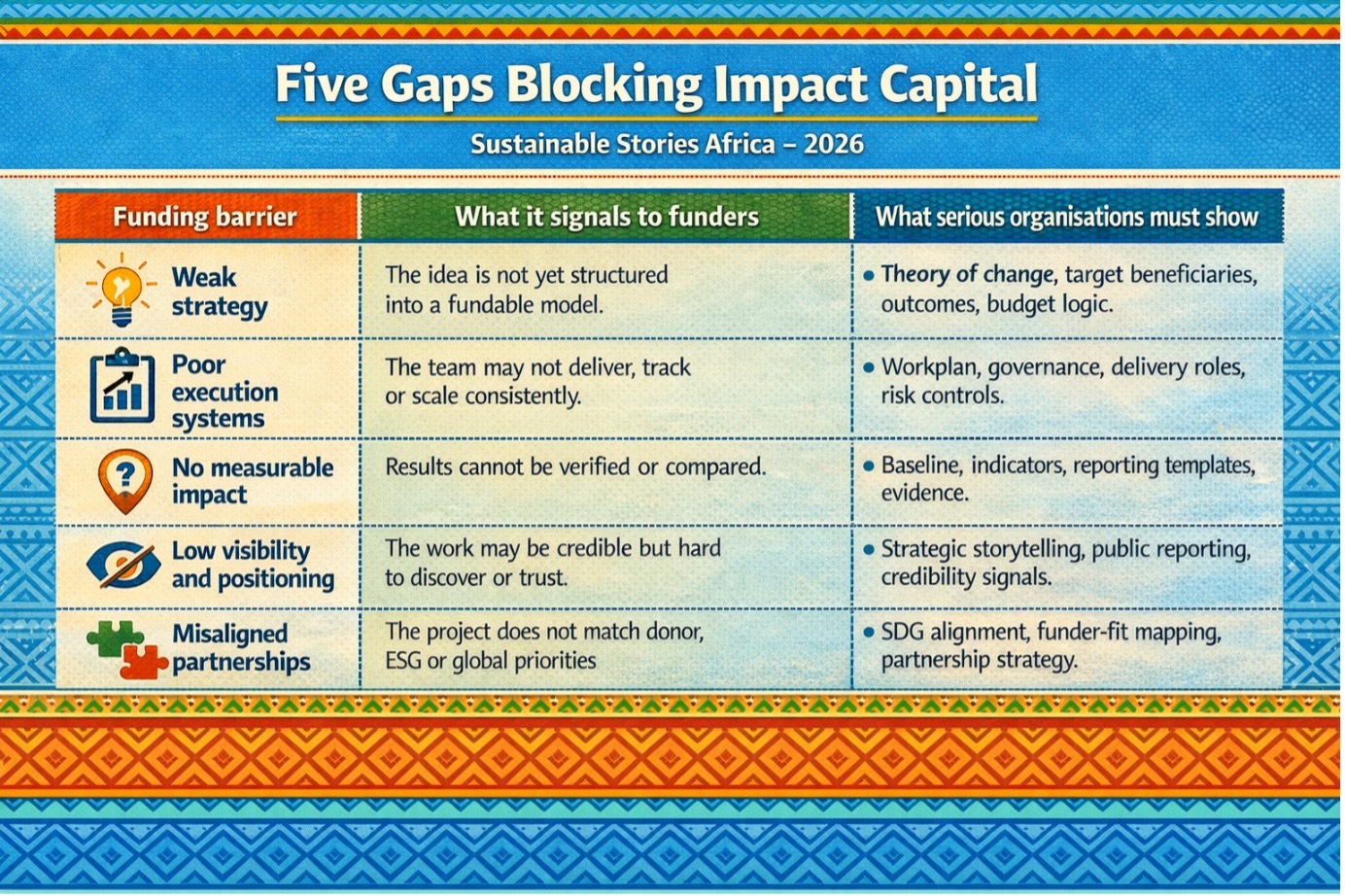
The second barrier, poor execution systems, is particularly important. The brief notes that “ideas exist”, but there are often no systems to deliver, track or scale impact.
That distinction is critical in African markets where implementation risk can be as important as the social problem itself. A project may have a strong founder, but funders also want continuity: procurement discipline, financial controls, beneficiary verification, field reporting, escalation protocols and learning loops.
The third barrier is measurement. The brief’s phrase, “No data. No reporting structure. No proof of results,” captures a growing reality in ESG and development finance.
Measurement is no longer a back-office activity. It is part of the product. Without a baseline, even real impact becomes invisible. Without indicators, progress becomes anecdotal. Without reporting, trust weakens.
Fundable Projects Can Scale Faster
The opportunity is that these weaknesses are fixable. In fact, the most significant impact organisations are not always the ones with the biggest teams or most polished branding.
They are often the ones that can explain their model clearly, demonstrate early traction, document results and align their work with funder priorities.
That shift can unlock practical gains. A community health project with a baseline can show whether maternal-health outreach improved clinic attendance. A clean-cooking programme with verified usage data can attract climate-linked support.
A school-retention project that tracks attendance, gender outcomes and learning progression can speak to education funders, corporate ESG teams and public-sector partners at once.
This is where visibility becomes more than publicity. The brief identifies low visibility and positioning as a major funding barrier, noting that some organisations do good work but lack strategic storytelling, credibility or visibility.
In a crowded funding market, silence can look like weakness. The issue is not vanity. It is discoverability, trust and narrative discipline.
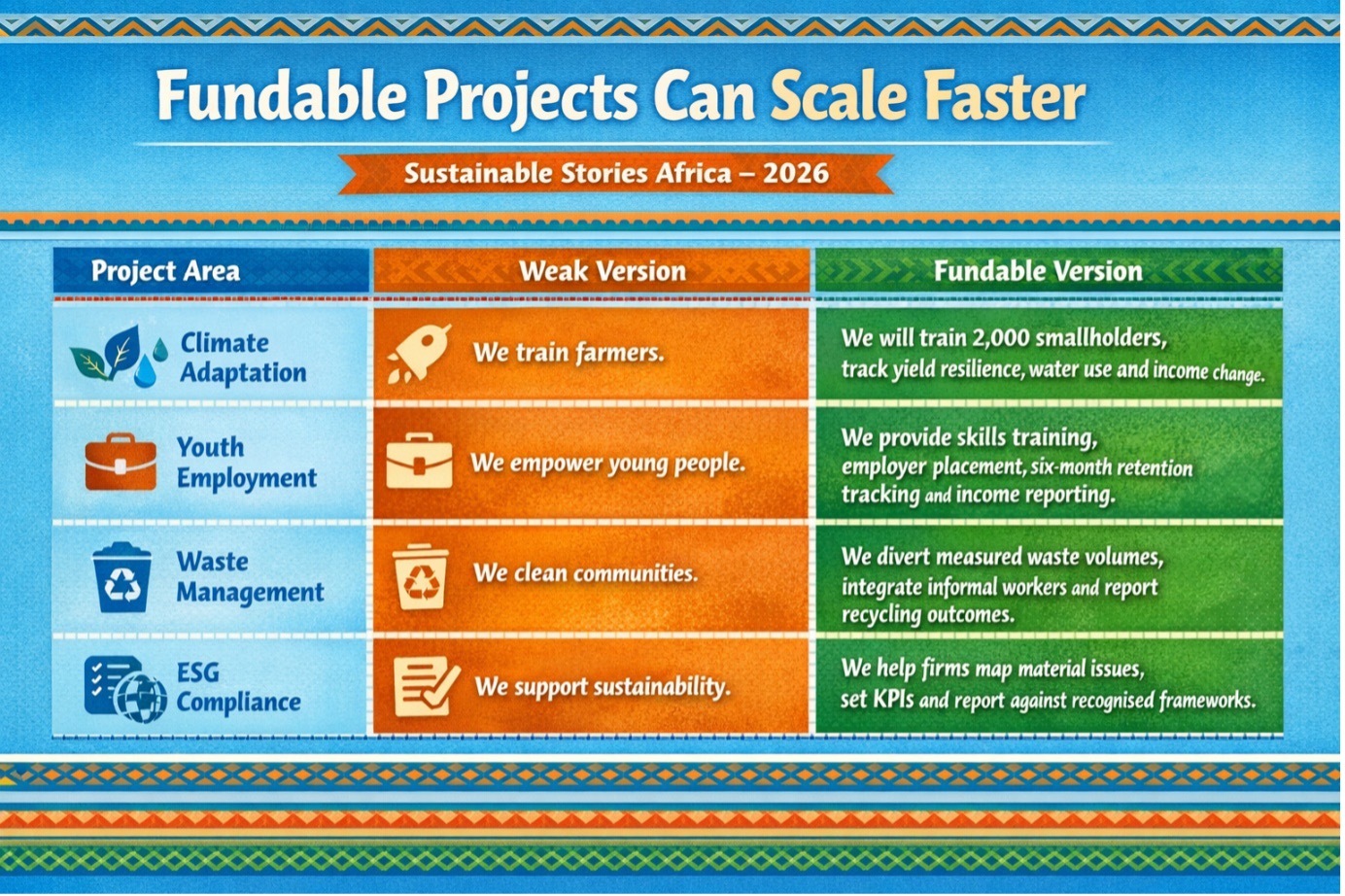
The better future is not only more funding. It is a better capital allocation. When impact projects become measurable, funders can compare models, back what works, and support scale.
Communities also benefit because resources move from vague promises into projects with clearer accountability.
Build Systems Before Seeking Capital
The practical next step for impact organisations is to stop treating funding as the beginning of structure. Funders increasingly expect structure before funding.
That means every serious project should begin with a fundability audit. The first question is not “Who will fund this?” but “Is this ready to be funded?” A strong answer should cover five areas: strategy, execution, measurement, positioning and partnership alignment.
Governments and regulators can also support this shift by improving the enabling environment for credible social-impact delivery. That includes clearer NGO reporting standards, procurement transparency, open development data, public-private partnership guidance and incentives for verified ESG outcomes. Corporate ESG teams can do more by moving beyond one-off donations towards structured partnerships with measurable community, climate or governance outcomes.
For funders, the lesson is equally important: promising organisations may need pre-funding technical assistance before they can absorb major capital. Proposal-writing support is not enough. Many need help with project design, data architecture, governance systems, stakeholder mapping and reporting discipline.
The EOB Consults brief ends with a solution-oriented offer: helping organisations structure ideas into fundable projects, build systems that deliver measurable impact, align with the SDGs, ESG and donor expectations, and position work for visibility and partnerships. That sequence is the real funding ladder: structure first, capital second, scale third.
Path Forward: Structure Must Lead Funding
African impact builders need to move from effort to evidence. The priority is to define outcomes, build delivery systems, measure results, and align projects with SDG, ESG and donor expectations.
The funding market is not only asking, “Is this important?” It is asking, “Can this work, can it scale, and can it be proven?” Projects that answer clearly will stand a stronger chance of moving from passion to capital.