
Women and girls represent nearly half the world’s population; however, women’s health receives only 6% of private healthcare investment, according to a new World Economic Forum report.
The gap is not only a public health failure. For Africa and emerging markets, it is an investment, productivity and ESG opportunity in plain sight across hospitals, households, workplaces and underserved health systems.
Women’s Health Becomes Investment Infrastructure
Women’s health is moving from the margins of healthcare funding into the centre of a new investment debate, after the World Economic Forum and Boston Consulting Group warned that chronic underinvestment has created both a health equity gap and a historic market inefficiency.
In its January 2026 insight report, Women’s Health Investment Outlook, the Forum says women’s health has captured just 6% of private healthcare investment, despite women and girls representing nearly half of the global population.
Companies focused exclusively on women’s health receive less than 1% of all private healthcare funding.
For African and emerging markets, the issue is especially urgent.
Women often anchor household health care decisions, informal care systems, agricultural productivity, small-business resilience and community welfare.
When women’s health is underfunded, the cost does not stay in clinics. It shows up in lost workdays, delayed diagnosis, weak maternal outcomes, lower labour participation and avoidable pressure on already stretched health systems.
Six Percent Funding for Half of Humanity
The most striking number in the WEF report is also the clearest indictment of global healthcare capital allocation: women’s health receives only 6% of private healthcare capital, while women’s health-specific companies capture less than 1%.
That imbalance is not just about reproductive and maternal care. The report stresses that women’s health includes conditions that affect women uniquely, differently or disproportionately, from endometriosis, menopause and polycystic ovary syndrome to cardiovascular disease, osteoporosis, Alzheimer’s and autoimmune disorders.
The consequences are measurable. Women may live longer than men, but they spend 25% more of their lives in poor health or with disability, a gap that erodes well-being and workforce participation.
The report also notes that women lose an estimated 75 million years of healthy life each year, equivalent to about one week of health lost per woman annually.
In development terms, that is not a niche healthcare issue. It is a productivity issue, a household resilience issue, an employer issue, and a governance issue for countries trying to build inclusive growth.
Capital Is Flowing Too Narrowly
The WEF’s Women’s Health Investment Index shows that funding is not only too small; it is also too concentrated.
Between 2020 and 2025, roughly 80% of funding events and 90% of capital flowed into just three areas: reproductive health, maternal care and women’s cancers.
That leaves significant white space in high-prevalence conditions that affect women differently or disproportionately.
This matters for Africa because the region’s health systems often face a double burden: underdiagnosed women-specific conditions and limited access to specialist care.
A woman managing untreated endometriosis, menopause symptoms, perinatal depression or metabolic risk may move through clinics without a clear diagnosis, while continuing to carry work, family and caregiving responsibilities.
The investment gap is also reinforced by research design. The report says men’s health has long served as the default baseline for clinical research and product development, leaving many standards calibrated to male physiology.
Five conditions unique to or prevalent in women, endometriosis, maternal health, premenstrual syndrome, menopause and cervical cancer, account for 14% of the female disease burden but have received less than 1% of relevant research funding in recent years.
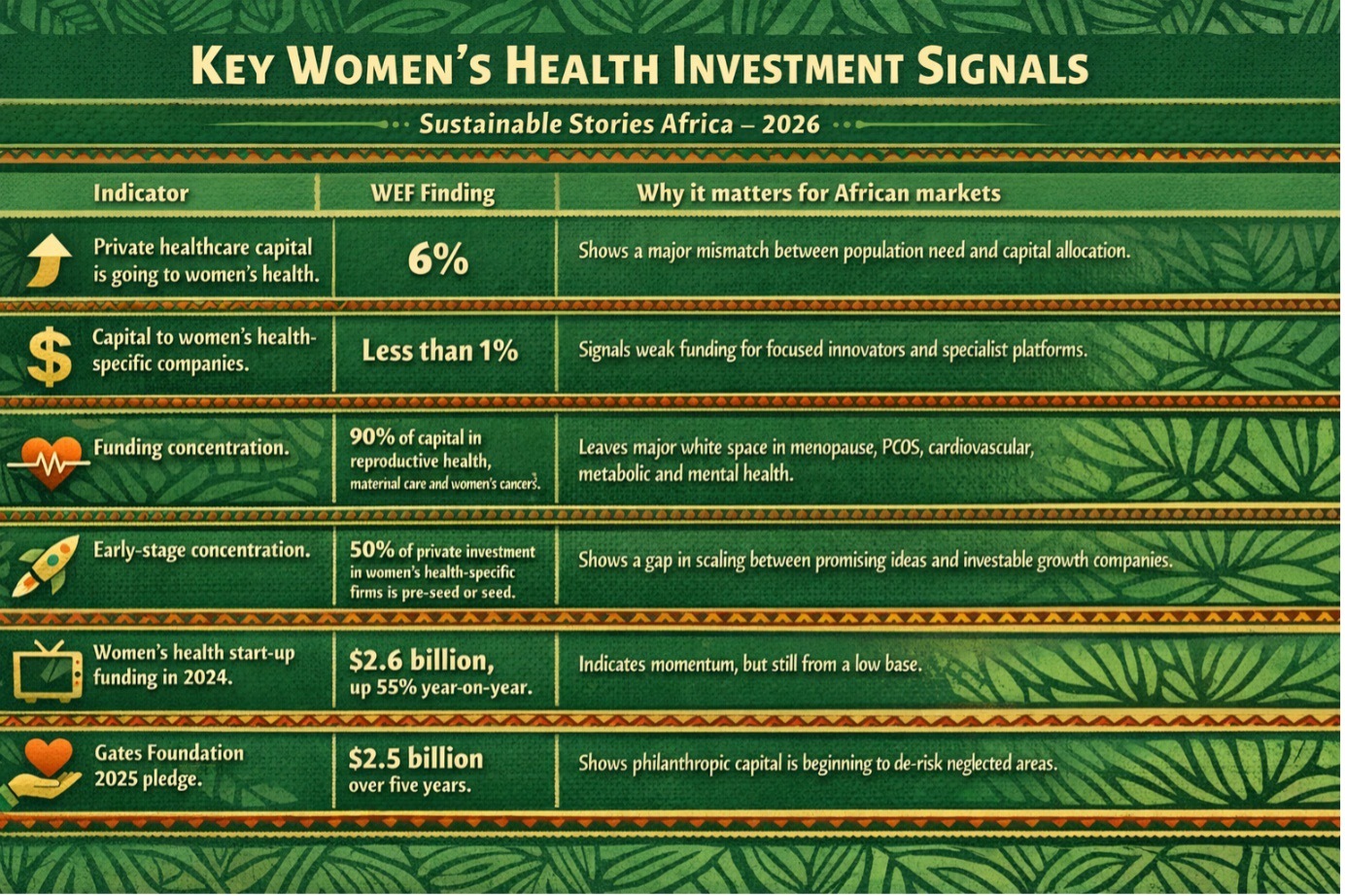
The report also identifies geographic imbalance. North America and Europe dominate deal activity, while low- and middle-income countries remain under-represented despite high disease burden.
Better Health Can Unlock Growth
The upside is substantial. BCG estimates that effectively addressing menopause, osteoporosis, Alzheimer’s disease and cardiovascular disease for women in the United States alone could unlock a market opportunity of more than $100 billion by 2030.
- For investors, that reframes women’s health from charity to commercial opportunity.
- For policymakers, it reframes women’s health from social spending to economic infrastructure.
- For employers, it reframes workplace health benefits as productivity protection.
The report shows in vitro fertilisation as proof of scale. IVF moved from a once-stigmatised experiment to a global multibillion-dollar industry when scientific reliability, outcome transparency, reimbursement and policy support aligned.
More than 12 million children worldwide have been born through assisted reproductive technology, and the global ART market was estimated at $13 billion in 2024.
The lesson is direct: markets grow when evidence, demand, policy and payment systems line up.
In African markets, the same logic could apply to maternal monitoring, cervical cancer screening, fertility support, menopause care, digital women’s health platforms and women-focused mental health services.
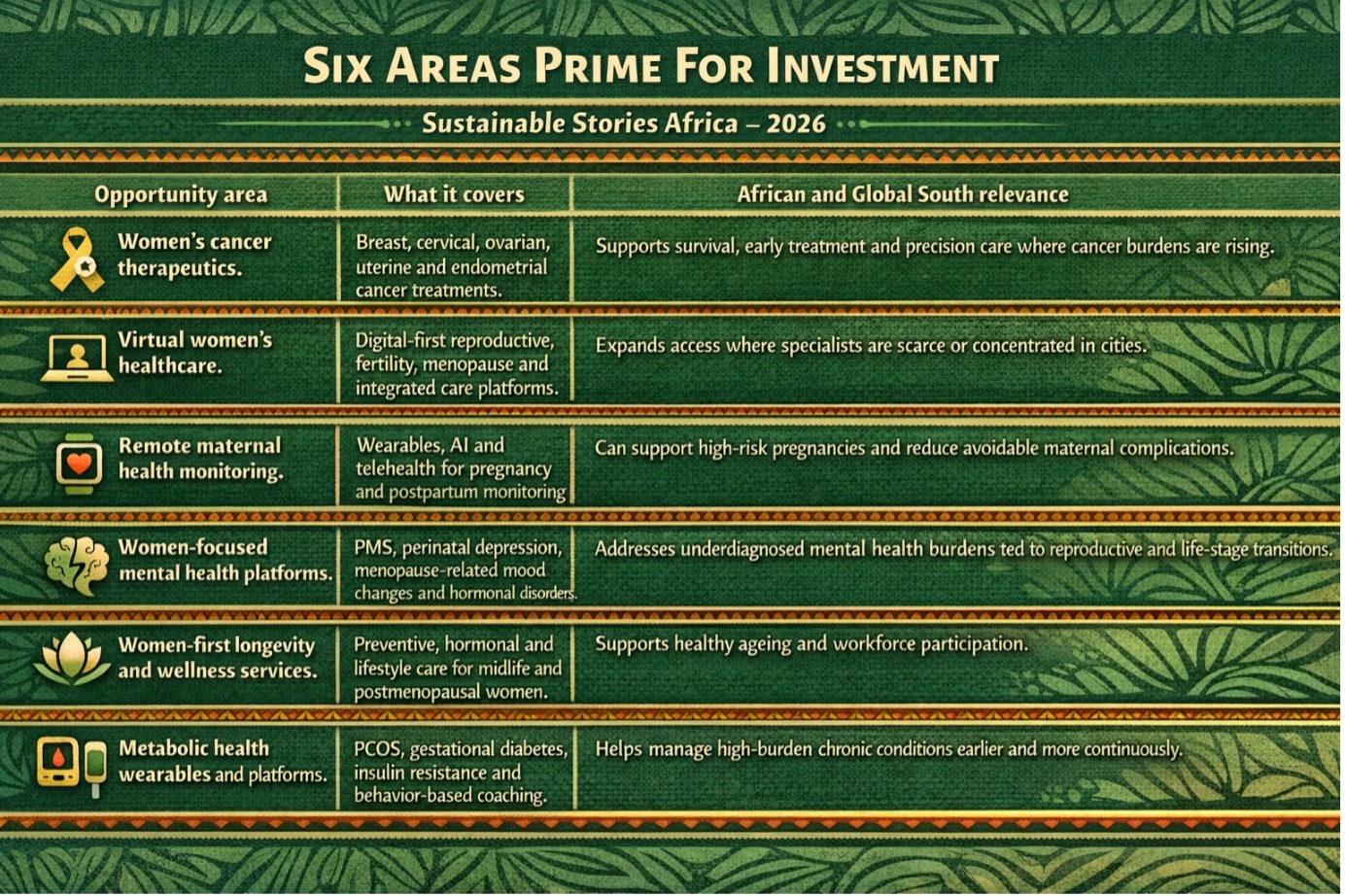
The WEF’s Figure 7 on page 19 visually groups these areas by whether conditions affect women specifically, disproportionately or differently, showing that the opportunity spans therapeutics, digital platforms, diagnostics, devices and preventive care, rather than a single narrow sector.
Build Markets Around Evidence And Access
The report’s call to action is practical: build a demand-driven evidence base, mobilise blended capital, modernise regulation, expand reimbursement, bring in adjacent healthcare incumbents and increase transparency on returns and clinical outcomes.
- For African governments, this means investing in sex-disaggregated health data, maternal and reproductive health infrastructure, national cancer screening systems, digital health regulation and reimbursement pathways that make women’s health ventures bankable.
Without reliable data, investors cannot size markets, insurers cannot price products, and innovators cannot prove outcomes.
- For development finance institutions and philanthropies, the opportunity is catalytic. Blended finance can help bridge the “valley of death” between research and commercial scale, particularly in areas where disease burden is high but early revenue models remain uncertain.
- For private investors, the white space is no longer invisible. Women’s health offers opportunities across diagnostics, digital care, benefits management, therapeutics, devices, AI-enabled monitoring and preventive health.
However, capital must move beyond familiar categories and back to companies addressing high-burden conditions with credible evidence and scalable delivery models.
- For employers, especially in banking, manufacturing, retail, agriculture and the public sector, women’s health benefits should be treated as workforce resilience tools.
Menopause support, fertility care, maternal monitoring, mental health platforms and preventive screenings can reduce absenteeism, improve retention and strengthen workplace inclusion.
Path Forward – Fund Women’s Health As Growth
Women’s health should be financed as public health, economic infrastructure and ESG value creation.
The priority is better data, stronger research, scalable care models, predictable reimbursement and catalytic capital for underfunded conditions.
For Africa, the opportunity is clear: build women-centred health markets before the gap widens. Investing in women’s health can improve productivity, deepen inclusion, strengthen families and unlock durable value across the broader health economy.