Cybersecurity is no longer a back-office technology concern. The World Economic Forum’s Global Cybersecurity Outlook 2026 frames it as a boardroom, governance and development priority shaped by AI, fraud, geopolitics and widening skills gaps.
For African and emerging markets, the warning is that digital growth without cyber resilience could expose public services, banks, energy systems, supply chains and households to faster, more intelligent and more costly threats.
Digital Trust Becomes Economic Infrastructure
Cybersecurity has become a frontline economic issue as artificial intelligence accelerates both cyber defence and cybercrime.
The geopolitical instability and supply-chain complexity expose deeper weaknesses in global digital systems, according to the World Economic Forum’s Global Cybersecurity Outlook 2026.
The report, published in collaboration with Accenture, warns that in 2026, cyber risk is dwill be driven by three linked forces:
- AI-enabled attacks
- Geopolitical fragmentation
- Cyber inequity.
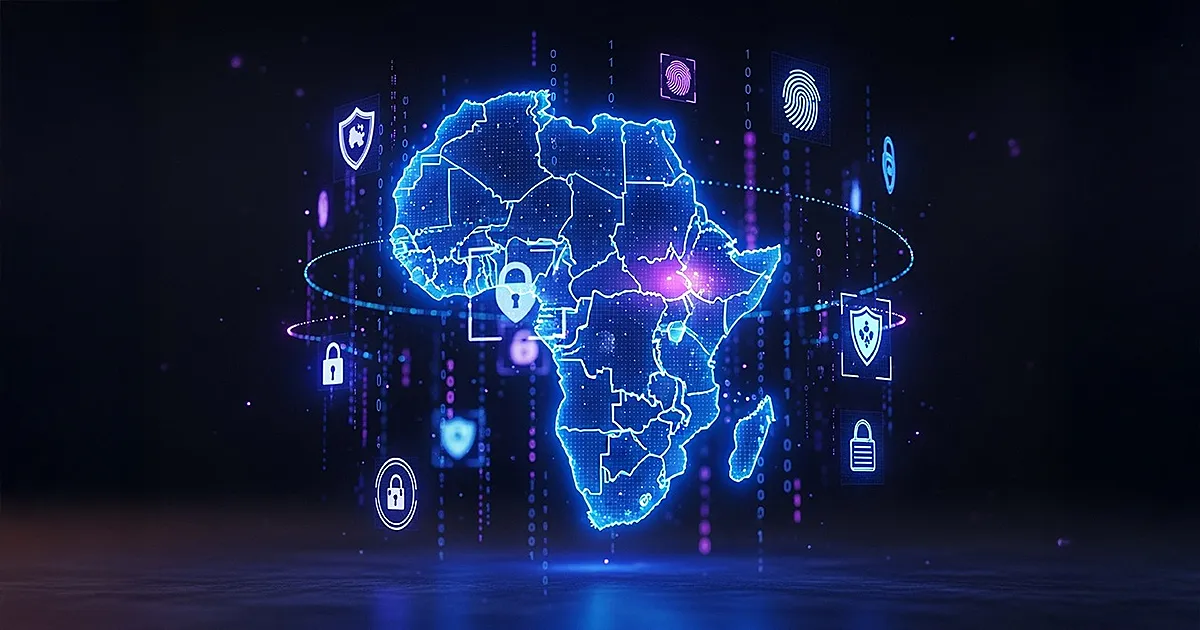
For Africa, this matters because the continent’s digital expansion, from mobile money and e-government to energy systems, health platforms and cross-border trade, increasingly depends on trust in connected infrastructure.
The Forum’s central message is that cybersecurity is no longer a technical department’s burden. It is now part of national resilience, corporate governance, investor confidence and social protection.
The report says the future of cybersecurity is not predetermined; it will be shaped by choices made now on skills, collaboration, technology governance and investment.
AI Has Supercharged Cyber Risk
The most urgent finding is also the clearest: 94% of surveyed respondents expect AI to be the most significant driver of change in cybersecurity in the year ahead
87% identified AI-related vulnerabilities as the fastest-growing cyber risk over 2025. The share of organisations assessing AI tools before deployment has nearly doubled, from 37% in 2025 to 64% in 2026.
That marks a shift from awareness to partial action. However, it also reveals a widening readiness gap. AI is helping defenders detect phishing, analyse abnormal activity and automate security operations.
At the same time, it is helping attackers scale phishing, impersonation, fraud and software exploitation.
In African markets, where mobile-first finance and digital public services are expanding rapidly, that dual-use reality turns cybersecurity into a development issue.
The risk is not abstract. A weak cyber system can delay payments, obstruct logistics, expose health data, disrupt electricity operations or undermine trust in public digital identity programmes.
For a small business in Lagos, Nairobi or Accra, a successful invoice-fraud attack may not be a “cyber event”; it may be the difference between payroll and closure.
Fraud Now Reaches Boardrooms And Households
Cyber-enabled fraud has moved to the top of the executive agenda. In the WEF survey, 73% of respondents said they or someone in their network had been affected by cyber-enabled fraud in the previous 12 months. CEOs ranked cyber-enabled fraud and phishing as their top concern for 2026, while CISOs continued to prioritise ransomware and supply-chain disruption.
CEOs see fraud through the lens of financial loss, customer trust and reputational exposure. CISOs see ransomware and supply chain attacks as operational continuity risks. Both views are correct, but neither is sufficient.
Cyber resilience now requires a shared boardroom language that connects fraud prevention, business continuity, compliance, procurement and citizen protection.
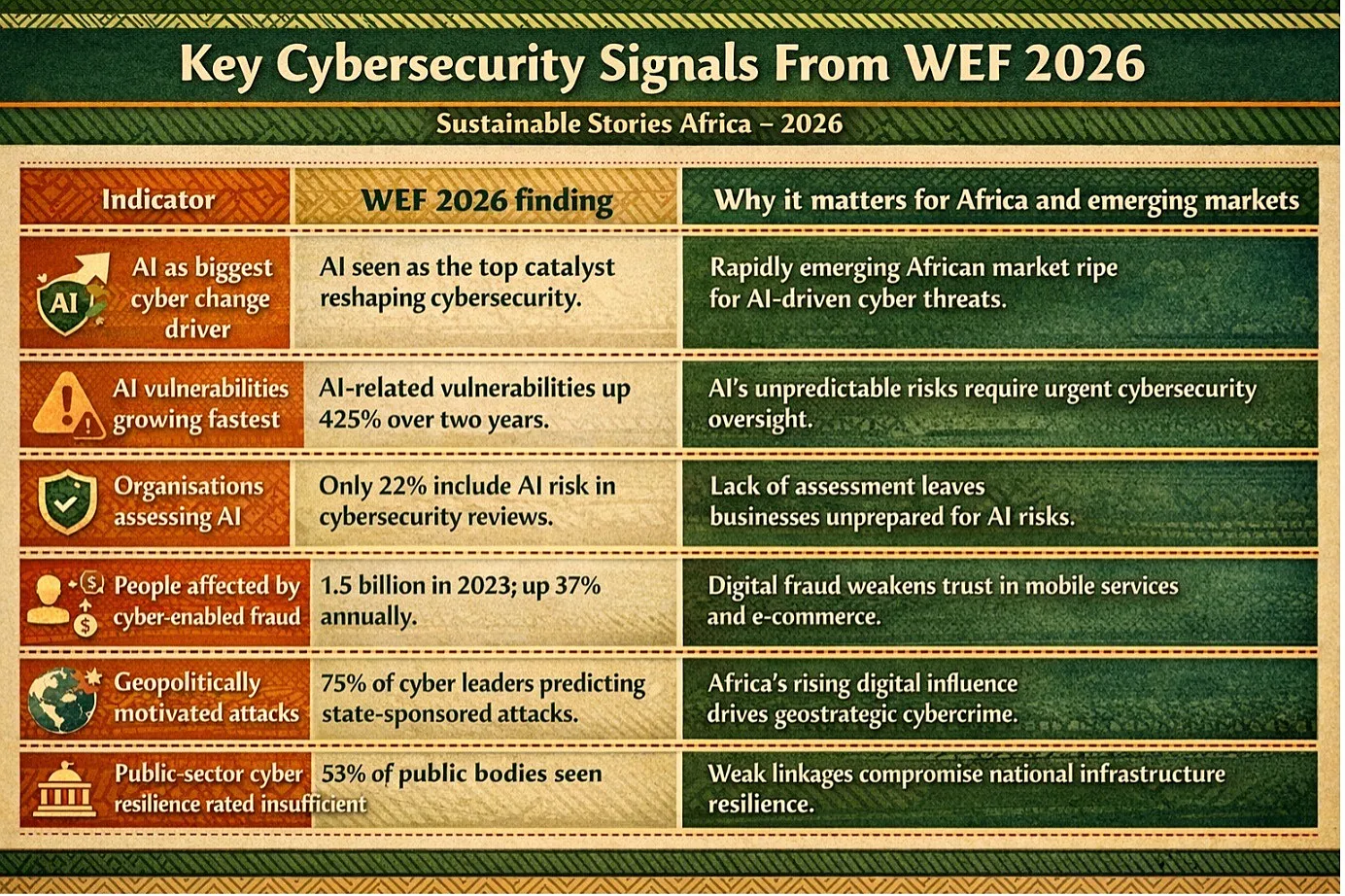
The report also links cybersecurity to geopolitics. 64% of organisations now consider geopolitically motivated cyberattacks in their cyber-risk strategies, including attacks on critical infrastructure or espionage.
The largest organisations have moved fastest: 91% of organisations with more than 100,000 employees have changed cybersecurity strategies due to geopolitical volatility.
For Africa, this has implications beyond corporate IT. Ports, electricity grids, telecoms networks, payment switches, tax systems and digital identity platforms are all part of the national economic infrastructure.
A local vulnerability can now create regional consequences.
Resilience Can Unlock Safer Growth
The positive story is that cyber resilience is becoming measurable, investable and governable.
The WEF report shows that more resilient organisations behave differently. They prioritise threat intelligence, government engagement, supply chain mapping and security-by-design procurement.
Among CEOs of highly resilient organisations, 52% are increasing threat intelligence on nation-state actors, compared with 13% among CEOs of insufficiently resilient organisations.
Similarly, 48% of highly resilient CEOs are increasing engagement with government agencies or information-sharing groups, compared with only 6% of insufficiently resilient peers.
This is the opportunity for African markets: cybersecurity can become a trust layer for digital growth. Banks can reduce fraud losses.
Manufacturers can protect industrial systems. Energy companies can defend the grid and metering infrastructure. Governments can protect citizen data. Investors can price digital risk more accurately. Citizens can use digital services with greater confidence.
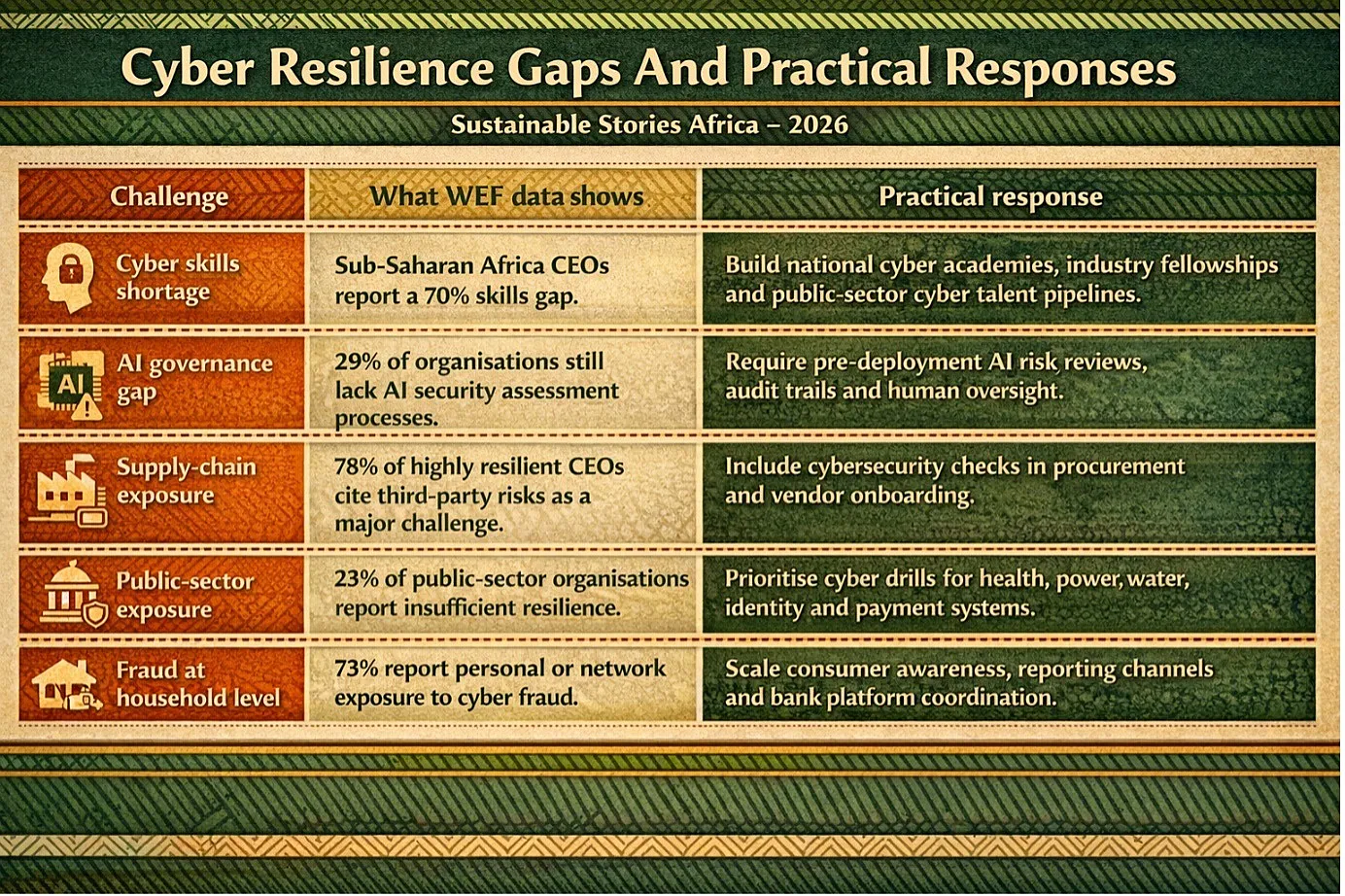
However, the skills gap is the binding constraint. Outside Europe and North America, more than half of CEOs said they lack the skills needed to achieve current cybersecurity goals.
Sub-Saharan Africa recorded the widest CEO-level skills gap, with 70% reporting lack of critical people and skills.
Cybersecurity Must Become Governance Discipline
The next move is institutional.
- Governments should treat cybersecurity as a core pillar of digital transformation, not an afterthought added after platforms go live.
That means cyber standards for digital public infrastructure, critical infrastructure testing, incident reporting systems, procurement rules and cross-border cooperation.
- Regulators should require boards to understand cyber exposure in the same way they assess financial, climate and operational risks.
- Banks, insurers, telecoms operators and energy companies should disclose how they manage cyber resilience across vendors, cloud services, AI tools and customer-facing channels.
- Businesses should also shift from compliance-heavy cyber paperwork to operational readiness.
- The WEF report shows highly resilient CEOs are more likely to involve security teams in procurement, assess supplier maturity, map ecosystem exposure, and simulate incidents with partners.
70% of CEOs from highly resilient organisations involve security in procurement, while 59% assess supplier maturity.
- Citizens need protection, too. Fraud prevention cannot sit only with banks or law enforcement agencies.
It requires real-time scam reporting, platform accountability, consumer education, stronger identity verification and faster dispute resolution.
In markets where mobile money, informal commerce and digital lending are growing, anti-fraud systems are now part of financial inclusion.
The governance lesson is simple: digital transformation without cyber resilience creates fragile growth. Digital transformation with cyber resilience creates trust, continuity and investable systems.
Path Forward – Build Trust Before Scale
Africa’s cyber priority should be resilience before scale: secure AI tools, train cyber talent, test critical infrastructure, protect citizens from fraud and make supplier security part of procurement.
These actions advance ESG by strengthening governance, social trust and institutional accountability.
The WEF report points to a practical agenda: shared intelligence, human-centred AI oversight, public-private coordination and sustained investment.
For African markets, cybersecurity is now a development infrastructure, as essential to digital growth as power, broadband and finance.