South Africans want solar power, but a new study shows many households fear panels could be stolen or damaged.
The concern comes despite high sunshine, rising power costs and years of load-shedding pressure.
For poorer families, the risk is sharper: solar promises basic energy security, but replacement costs can be impossible.
The Sun Is Available, Trust Is Not
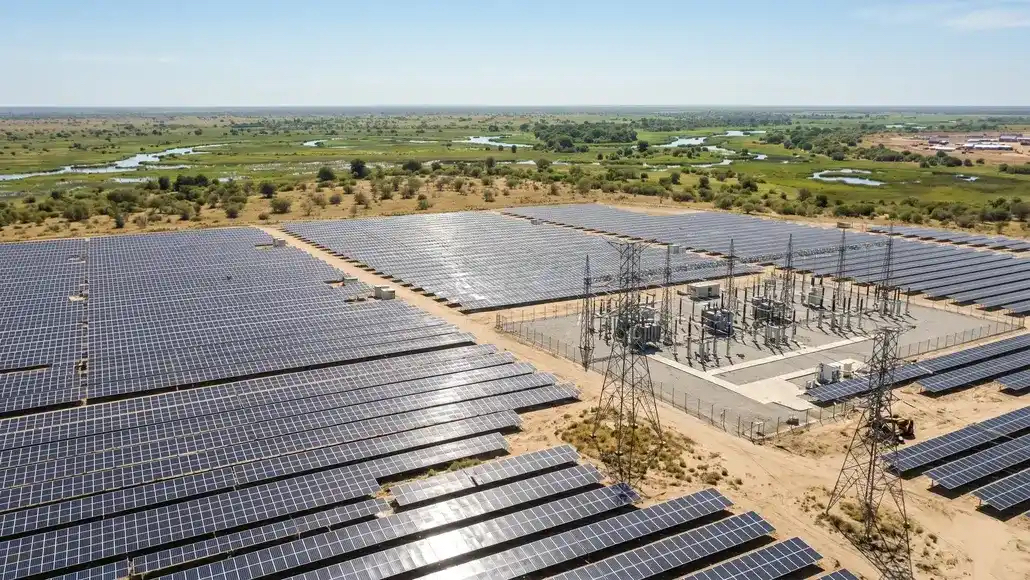
South Africa has the sunshine, and the memory of the demand and power crisis has accelerated household solar adoption.
A new study shows that many households remain hesitant to install solar panels because they fear theft, damage, high upfront costs and long-term maintenance bills.
The study, reported by Down To Earth and based on research by Uzziah Mutumbi, Gladman Thondhlana and Sheunesu Ruwanza, examined households in four Eastern Cape locations: Gqeberha, KuGompo City, Makhanda and Komani.
Researchers interviewed 49 high-income households and 94 low-income households to find out what stops families from adopting rooftop solar in one of South Africa’s poorest provinces.
The findings are striking because South Africa appears, on paper, as an ideal solar market. It has strong solar generation potential, increasing pressure on electricity reliability, and household incentives to reduce dependence on coal-powered electricity, diesel, paraffin and wood. However, solar remains below 10% of the country’s energy mix, while about 74% of electricity still comes from coal.
Interest: Solar Desire Is High, But Risk Feels Higher
South Africans broadly want solar, but adoption remains uneven. The research found that nearly 90% of respondents would choose solar to avoid future power cuts after years of load-shedding disrupted homes, businesses, schools and public services.
However, interest is shaped by income: just over 80% of high-income households had considered switching, compared with 63% of low-income households.
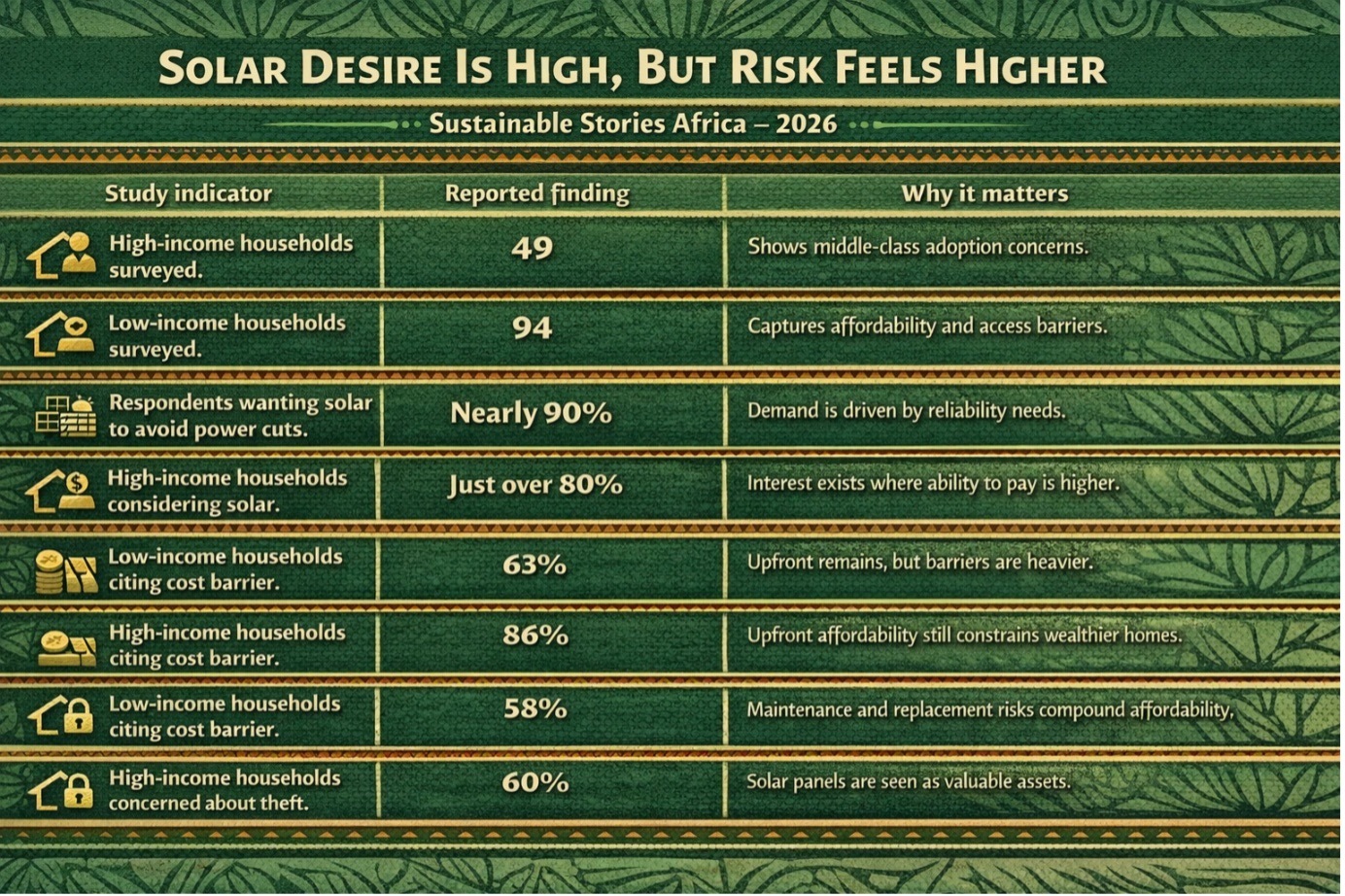
Cost remains the biggest barrier. Among high-income households, 86% cited cost as the main obstacle.
Among low-income households, 58% did, but their concerns were broader, including battery replacement, inverter repairs, technician call-outs and panel damage.
Theft anxiety also cuts across income groups, affecting about 60% of wealthier households and 52% of lower-income households.
At the household level, this is the real story: solar promises cleaner, more reliable power, but if systems are too costly, vulnerable to theft or expensive to maintain, the investment can feel like a gamble.
A Just Solar Transition Needs Security
The findings point to a larger lesson for Africa’s energy transition: technology adoption is not only about price and supply. It is also about trust, safety, maintenance and social design.
For South Africa, that means solar policy must be differentiated.
- High-income households may need better insurance products, anti-theft fasteners, security lighting and clearer grid-feed rules.
- Low-income communities may need communal solar mini-grids, shared maintenance systems, public guarantees, subsidised connections and local security arrangements.
The study’s authors recommend communal mini grids for low-income areas because a shared system can be centrally located and collectively maintained. Mini-grids can also reduce household-level cost burdens by spreading expenses across multiple users.
When done well, this approach can unlock more than electricity. It can create local maintenance jobs, improve community ownership, reduce reliance on paraffin and wood, and make clean energy part of daily resilience rather than a privilege for wealthier households.
Policy Must Address Fear, Not Just Finance
The next phase of South Africa’s solar transition should treat security as infrastructure.
A panel that households believe will be stolen is both a private risk and a public-policy barrier.
Government, municipalities, lenders and developers should design solar programmes that include theft prevention, warranties, insurance, maintenance support and community governance from the start.
Financing should not stop at installation. It should cover the full life cycle of systems: batteries, inverters, repairs, trained technicians and replacement pathways.
This matters across African markets. If renewable-energy programmes ignore theft, vandalism, affordability and maintenance, adoption will remain unequal.
Solar will become a solution for those who can afford security, while poorer households remain locked into unreliable or polluting alternatives.
Path Forward – Make Solar Secure, Affordable, Shared
South Africa’s solar challenge is not a lack of sunlight; it is about trust and confidence.
Policy must combine finance, security, maintenance and community ownership so that households can adopt solar without the fear of loss.
For African markets, the message is clear. A just transition must protect clean-energy assets, lower costs, and build systems that work for ordinary families, not only those who can afford private resilience.
Culled From: https://www.downtoearth.org.in/africa/south-africans-want-solar-power-but-they-worry-panels-will-be-stolen-study