The World Bank Group used its final 2026 Spring Meetings livestream to spotlight a new Target Map linking development targets to measurable outcomes.
The session argued that targets matter only when they translate into jobs, incomes, services and visible opportunity.
For African markets, the shift raises a sharper question: can development finance be judged less by promises and more by lived results?
Targets Move From Promises To Proof
The World Bank Group has placed measurement at the centre of its development agenda, using the closing livestream of its 2026 Spring Meetings series to introduce a public Target Map designed to show how global commitments are translating into results across countries and sectors.
The session, “Spring Meetings 2026: Putting Targets on the Map,” brought together Lisandro Martin, Director of the Outcomes Department at the World Bank Group, and Rémy Rioux, CEO of Agence Française de Développement and President of the Finance in Common Summit, to examine a deceptively simple question: what are development targets for?
The answer, according to the event framing, is tangible impact: “more and better jobs, higher incomes, and expanded economic opportunity.”
Held during the World Bank Group and IMF Spring Meetings in Washington, D.C., from April 13–18, 2026, the session aligned with the meetings’ wider theme of building prosperity through policy, with leaders discussing reforms that support job creation, private investment and economic growth.
Data Becomes A Development Discipline
The World Bank’s new Target Map is more than another development dashboard. It signals a shift from counting projects to testing whether interventions are changing lives.
Instead of celebrating megawatts financed or boreholes built, the focus is on outcomes: whether power expands access, supports firms and jobs, or whether water projects deliver safer services, free up women’s time, raise farm productivity and strengthen local resilience.
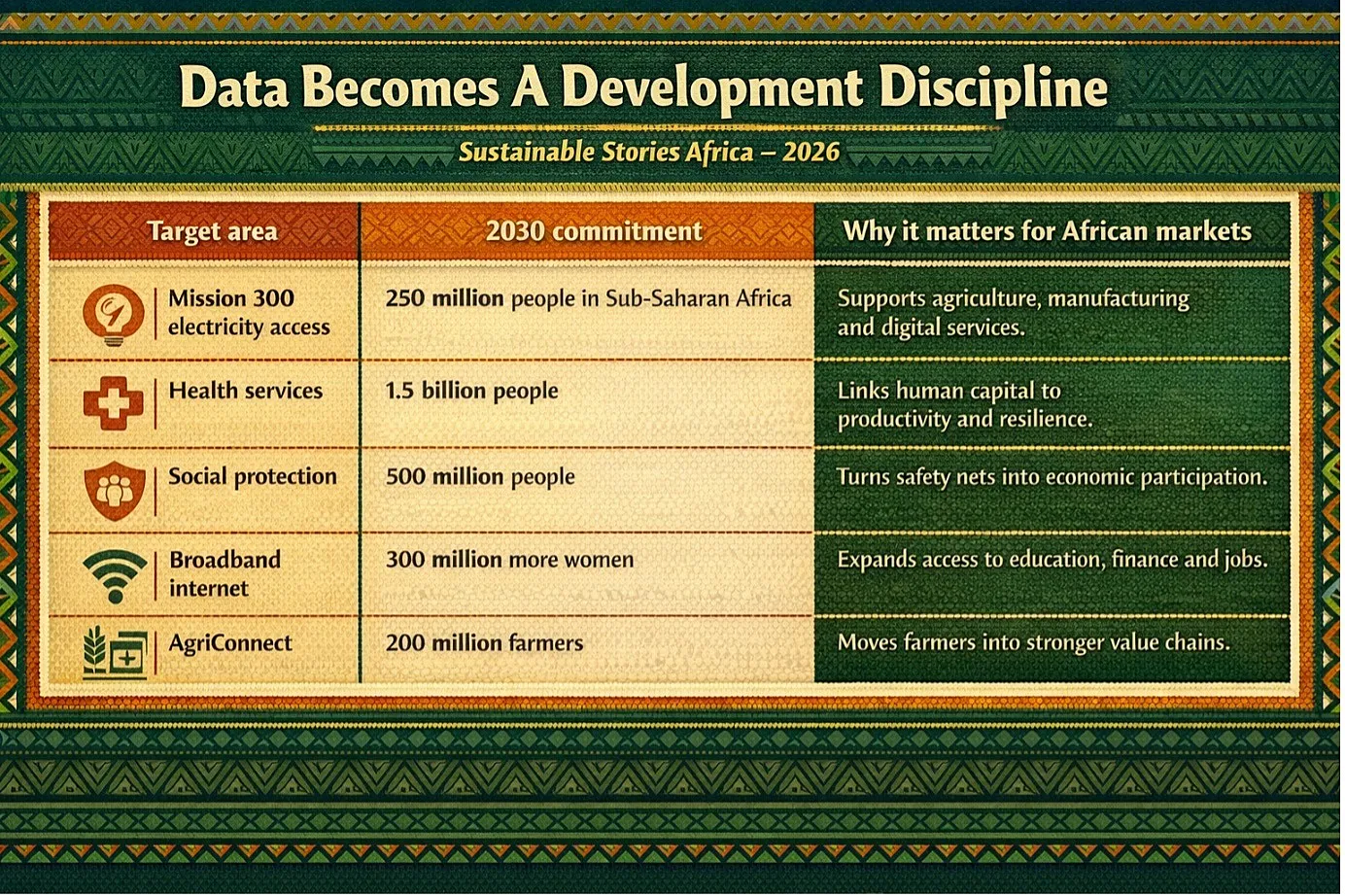
The Target Map sets nine headline ambitions for 2030, including health services for 1.5 billion people, social protection for 500 million poor and vulnerable people, broadband access for 300 million more women, electricity access for 250 million people in Sub-Saharan Africa, and value-chain support for 200 million farmers.
Demographics sharpen the stakes: 1.2 billion young people in developing countries will reach working age within 10 to 15 years, turning jobs into a test of both economic strategy and political stability.
Better Measurement Can Unlock Trust
- For African economies, this shift in measurement is practical, not cosmetic. Investors want credible data, citizens want visible delivery, and governments need finance they can defend in budgets, elections and development plans.
- Development institutions need proof that capital is producing outcomes rather than reports.
The latest Scorecard shows why that matters. Internet access is improving, but unevenly:
- Sub-Saharan Africa remains the least connected region, with fewer than 4 in 10 people online
- Digital government readiness in Western and Central Africa still trails far behind North America.
- Health and water indicators tell a similar story, with progress in coverage but slower gains in poorer countries and persistent regional gaps in sanitation and basic services.
That is why the Target Map matters beyond communications. It can help expose the distance between national ambition and delivery capacity, while giving African finance ministries, regulators and development partners a clearer view of where projects are generating momentum and where targets remain stranded on paper.
Accountability Must Follow The Numbers
The next test is whether targets shape decisions before money is spent, not after reports are written.
- For African governments, that means embedding measurable outcomes into national planning, procurement, public-private partnerships and ESG reporting.
Energy access targets should be tied to productive use of power.
Broadband targets should track women’s access to digital work and finance.
Agricultural targets should measure farmer incomes, access to inputs and market participation, rather than hectares covered.
- For financiers, the lesson is equally direct: capital must follow credible pathways to jobs and resilience.
A project that cannot show how it improves livelihoods, expands opportunity or reduces vulnerability will face harder questions in a world where development finance is under pressure to prove delivery.
- For citizens, transparent tools can reduce the distance between global meetings and local experience.
- A young entrepreneur in Kaduna, a rice farmer in Kano, or a health worker in rural Malawi may never read a Scorecard.
However, they will feel the consequences if targets begin to shape where roads, electricity, water, finance and digital services actually go.
Path Forward – Measurement Must Now Drive Delivery
Targets should become operating tools, not ceremonial commitments. African policymakers can use the Target Map logic to connect finance, implementation and public accountability.
The priority now is sharper local data, stronger institutions and outcome-linked investment.
If measurement becomes direction, development promises can move closer to the communities they are meant to serve.