The World Bank Group used its 2026 Spring Meetings to spotlight how digital health and AI can expand access to quality, affordable care.
The session focused on reaching 1.5 billion people by 2030 through digitally connected primary healthcare systems.
For African markets, the message was clear: technology can help close care gaps, but only if regulation, investment and infrastructure move faster.
Healthcare’s Access Gap Is Becoming Digital
The World Bank Group has made digital health and artificial intelligence central to its push to deliver quality, affordable healthcare services to 1.5 billion people by 2030, using its 2026 Spring Meetings session, “Delivering Digital Health Care to 1.5 Billion People,” to argue that technology can help countries reach patients faster, improve service delivery and strengthen overstretched primary healthcare systems.
The discussion, hosted during the World Bank Group and IMF Spring Meetings in Washington, D.C., focused on how digital tools, remote care and data-driven systems can reach underserved populations, especially in countries where doctors are scarce, patients travel long distances for basic care, and health systems remain fragmented.
The session featured Mirja Sjöblom, Health Private Sector Program Lead at the World Bank Group, and Moustapha Cisse, Founder and CEO of Senegal-based Kera Health Platforms.
Digital Tools Meet Human Shortages
For Africa, the urgency is not abstract. Cisse described Senegal as a country of about 18 million people with only 7 to 10 medical doctors per 100,000 people, compared with more than 200 in many OECD countries and over 300 in countries such as France, Switzerland and Italy.
He warned that the continent’s population, currently slightly below 1.5 billion, could reach 2.5 billion in about two decades, widening the gap between healthcare demand and the number of available professionals.
His argument was blunt: Africa cannot train enough doctors quickly enough to keep pace with demographic growth. AI, he said, can help by making health workers more productive and enabling more proactive, preventive and personalised care.
In practical terms, that could mean AI-assisted triage, digital patient records, remote consultation, automated follow-up reminders and data systems that help health workers identify risk before illness becomes an emergency.
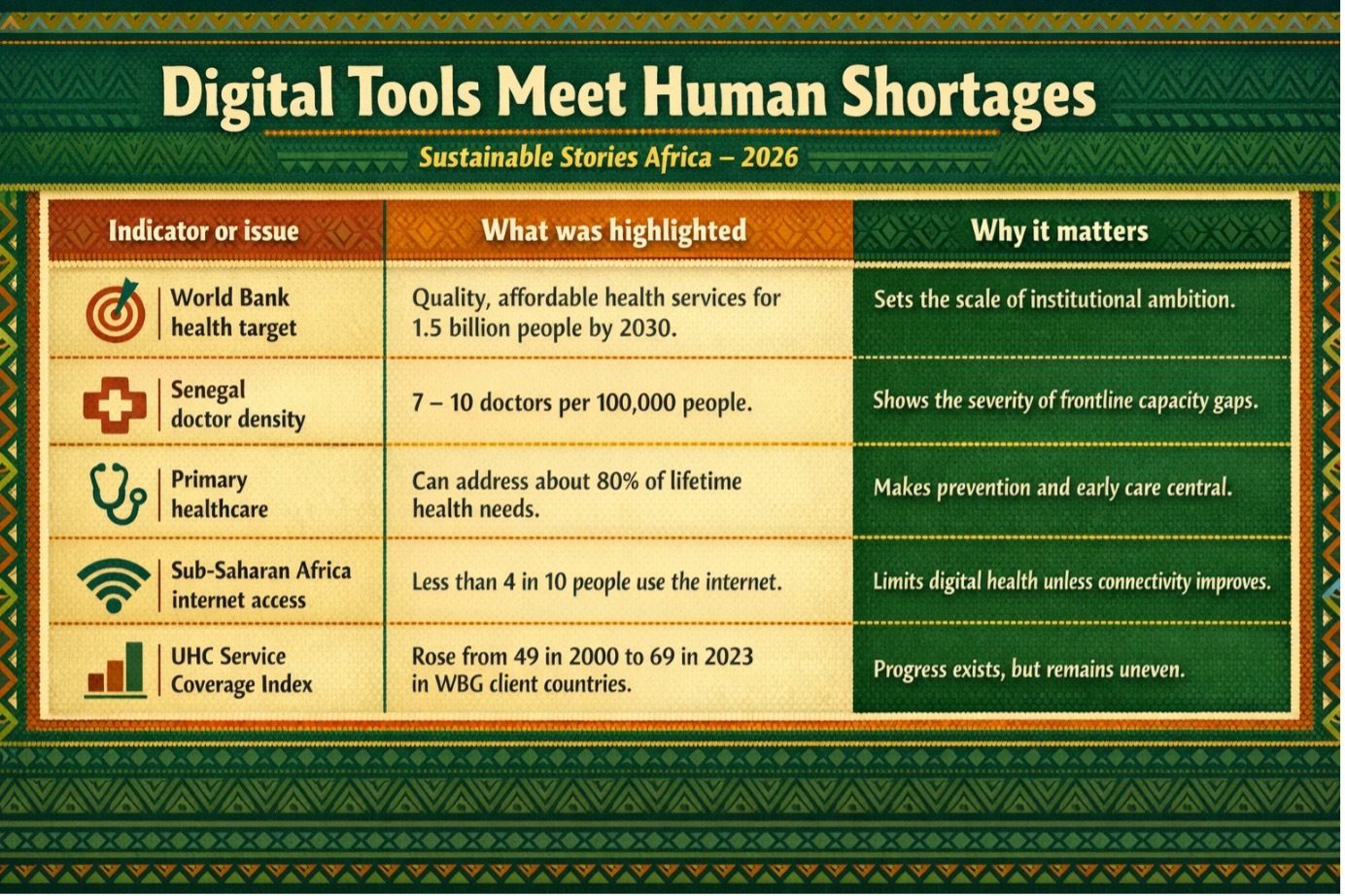
The World Bank’s 2026 Scorecard update reinforces that digital and health access are moving in the right direction, but unevenly.
It notes that Sub-Saharan Africa remains the least connected region, with fewer than 4 in 10 people using the internet, and many low-income countries still score below 50 on the Universal Health Coverage Service Coverage Index.
Prevention Can Become A Growth Strategy
The promise of digital health is not only better treatment. It is a new model of care in which prevention becomes cheaper, faster and more widely available.
- For a mother in rural Senegal, a digital health system could mean fewer missed vaccinations, quicker referral decisions and better continuity of care.
- For a nurse in northern Nigeria, AI-enabled decision support could reduce administrative pressure and help prioritise urgent cases.
- For governments, better health data can improve planning, procurement and insurance design.
- For investors, scalable digital platforms can turn fragmented health markets into investable infrastructure.
Cisse argued that African innovators should not merely copy tools designed for wealthier countries. Africa has a young and fast-growing population, he said, and the continent has an opportunity to build health systems around prevention, personalisation and proactive care.
Solutions built for underserved communities, he suggested, may later become useful globally.
Regulation Must Enable Local Innovation
The session also carried a warning: digital health will not scale on technology alone.
Cisse said governments must avoid copying regulatory frameworks from other regions without considering local realities.
He cited data protection rules as one area where well-intentioned compliance burdens could unintentionally block African startups from competing, especially when health technology companies already face high costs for security, certification and trust-building.
For policymakers, the priority is to build regulations that protect patients without suffocating innovators.
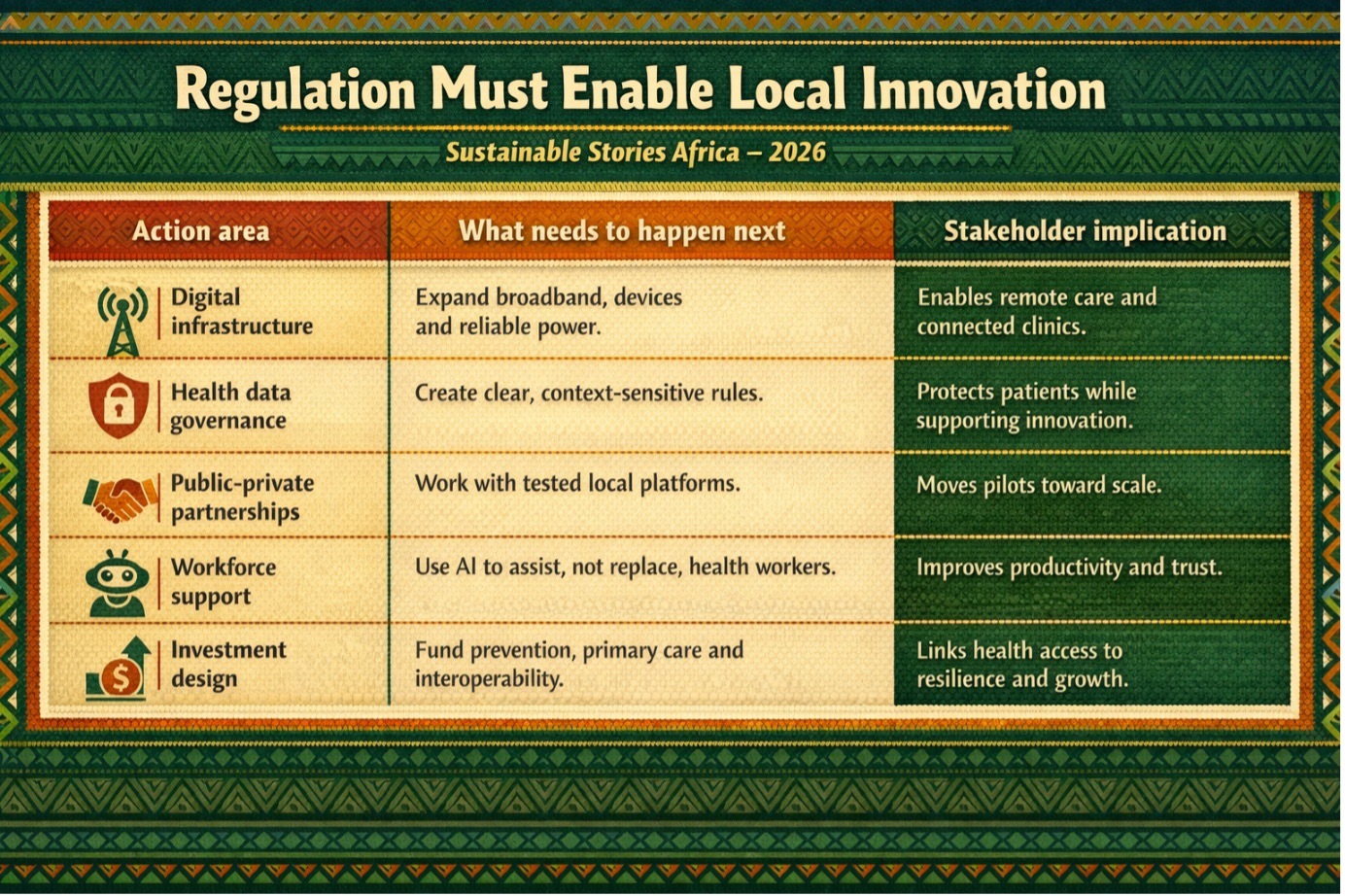
That means clearer rules on health data, responsible AI, cybersecurity, procurement, interoperability and public-private collaboration.
- For financiers, it means backing platforms that solve real access problems, not just fashionable AI experiments.
Path Forward: Build Care Around Local Needs
Digital health must be designed around people, not platforms. African governments should prioritise primary healthcare, patient protection, local-language tools and interoperable data systems.
The strongest opportunity is not replacing doctors with AI. It is giving scarce health workers better tools, giving patients earlier care, and giving markets proof that inclusive health systems can drive productivity, resilience and sustainable growth.