Climate & Capital Media has spotlighted how universities are already training students for sustainability jobs through campus-based carbon accounting and reporting projects.
The shift matters because climate disclosure rules are increasing demand for professionals who understand Scope 3 emissions, supplier data and decarbonisation.
For African markets, the lesson is urgent: universities can become practical engines for ESG skills, green jobs and institutional accountability.
Climate Skills Are Becoming Employability Skills
Universities are shifting from climate theory to practical workforce training by turning their own campuses, suppliers and emissions into real-world laboratories for sustainability skills.
A 1 April 2026 Climate & Capital Media article by Mike Wallace argues that students can help close the climate talent gap by treating their university like a Fortune 500 company: collecting energy, procurement and materiality data, conducting carbon and supply-chain emissions accounting, and converting this into disclosures and professional portfolios.
The timing is critical. New climate disclosure laws and market pressure are forcing thousands of companies, including more than 4,000 in California alone, to measure, report and reduce greenhouse gas emissions, particularly complex Scope 3 supply-chain and investment emissions.
The Campus Is Now A Climate Classroom
The Climate & Capital article traces this model to an early experiment where students produced a Global Reporting Initiative-style sustainability report for their own university.
They interviewed facilities teams, gathered energy and procurement data, ran a materiality assessment and drafted disclosures aligned with GRI guidelines. Within a year, some had moved into corporate reporting roles using the same skills.
That is the key turn: sustainability education doubling as employability infrastructure, with Wallace citing collaborations with leading US universities to build courses on carbon accounting and decarbonisation.
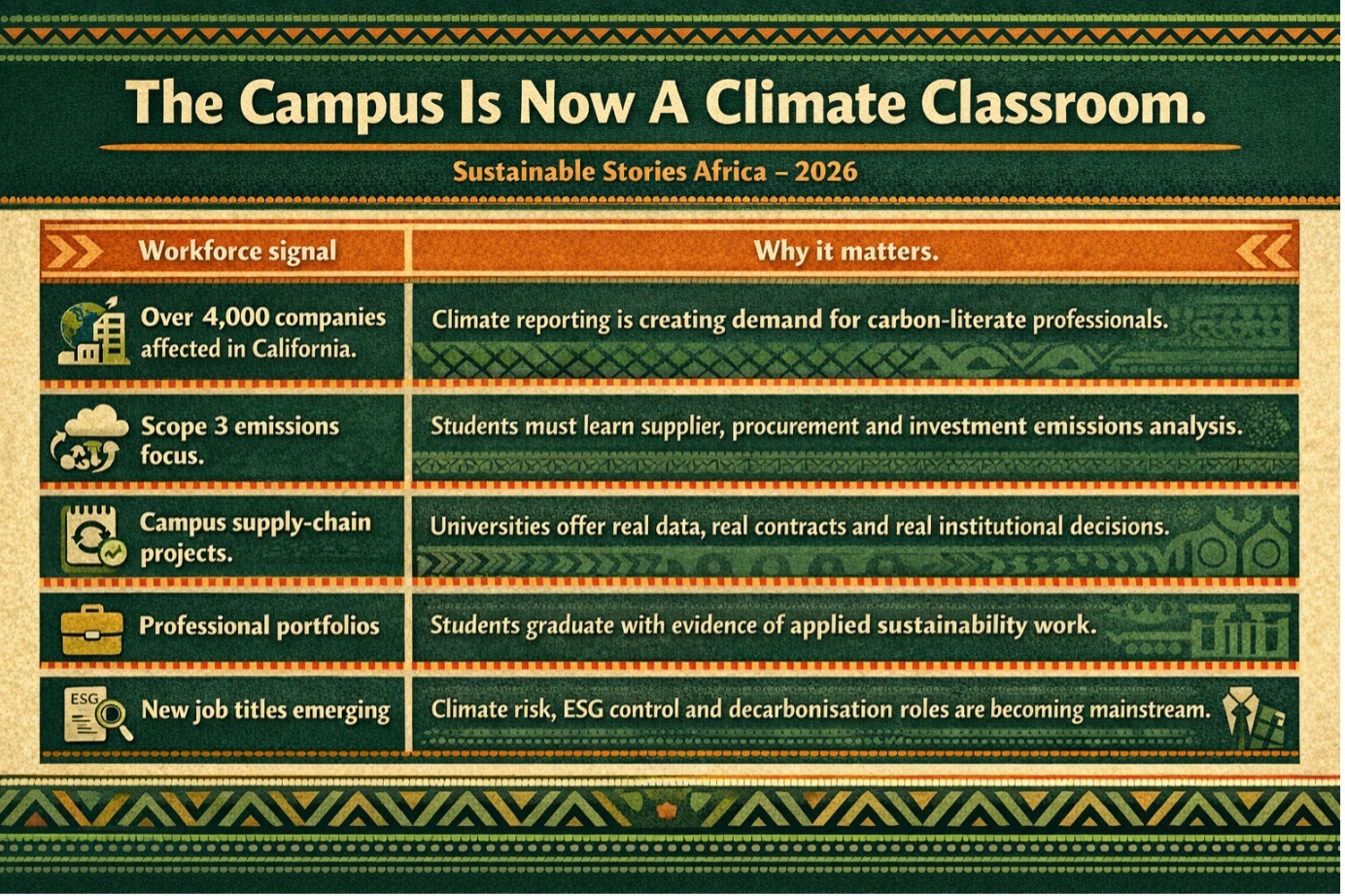
The labour market is signalling a clear shift. The World Economic Forum’s Future of Jobs Report 2025 identifies climate-change mitigation and adaptation as major forces reshaping business, driving demand for renewable energy engineers, environmental engineers and related roles.
It also ranks environmental stewardship among the world’s top 10 fastest-growing skills for the first time.
For African universities, the implication is immediate. A student in Lagos, Nairobi, Accra or Johannesburg can use their own campus bills, contracts and emissions data as live ESG reporting case studies.
Universities Can Build Green Job Pipelines
The opportunity is bigger than curriculum reform. Universities can become anchor institutions for the green economy by linking classrooms to facilities departments, procurement teams, local businesses, regulators and investors.
Students trained in real-world carbon accounting can support banks reviewing transition finance, manufacturers preparing ESG disclosures, agribusinesses measuring supply-chain emissions, cities developing climate plans and startups building clean-energy solutions.
In African markets, where ESG reporting capacity is still uneven, this type of training can reduce reliance on expensive external consultants and build domestic professional capacity.
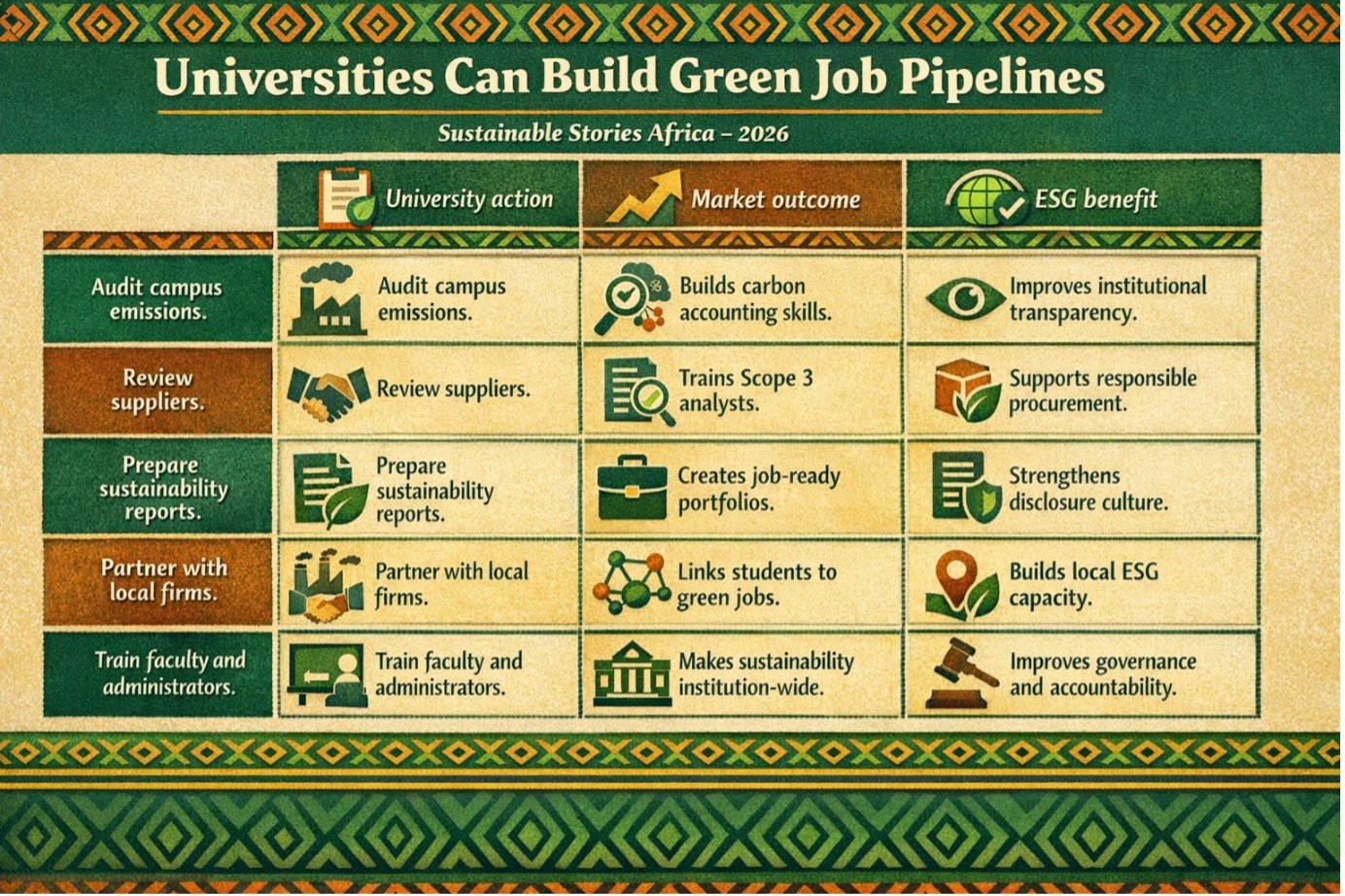
Climate & Capital identifies emerging roles such as Chief Decarbonization Officer, ESG or Sustainability Controller, Supplier Emissions Analyst, Climate Risk Manager and Net-Zero Program Lead. These are not distant job titles.
They are the functions companies will need as climate disclosure shifts from voluntary storytelling to auditable business data.
Action: Make Sustainability Training Practical
African universities should treat sustainability skills as core economic infrastructure. That means embedding carbon accounting, climate risk, circular economy, nature reporting, responsible procurement and ESG assurance into business, engineering, agriculture, law, finance and public policy programmes.
- Governments and regulators can support this by connecting universities to national sustainability reporting roadmaps.
- Companies can open anonymised data, sponsor applied projects and recruit from campus sustainability labs.
- Development partners and philanthropies can fund faculty training, digital tools and regional centres for ESG competence.
The key is to avoid making sustainability education too abstract. Students need to work with real utility bills, supplier contracts, emissions factors, reporting frameworks and decarbonisation options.
That is how classroom learning becomes market-ready capability.
Path Forward – Teach Skills, Build Climate Careers
Universities should become practical sustainability workforce hubs, not only centres of climate awareness.
Campus data, procurement systems and reporting needs can train students for real ESG jobs.
For African markets, the priority is clear: integrate applied carbon accounting, Scope 3 analysis and sustainability reporting into higher education.
That strengthens green employment, corporate disclosure, climate resilience and long-term competitiveness.
Culled From: How universities are already building the next-gen sustainability workforce - Climate and Capital Media