Amazon Australia has signed nine new renewable-energy deals, adding 430MW of clean-energy capacity across New South Wales and Victoria.
The agreements lift Amazon’s contracted renewable capacity in Australia to 990MW across 20 projects, almost reaching the 1GW mark.
The move shows how AI, cloud computing and data-centre growth are reshaping corporate energy procurement, with lessons for African markets.
Amazon’s Energy Bet Follows AI Demand
Amazon Australia has signed nine new renewable-energy power purchase agreements that will add 430MW of clean-energy capacity to the grid, lifting its total renewable portfolio in the country to 990MW once fully operational.
The agreements, announced in April 2026, cover projects in New South Wales and Victoria and represent Amazon’s largest renewable-energy investment in Australia to date.
The company says the projects will support its cloud computing, data-centre and AI operations while contributing to its global goal of reaching net-zero carbon emissions by 2040.
The timing matters. Across the world, artificial intelligence is increasing the demand for electricity-intensive data infrastructure.
For companies, governments and grid operators, the big question is no longer whether digital growth will need more power. It is whether that power can be made cleaner, more reliable and more socially acceptable.
Batteries Move To Centre Stage
The new portfolio includes one wind farm, three utility-scale solar-plus-storage projects, four distributed solar-battery projects and a new battery installation at the existing Mokoan solar farm.
Eight of the nine agreements include battery energy storage, marking Amazon’s first solar-battery hybrid projects in Australia and its first such projects outside the United States.
That detail is important. Renewable energy is no longer only about adding solar panels and wind turbines. It is increasingly about storing power, smoothing supply and supporting grids under pressure from electrification, climate shocks and digital demand.
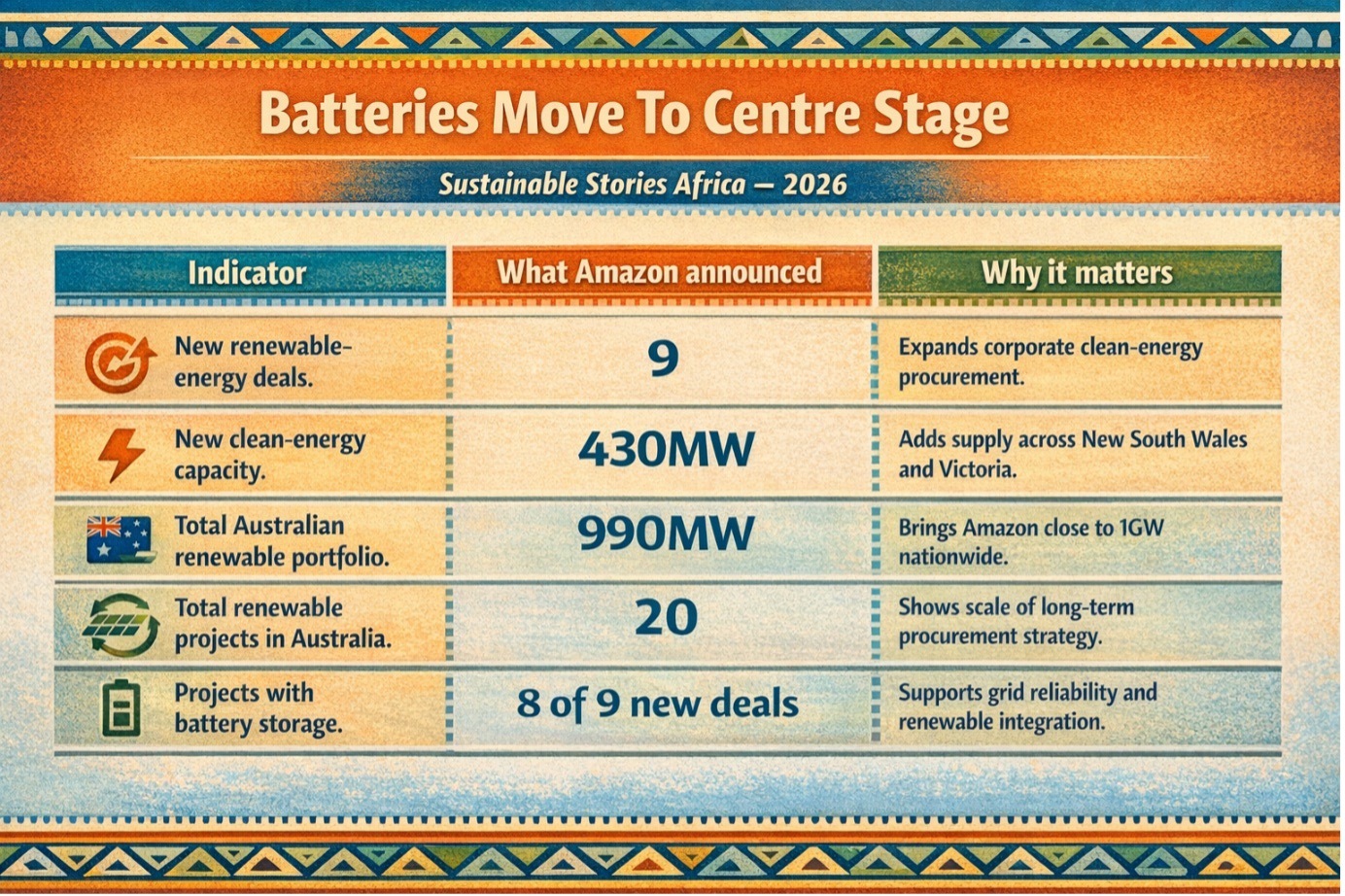
Amazon says its 20 renewable-energy projects in Australia will provide almost 1GW of capacity once operational, enough to power the equivalent of more than half a million Australian households annually.
Since 2020, the company says it has invested an estimated AU$2.8 billion in renewable-energy projects across the country.
For an Australian household, the story may sound like a distant corporate energy contract.
However, the local impact is practical: renewable projects can affect land use, regional employment, grid stability and community infrastructure. Amazon highlighted projects such as the Muswellbrook solar farm on rehabilitated former coal-mining land, showing how clean-energy investment can also intersect with brownfield restoration.
Clean Power Can Support Digital Growth
The stronger promise is that digital expansion and clean-energy growth do not have to move in opposite directions. If designed well, corporate renewable-energy procurement can bring new generation into the grid, support storage deployment, strengthen regional economies and reduce emissions linked to data infrastructure.
For African markets, the lesson is immediate. Data centres are expanding across Lagos, Nairobi, Johannesburg, Cairo and other digital hubs.
As cloud services, fintech, streaming, AI tools and enterprise platforms grow, electricity demand will rise.
Without clean and reliable power, digital infrastructure risks deepening diesel dependence, raising operating costs and increasing emissions.
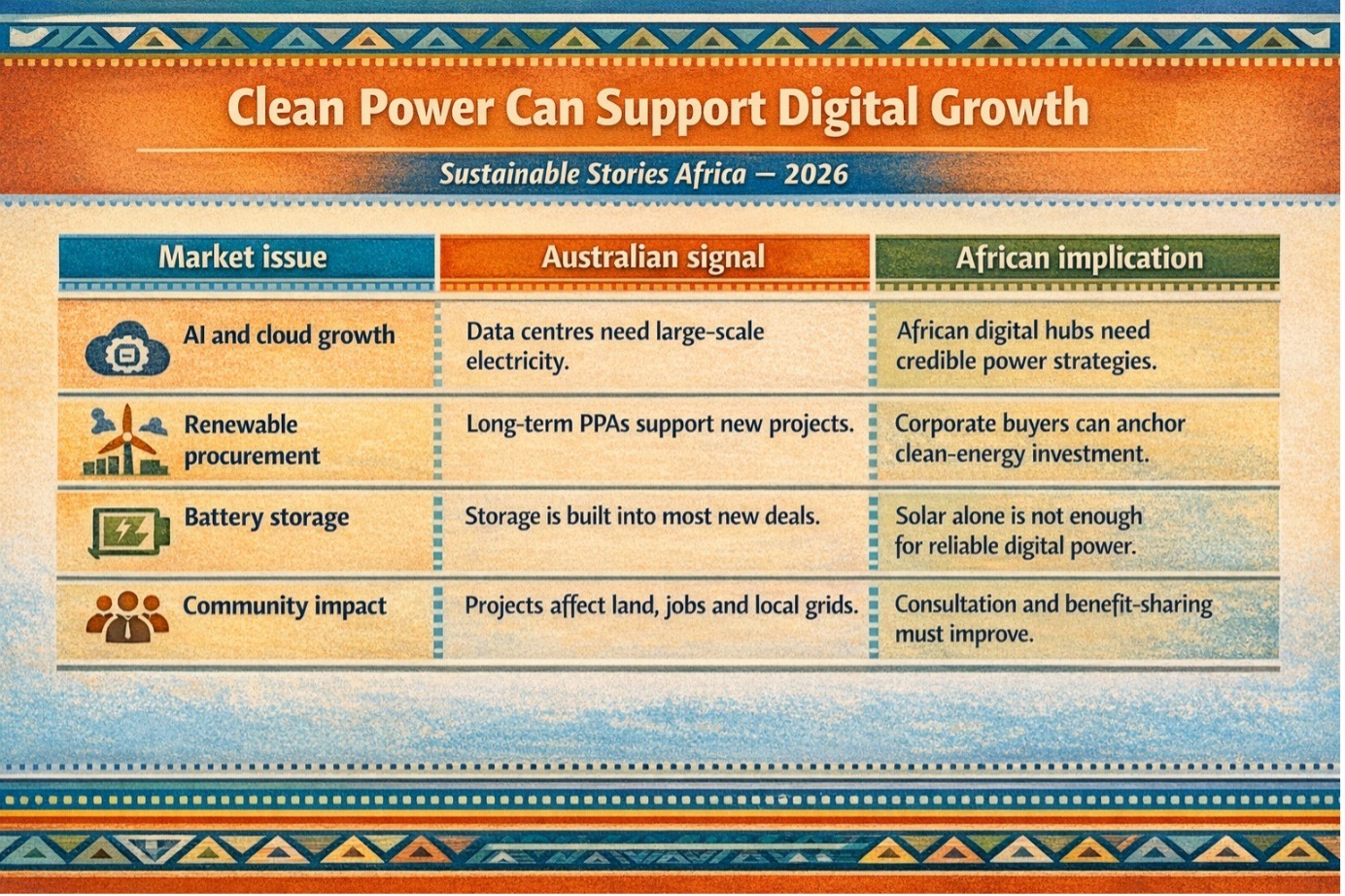
The opportunity is significant. Large corporate buyers can help unlock renewable-energy investment in African markets by signing bankable power purchase agreements, supporting mini-grids and utility-scale projects, and investing in storage.
However, the risks are also real. If data-centre growth outpaces grid planning, it can strain electricity systems already struggling with access, affordability and reliability.
Africa Needs Cleaner Digital Infrastructure
Amazon’s Australian deals show that the next phase of corporate sustainability will be judged not only by targets, but by infrastructure choices.
Digital companies will need to show how their power demand is being met, whether projects add new clean capacity, and how local communities benefit.
African policymakers should prepare for this shift. Energy regulators, investment agencies and digital-economy ministries need clearer frameworks for corporate renewable procurement, wheeling arrangements, embedded generation, battery storage and grid connection.
Without those rules, clean-energy deals will move slowly, and data-centre growth may lean back on fossil-fuel backup.
For companies, the call is also direct: plan power before scaling compute. AI and cloud investments should come with renewable-energy procurement, storage strategy, water-use transparency and community engagement.
In a continent where electricity access remains uneven, digital growth must not become another pressure point on fragile grids.
Path Forward – Build Clean Power Around Digital Growth
Amazon Australia’s 430MW renewable expansion shows how corporate energy buying is being reshaped by AI, data centres and climate targets.
African markets should treat this as a planning signal. The priority is to link digital infrastructure with renewable procurement, battery storage and fair community benefits, so the next wave of cloud and AI growth strengthens power systems instead of stretching them.
Culled From: Amazon Australia Signs 9 Renewable Energy Deals Adding 430 MW as Total Capacity Reaches 990 MW Nationwide