Radisson Hotel Group is scaling its Verified Net Zero hotel model beyond the pilot stage.
That matters because ESG is shifting from pledges and policies to audited delivery.
For African markets, the lesson is simple: visible execution can build trust, demand and investment.
From pledge to provable performance
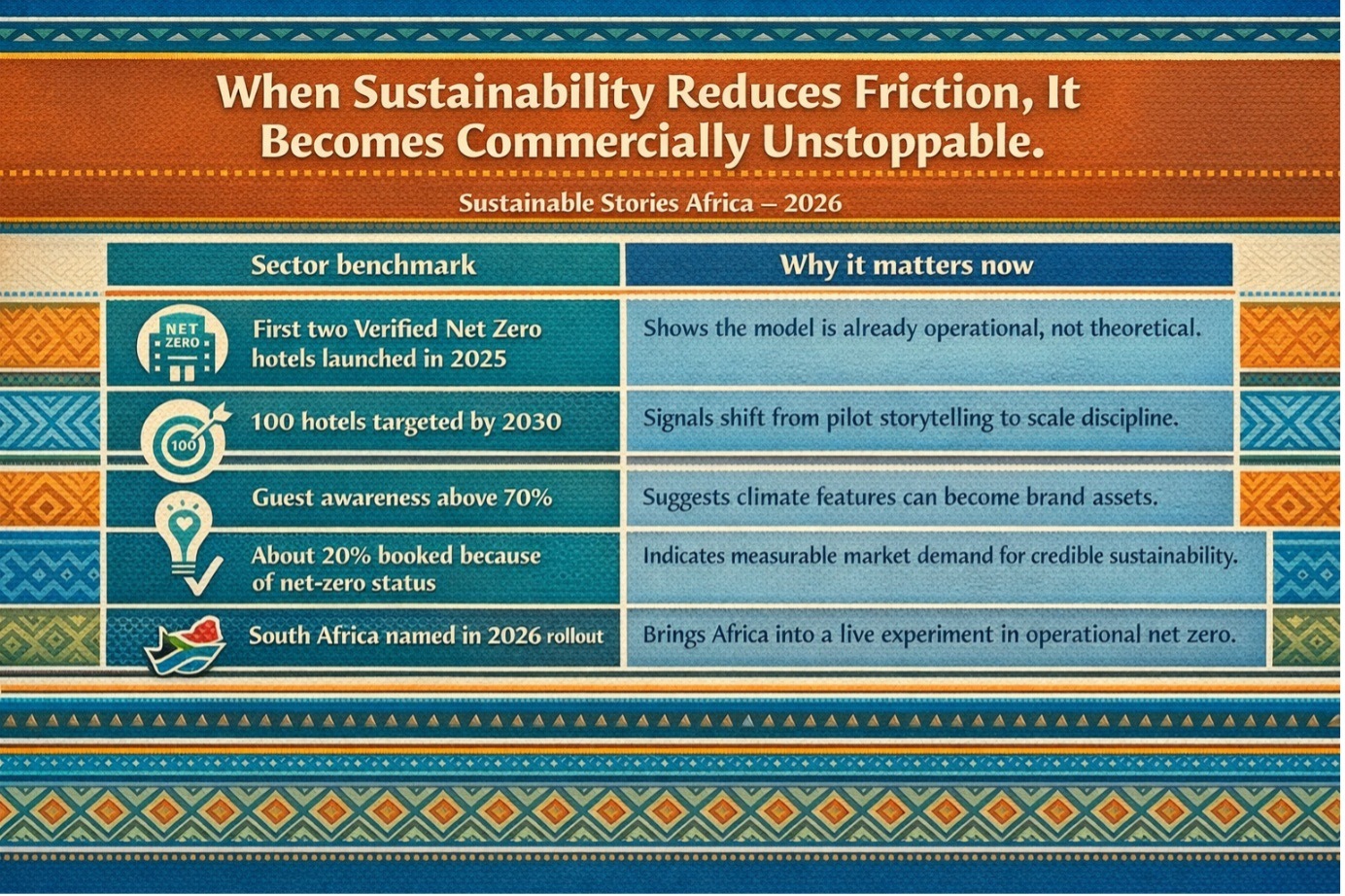
Radisson Hotel Group has moved its Verified Net Zero Hotels programme from pilot phase to full rollout, targeting 100 such properties by 2030 following the launch of its first two operational sites in Manchester and Oslo.
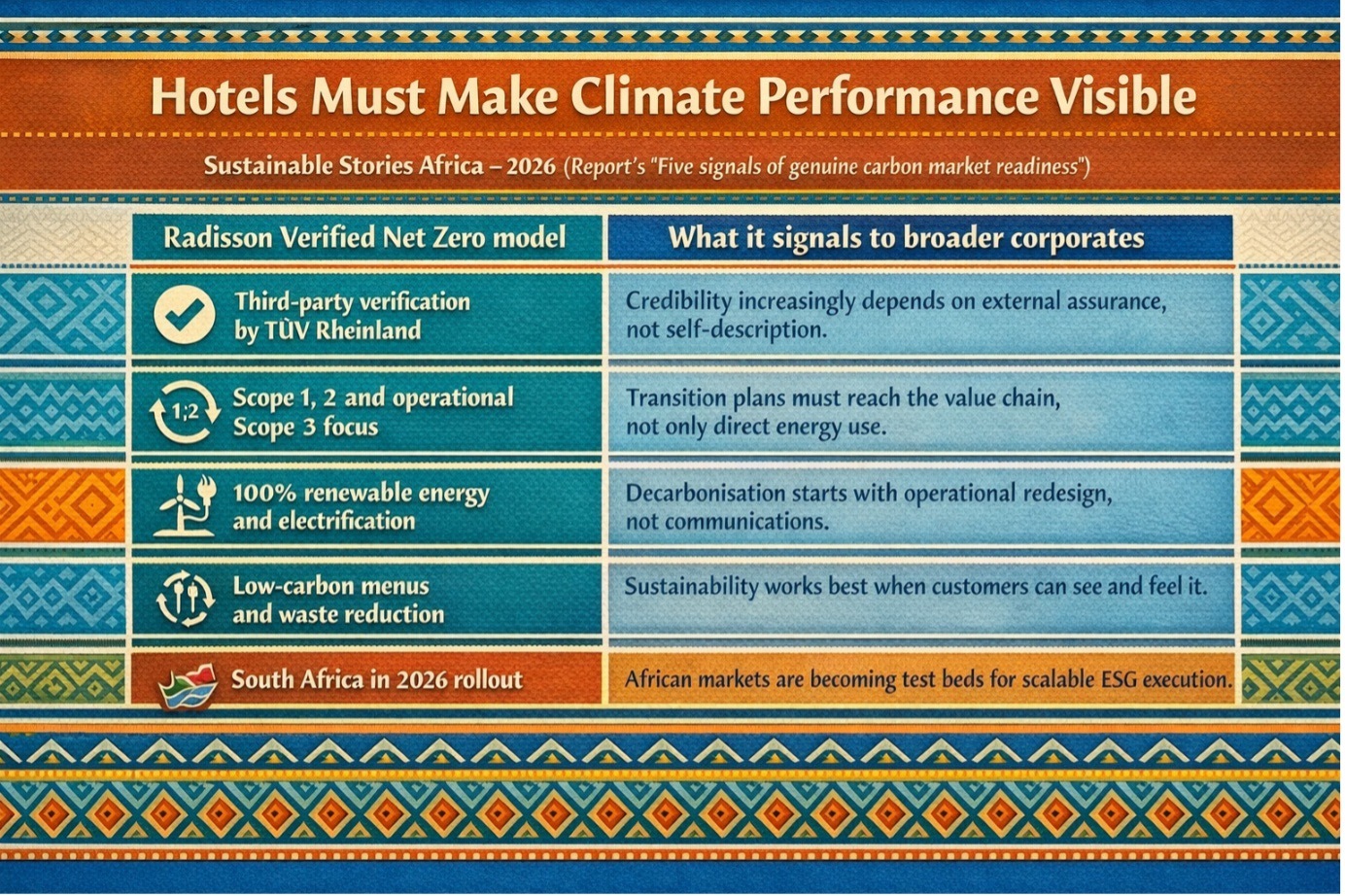
The company says the model is independently verified, aligned with the Net Zero Methodology for Hotels and designed to eliminate Scope 1 and 2 emissions while materially cutting operational Scope 3 emissions.
Its 2026 roadmap now includes South Africa, which is set to host the programme’s first African property.
That makes this more than a hospitality milestone. It is a live test of a broader corporate sustainability question: can companies turn net-zero language into something customers can see, investors can check, and operators can actually run? Radisson is betting that they can.
Year-to-date data from its first two sites show guest awareness above 70%, while around one in five guests said the hotels’ net-zero status influenced their booking decision.
Hotels Must Make Climate Performance Visible, Not Just Reportable
Hotels face an unusually direct test of decarbonisation. They consume energy intensively, manage sprawling supply chains, and deliver climate performance as a frontline guest experience every day.
The Net Zero Methodology for Hotels sets the stakes clearly: the sector must reduce greenhouse-gas emissions per room by 66% by 2030 and by 90% by 2050.
Radisson's Verified Net Zero model offers operational answers, such as electrification, renewable heating and cooling networks, and 100% renewable energy sourcing to address Scope 1 and 2 emissions, with Scope 3 coverage spanning food and beverage, laundry, waste, amenities, and business travel.
Guests encounter the model through low-carbon menus, minimal-waste practices, and digital prompts that make decarbonisation visible rather than confined to sustainability reports.
For African and Global South markets, where sustainability debates often stall between imported reporting frameworks and local commercial realities, Radisson's South Africa rollout signals something important: the next phase of ESG competition may be won not by disclosure sophistication.
However, who can make climate performance practical in existing assets? Most buildings that need to be net-zero by 2050 are already standing.
When Sustainability Reduces Friction, It Becomes Commercially Unstoppable
Radisson's model delivers a deeper strategic lesson: the most effective sustainability strategies reduce friction rather than add complexity.
By embedding climate action into procurement, design, service delivery, and pricing logic, the model makes the lower-carbon choice straightforward for guests, owners, and meeting planners, no goodwill required, no abstraction tolerated.
The commercial signal is equally important. Radisson reports that its first two Verified Net Zero sites demonstrate that environmental and commercial performance can move together, not in opposition.
That evidence matters at a moment when many businesses are quietly retreating from broad ESG branding toward narrower claims designed to survive scrutiny.
Hospitality may be ahead of other sectors precisely because it has less room to hide. The lights, heating, food, waste, and water are not background operations; they are the product itself.
When the product is the proof, sustainability cannot remain a reporting exercise. It must become an operational reality, and Radisson's rollout suggests that transition is already underway.
Action: What the rest of corporate sustainability should copy
Other sectors do not need to become hotels to learn from this. But they do need to borrow the discipline.
- First, make claims auditable.
- Second, focus on operational hotspots, not just portfolio averages.
- Third, make sustainability legible to customers and workers. Fourth, treat supply chains as central, not peripheral.
- Prove that transition plans can work in existing assets, because that is where the real economy still lives.
For African businesses, regulators and financiers, the message is especially relevant. The next generation of ESG leadership may belong less to firms with the thickest disclosure packs than to those that can show verified reductions, visible product changes and locally workable models for decarbonising everyday operations.
In that sense, Radisson’s net-zero hotels are not only about hospitality. They are about whether corporate sustainability can finally become concrete.
Path Forward – Verify, localise, and scale delivery
African markets will need climate strategies that are measurable, financeable and grounded in existing assets.
That means stronger assurance, cleaner energy access, better supplier engagement and practical standards that translate global rules into local execution.
Radisson’s rollout will not settle the wider ESG debate. However, it does point to a tougher benchmark: sustainability claims must now work in the building, in the supply chain and at the point of sale.
Culled From: Radisson's Net Zero Hotels: What Hospitality Can Teach the Rest of Corporate Sustainability