
Nigeria still imports at least 70% of its medicines, despite having over 120 local manufacturers.
That dependence matters now because domestic production remains concentrated in lower-value drugs, while policy support has stayed weak and uneven.
The result is a system where firms often import and manufacture simultaneously, leaving patients, investors and industrial planners trapped in a fragile market.
Nigeria’s medicine import burden shows why industrial policy still matters
Nigeria’s pharmaceutical market presents a difficult contradiction: Africa’s most populous country has a sizeable base of domestic drug makers; however, it still relies on imports for at least 70% of the medicines it consumes.
The deeper problem, according to fresh reporting and underlying academic research, is not simply a shortage of factories or finance.
It is a political economy that still makes importing medicines more attractive than building the capacity to manufacture more complex ones locally.
That matters far beyond the health sector. In a country of more than 230 million people, medical security is not only a public health concern; it is also a test of industrial resilience, foreign-exchange stability and national economic strategy.
The latest report argues that Nigeria’s dependence persists even though the country has at least 120 active pharmaceutical manufacturers, because many local firms remain concentrated on simpler, lower-end products. Higher-value and more technologically demanding medicines continue to be imported from abroad.
A large market, a weak production base
The most striking insight is that Nigeria’s pharmaceutical vulnerability is no longer well explained by the usual argument of “limited local capability” alone.
The reporting points instead to a system of weak policy incentives, mixed commercial interests and institutional fragility that has prevented local manufacturing from moving up the value chain.
A 2005 restriction on imports of 17 lower-end medicines was the first major policy designed to support domestic producers, but it was never meaningfully expanded. That left manufacturers with little reason to invest in the technological upgrading needed to produce more sophisticated medicines at scale.
Why the market keeps rewarding imports
One of the clearest explanations in the reporting is that many Nigerian pharmaceutical firms do not sit neatly on one side of the market.
A large number of them manufacture locally and import finished medicines, sometimes even importing products that are already made in Nigeria.
This dual role reduces the urgency for reform because importing offers a lower-risk, commercially attractive revenue stream.
Two examples make the distortion plain. Tablet-form ciprofloxacin is imported by at least 93 registered pharmaceutical companies, even though 21 domestic producers already make it locally.
Artemether-lumefantrine, a widely used antimalarial, is produced by fewer than 30 local companies; however, more than 200 firms import it.
In other words, the market is not merely failing to support local production; it is actively structured in ways that dilute the rewards of expanding it.
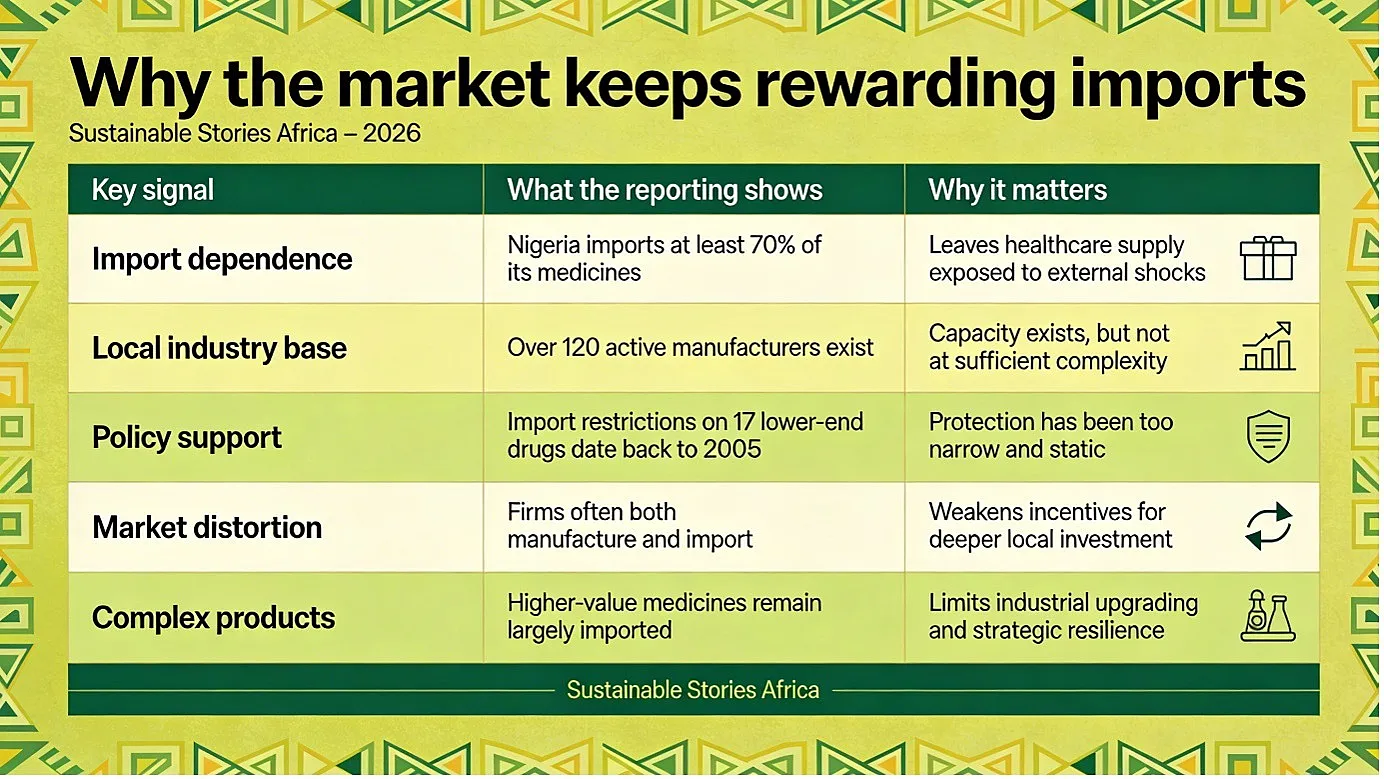
The article also notes that local manufacturers face broader structural pressures: high imports of finished drugs, weak protection, low manufacturing capability, and the difficulty of long, costly learning curves in more advanced pharmaceutical production.
In fragile governance settings, firms often lean on political networks to protect their business models or resist reforms that threaten import-led income.
What a stronger local industry could unlock
The upside of change is substantial. A stronger domestic pharmaceutical base would not only improve medicine security; it could also reduce exposure to currency volatility, create skilled industrial jobs, deepen supply-chain capabilities and support broader health-system resilience.
For a country like Nigeria, that is a strategic industrial opportunity, not a niche sectoral debate.
However, the warning is just as important. If current incentives remain unchanged, local firms may continue producing simpler medicines while relying on imports for complex and higher-margin products.
That would preserve a fragile status quo: factories without enough technological depth, industrial policy without enough enforcement power, and healthcare access still tied to external suppliers.
Redesign incentives, not just ambitions
The strongest takeaway from the reporting is that Nigeria does not simply need more rhetoric about local production. It needs policies that change the reward structure.
That means making it commercially worthwhile for firms to invest in more complex manufacturing, while reducing the ease with which importing continues to outcompete domestic upgrading.
For policymakers, that points to a more disciplined package of industrial support: smarter tariff design, targeted protection where local capability can grow, financing linked to technological upgrading, and procurement frameworks that create credible demand for locally produced medicines.
For investors and development institutions, it suggests that capital alone will not solve the problem unless it is tied to institutional reforms that rebalance incentives.
In the end, Nigeria’s medicine story is really about state capacity and market design. When a country with scale, demand and a domestic manufacturing base still imports most of its drugs, the message is clear: industrial ambition without aligned incentives rarely delivers structural change.
Path Forward – Build Incentives That Reward Local Value
Nigeria’s next step is not merely to fund more factories, but to build a policy regime that rewards technological upgrading, deeper local production and more credible coordination across industry and government.
That is where pharmaceutical resilience begins.
Done well, such reforms would support public health, industrial competitiveness and economic sustainability at once, making medicine security part of a wider African manufacturing story.
Culled From: https://www.downtoearth.org.in/africa/nigeria-imports-70-of-its-medicines-why-local-manufacturing-doesnt-meet-demand