
Central banks have begun using AI to process climate data more quickly and more consistently.
That matters because climate shocks are becoming more immediate, while supervisors still face fragmented disclosures and uneven risk reporting.
For African markets, better tools could improve resilience, credit pricing and policy readiness before shocks become systemic.
Climate risk is getting faster, and central banks are racing to keep up
Climate risk used to sit at the edge of monetary and supervisory debates, treated as a long-horizon problem best left to ministries, development banks and corporate sustainability teams.
That is no longer the case. Central banks and supervisors are now moving climate risk closer to the core of financial stability work, and artificial intelligence is becoming one of the tools helping them do it.
Climate risk analysis depends on a large amount of messy, inconsistent, and often text-heavy data:
- Emissions disclosures
- Transition plans
- Sector exposures
- Green bond frameworks
- Physical hazard information.
The Bank of International Settlements (BIS) says central banks are increasingly exploring and using generative AI across
- Economic analysis
- Supervision
- Statistics
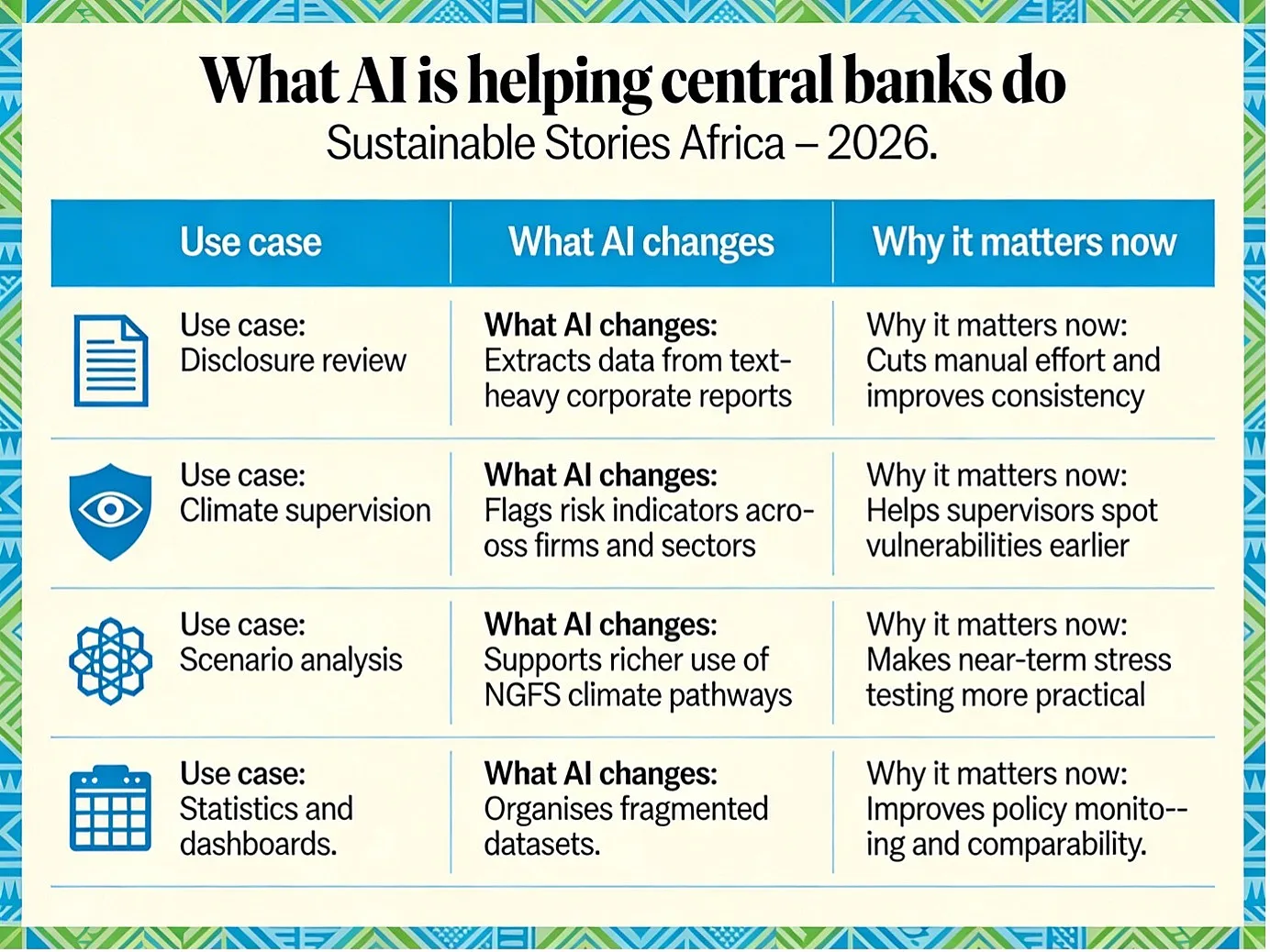
Its Project Gaia has been built specifically to help analysts search climate-related disclosures and extract indicators such as total emissions, green bond issuance and voluntary net-zero commitments more efficiently.
The real breakthrough is not prediction, but usable intelligence
AI is not replacing prudential judgment. It is helping central banks turn unstructured information into usable risk intelligence.
Project Gaia, coordinated by the BIS Innovation Hub with Eurosystem partners, highlights that combining semantic search with large language models can improve the comparability of climate-related information across jurisdictions, despite differences in naming conventions and disclosure frameworks.
That matters for supervisors trying to understand where climate vulnerabilities reside in the banking system.
At the same time, the climate-risk toolkit itself is getting more practical. The NGFS launched its first short-term climate scenarios in May 2025, giving central banks and supervisors a public framework focused on a three- to five-year horizon.
The network says these scenarios are designed to capture near-term shocks to the economy and financial system, including policy shifts, extreme weather and cross-border spillovers.
That makes them more relevant for financial stability work and monetary policy than distant 2050 pathways alone.
The European Central Bank’s (ECB’s) January 2026 update shows how far this integration has already gone in major jurisdictions.
It said climate and nature considerations are now more deeply embedded across its monetary policy framework, scenario analysis, banking supervision and statistical indicators, with banks better able to assess climate and nature risks after sustained supervisory follow-up.
For African and broader Global South markets, the story is especially relevant. South Africa’s Prudential Authority now explicitly treats climate risk and financial technology as two “mega trends” shaping supervision through 2030.
Its strategy says the authority will refine climate-related metrics and indicators while also developing regulatory and supervisory approaches to artificial intelligence.
In other words, the same institutions that must watch financial stability are beginning to connect the climate challenge with the data and technology challenge.
A smarter system could price climate risk earlier and better
If this works, the payoff is significant. Better climate-risk analysis can help supervisors identify weak governance sooner, prompt banks to improve transition planning, and reduce the odds that extreme weather or abrupt policy shifts are treated as surprises when they hit balance sheets.
BIS's work on AI for policy purposes says projects like Gaia and Symbiosis are aimed at exactly that gap: extracting and organising difficult climate information so regulators can assess exposures faster and more effectively.
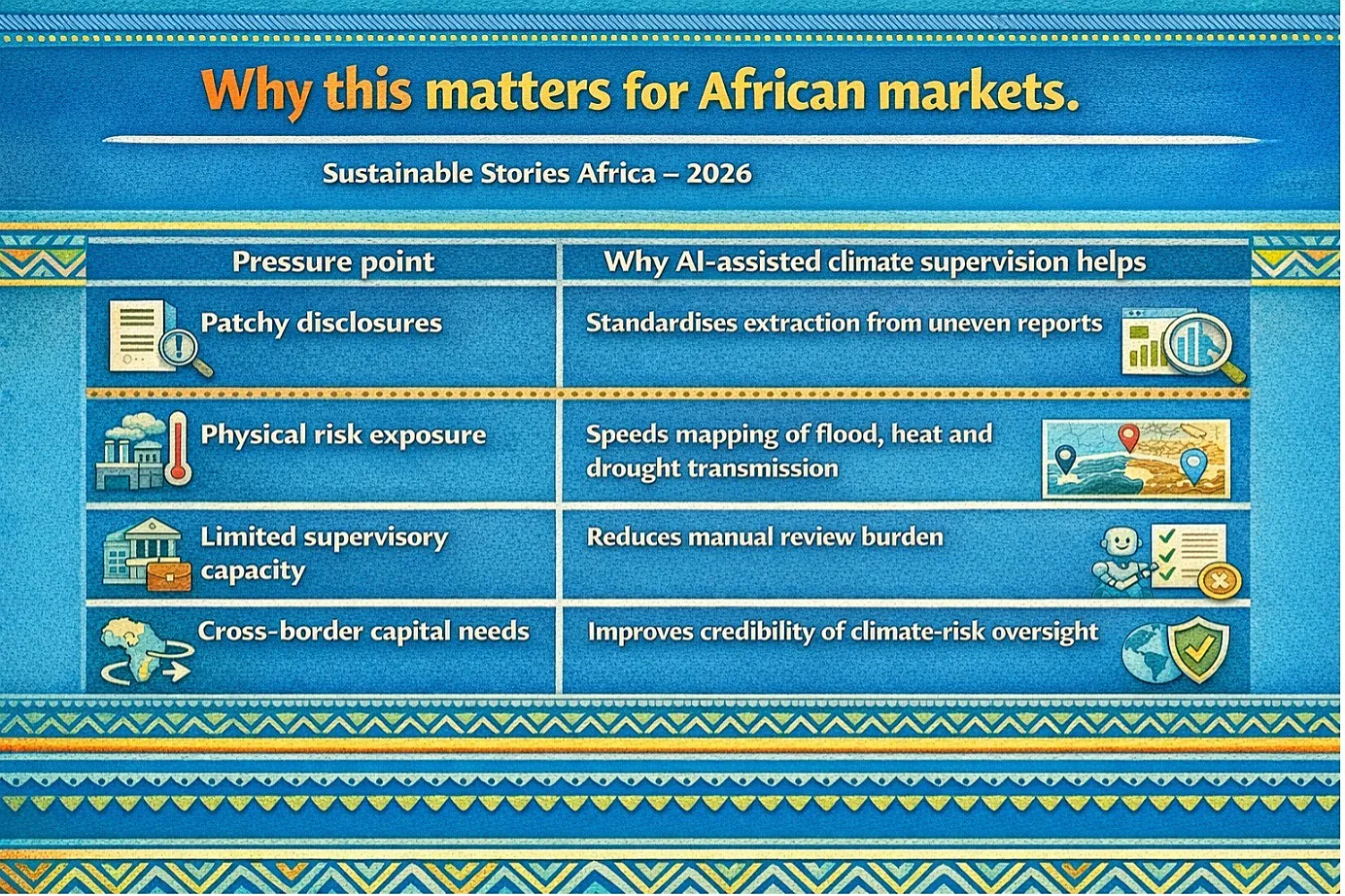
That could be especially valuable in Africa, where drought, floods, heat and infrastructure vulnerabilities can quickly translate into food Prices, insurance losses, credit quality and sovereign stress.
The NGFS short-term scenarios explicitly include compound weather events, financial spillovers and disruptions affecting Africa in some scenario paths.
For policymakers in African markets, faster climate intelligence is not a futuristic luxury. It is an increasingly practical part of risk management.
Better tools still need better governance
The next chapter of green central banking will depend on discipline as much as technology. The BIS warns that AI use in central banking still raises serious questions around governance, data quality, accuracy, explainability, privacy and ethics.
That means supervisors need clear controls, skilled staff and reliable source data, not just new models.
The policy direction is already tightening. The Bank of England’s SS5/25 says firms need stronger governance, risk management, climate scenario analysis, data and disclosures to manage climate-related risks effectively.
Brazil’s central bank has also made studying the risks and impacts of AI use by financial institutions part of its 2025–2026 regulatory priorities.
The signal is unmistakable: AI may help manage climate risk, but regulators want that innovation governed, audited and embedded, not improvised.
Path Forward – Sharper Data, Stronger Rules, Earlier Action
Central banks are moving from climate awareness to climate capability. The priority now is to combine AI tools, short-term scenario analysis and stronger supervisory standards so climate risks are identified before they destabilise financial systems.
For African markets, the opportunity is clear: build climate data capacity, strengthen supervisory metrics and use AI carefully to close information gaps.
Done well, green central banking could become a resilience strategy, rather than just a reporting exercise.
Culled From: How central banks are using AI to manage climate risk - Green Central Banking