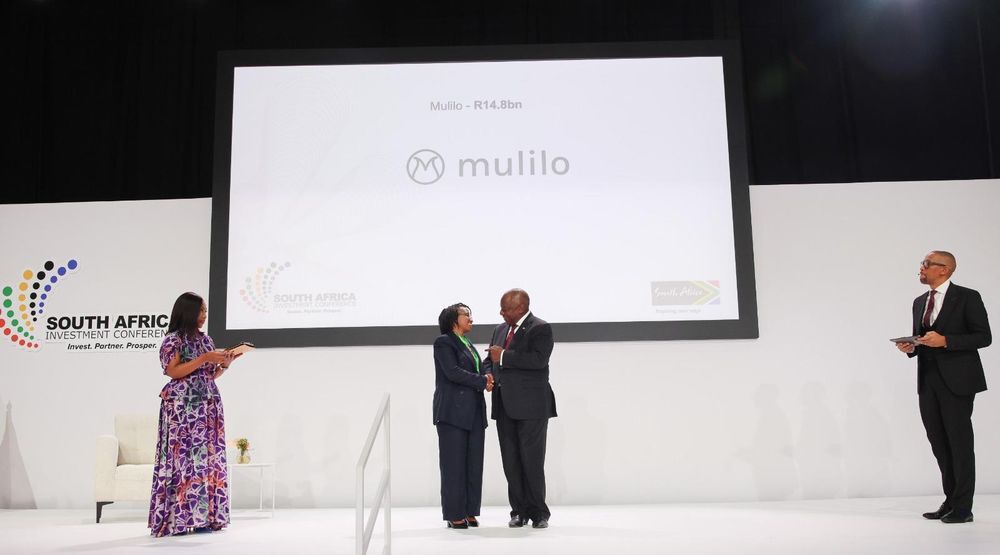
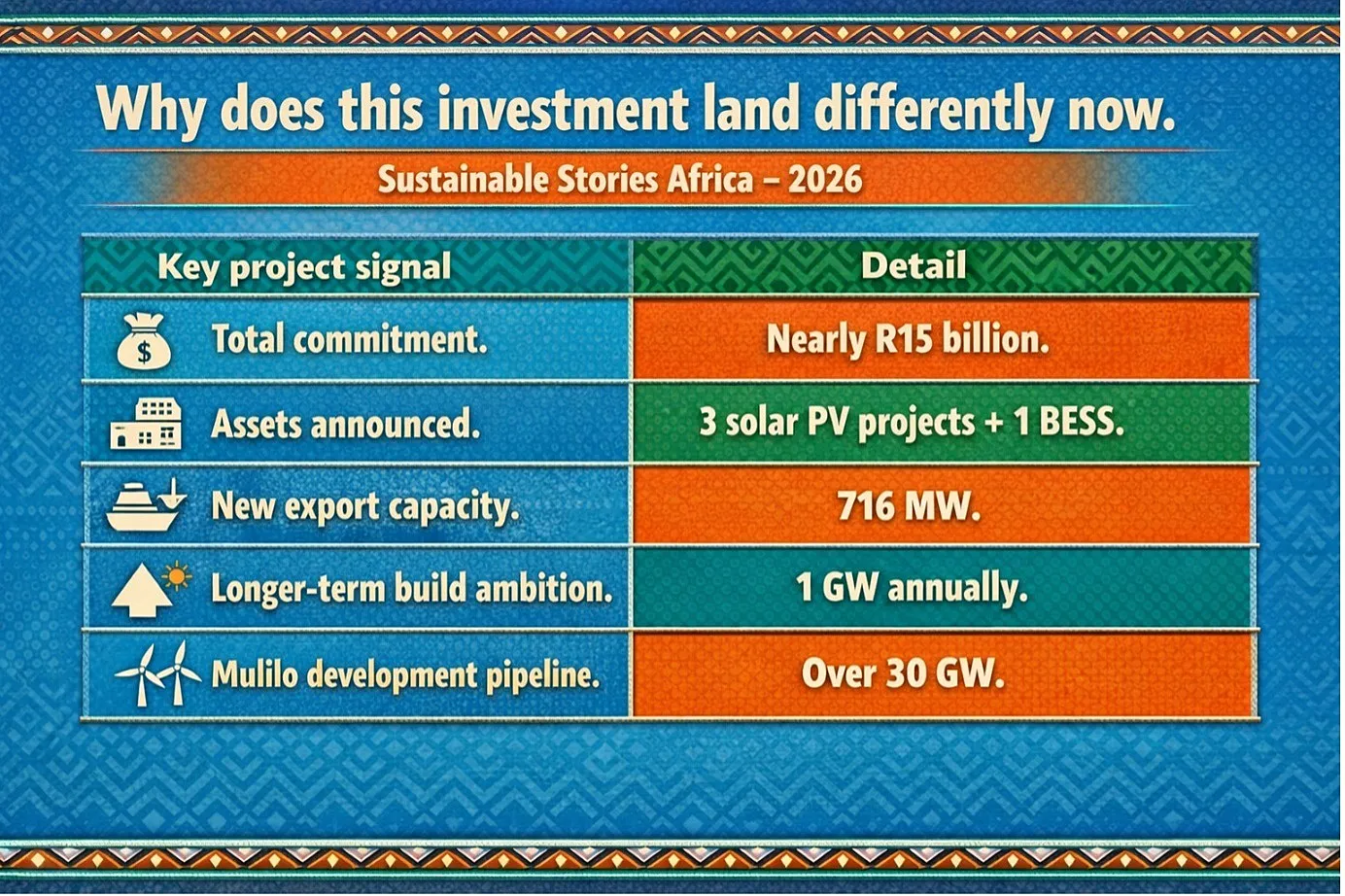
Mulilo has committed nearly R15 billion to new solar and battery storage projects in South Africa.
The move matters because South Africa still needs more reliable, dispatchable power even as electricity reforms begin to ease the worst of the crisis.
For households, industry and investors, the real test is whether private capital can now help turn energy reform into durable grid relief, jobs and faster decarbonisation. (IOL)
A private-capital vote of confidence
South Africa’s renewable energy transition received a fresh boost this week after Mulilo announced a commitment of nearly R15 billion at the South Africa Investment Conference 2026.
The funding will support three large-scale solar photovoltaic projects and a battery energy storage system, together expected to add 716 MW of new export capacity to the national grid.
The move comes as the country continues trying to turn energy reform into lasting electricity reliability.
The announcement is notable not only for its scale, but for what it signals about investor confidence.
Mulilo said the commitment reflects belief in South Africa’s economic direction and its just energy transition, positioning the investment as a long-term infrastructure bet rather than a short-term capital deployment.
That matters because South Africa’s electricity crisis has stretched for more than 15 years, weighing on growth, competitiveness and daily life.
With coal still accounting for about 70% of installed generation capacity, major investments in renewable energy and storage remain strategically important.
Why does this investment land differently now
Mulilo’s R15 billion pledge appears to be more than a one-off project announcement. The company said it is targeting the deployment of 1 GW of renewable energy capacity each year and is developing a pipeline of more than 30 GW across wind, solar and battery storage, suggesting the latest commitment could be the start of a much larger investment cycle.
The timing also matters. At this year’s investment conference, South Africa highlighted 16 landmark investments of R10 billion or more across sectors, including energy, tourism, digital infrastructure and manufacturing, reinforcing the government’s effort to show that reform is beginning to unlock capital at scale.
For South Africans, the stakes are practical. More reliable electricity can help factories run consistently, reduce diesel costs for small businesses, and ease daily disruption for households.
In the same vein, renewable power paired with storage offers a more flexible path to improving grid stability.
What South Africa stands to gain
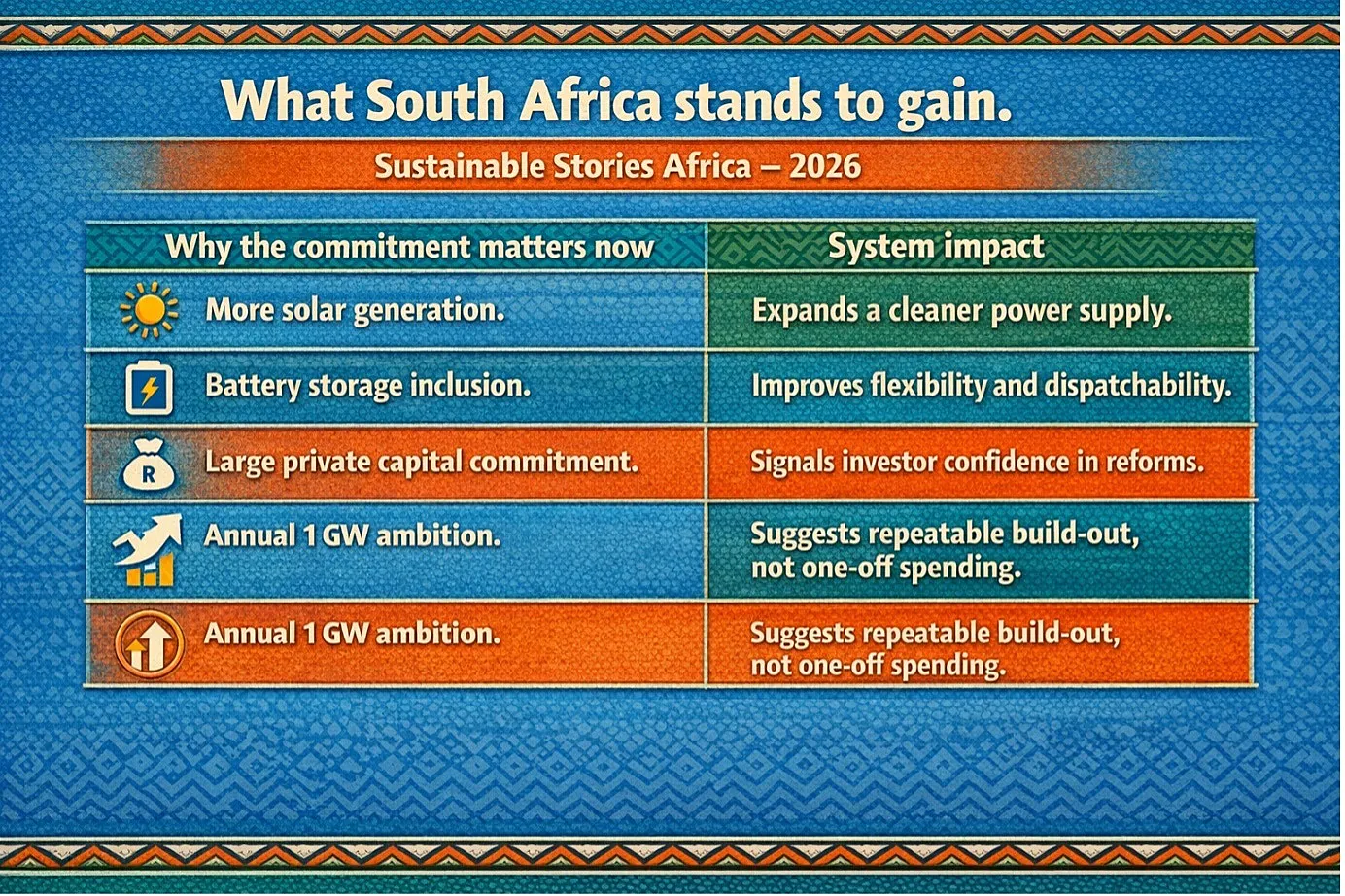
If projects like these move quickly from announcement to operation, the upside is substantial.
More renewable generation and storage can reduce pressure on a power system long shaped by ageing coal infrastructure, improve energy security, and lower the cost of volatility for businesses and consumers.
It can also help South Africa diversify its power mix, currently exposed to carbon-intensive generation.
There is also a development story here. Mulilo said the investment is intended to unlock infrastructure, create sustainable jobs and deliver benefits in partnership with government, financiers, regulators and local communities.
That framing matters in African energy markets, where the credibility of transition investments increasingly depends on whether they improve both system performance and local livelihoods.
The test is execution, not announcement
The bigger policy lesson is clear: South Africa now needs to turn investment announcements into commissioned assets more quickly, while strengthening transmission, regulation and community alignment around new projects.
Private developers can help close the reliability gap, but only if project pipelines move with less friction and more consistency.
That puts pressure on the full ecosystem, not just Mulilo. The government must ensure reform momentum is intact.
Regulators must enable faster approvals without weakening safeguards. Financiers must back scalable projects and storage.
Developers must prove that a just transition can mean cleaner electrons, stronger local value chains and visible benefits for communities near generation assets.
Path Forward – Build Faster, Deliver Power Fairly
Mulilo’s announcement shows that private capital is ready to fund South Africa’s next phase of power reform.
The opportunity now is to move from conference pledges to operational projects that strengthen grid reliability and expand low-carbon supply.
The path forward is straightforward but demanding faster execution, stronger grid integration, durable regulatory coordination and community-centred delivery.
That is how investment becomes energy security, and energy security becomes economic confidence.