JPMorgan Chase's institutional clients, among the world's most powerful investors, are actively pricing climate tipping point risks into long-term scenario planning, according to the bank's global head of climate advisory.
The shift marks a fundamental change in how capital is assessed against planetary boundaries, as the world's 1.5°C and 2°C targets appear increasingly out of reach.
For Africa, the continent most exposed to these irreversible shifts, the implications are both urgent and transformative.
Crossing Thresholds With No Return
Major institutional investors no longer treat Climate tipping points as a distant environmental theory.
In a recent Bloomberg interview, Sarah Kapnick, JPMorgan Chase’s global head of climate advisory and former NOAA chief scientist, said pension funds, sovereign wealth funds and other clients are increasingly testing such scenarios as plausible long-term financial risks.
That shift matters because it suggests global finance is beginning to reprice climate risk in structural, not merely cyclical, terms and when JPMorgan’s client base moves, wider capital markets often pay attention.
From Theory to Priced Risk
Climate tipping points are critical thresholds at which gradual warming can trigger abrupt, self-reinforcing and potentially irreversible shifts across Earth systems, from ice sheets and permafrost to forests and ocean circulation. Researchers increasingly describe them as systemic risks with the potential to cascade across sectors and regions.
For JPMorgan’s institutional clients, the immediate concern is the Atlantic Meridional Overturning Circulation. According to Sarah Kapnick, investors are increasingly treating weaker Atlantic currents and related climate scenarios as plausible long-term financial risks rather than distant theory.
The wider warning is no longer theoretical. University of Exeter researchers said in October 2025 that warm-water coral reefs are already passing a tipping point, with widespread dieback underway and major implications for ecosystems, food systems and coastal resilience.
That is why the repricing matters. JPMorgan recently said adaptation and resilience investments can deliver returns of $2 to $43 per dollar spent, even as tipping-point risks remain underpriced in many portfolios.
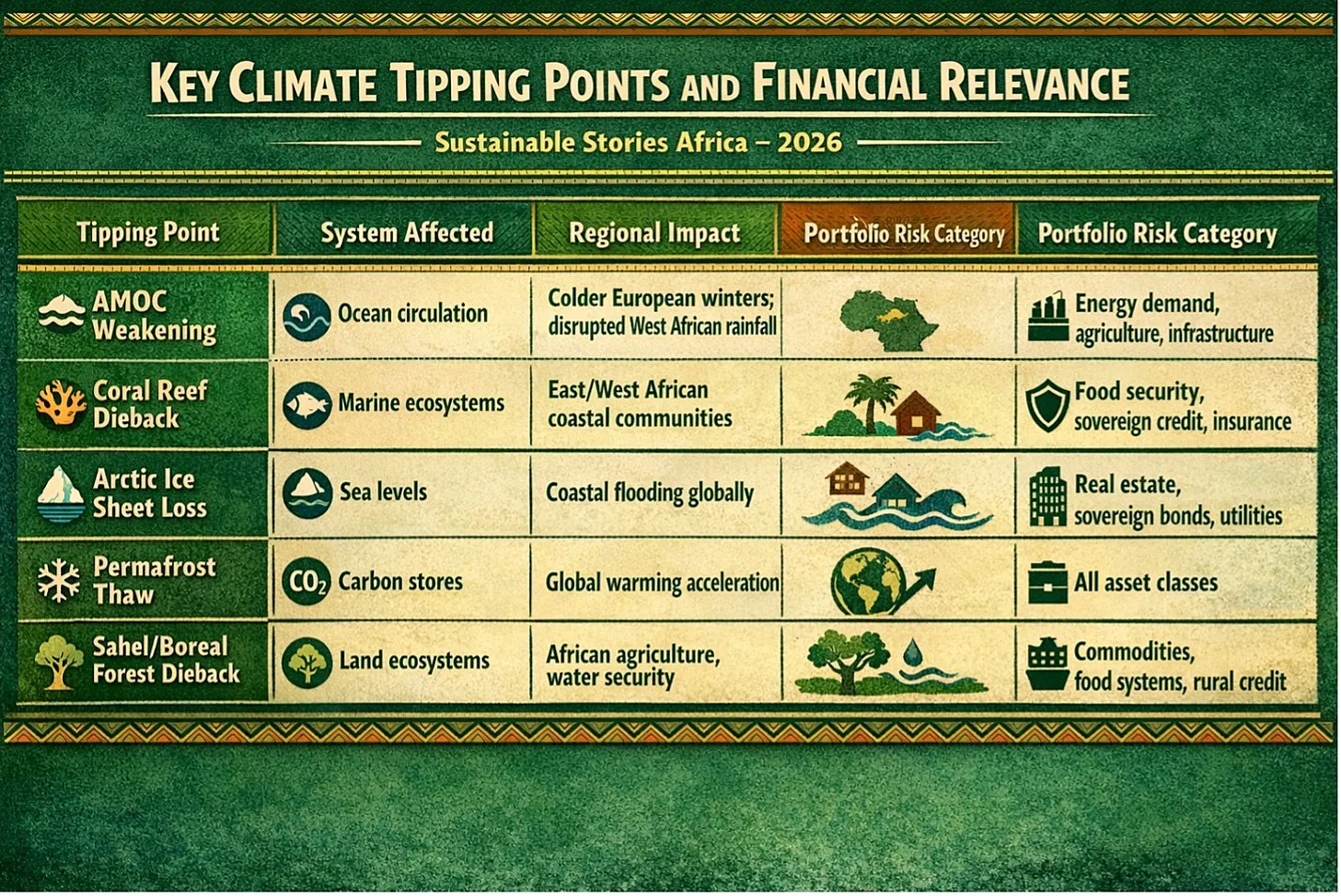
Key Climate Tipping Points and Financial Relevance
| Tipping Point | System Affected | Regional Impact | Portfolio Risk Category |
|---|---|---|---|
| AMOC Weakening | Ocean circulation | Colder European winters; disrupted West African rainfall | Energy demand, agriculture, infrastructure |
| Coral Reef Dieback | Marine ecosystems | East/West African coastal communities | Food security, sovereign credit, insurance |
| Arctic Ice Sheet Loss | Sea levels | Coastal flooding globally | Real estate, sovereign bonds, utilities |
| Permafrost Thaw | Carbon stores | Global warming acceleration | All asset classes |
| Sahel/Boreal Forest Dieback | Land ecosystems | African agriculture, water security | Commodities, food systems, rural credit |
The Opportunity in the Alarm
The significance of JPMorgan's clients embracing this framework is not only cautionary — it is potentially transformative for Africa.
If global capital increasingly prices tipping point risk, it will logically seek to fund the transitions, resilience infrastructure, and nature-based solutions that reduce those risks.
Africa, where the climate adaptation financing gap is estimated at over $2.5 trillion through 2030, stands at the intersection of the world's greatest vulnerability and its greatest opportunity.
African pension funds, development finance institutions, and sovereign wealth funds that embed tipping point analysis into their own investment frameworks will be better positioned to attract international capital co-investments, access concessional green finance, and meet the ESG disclosure benchmarks increasingly demanded by global partners.
Early movers on this frontier will shape the next chapter of sustainable finance on the continent.
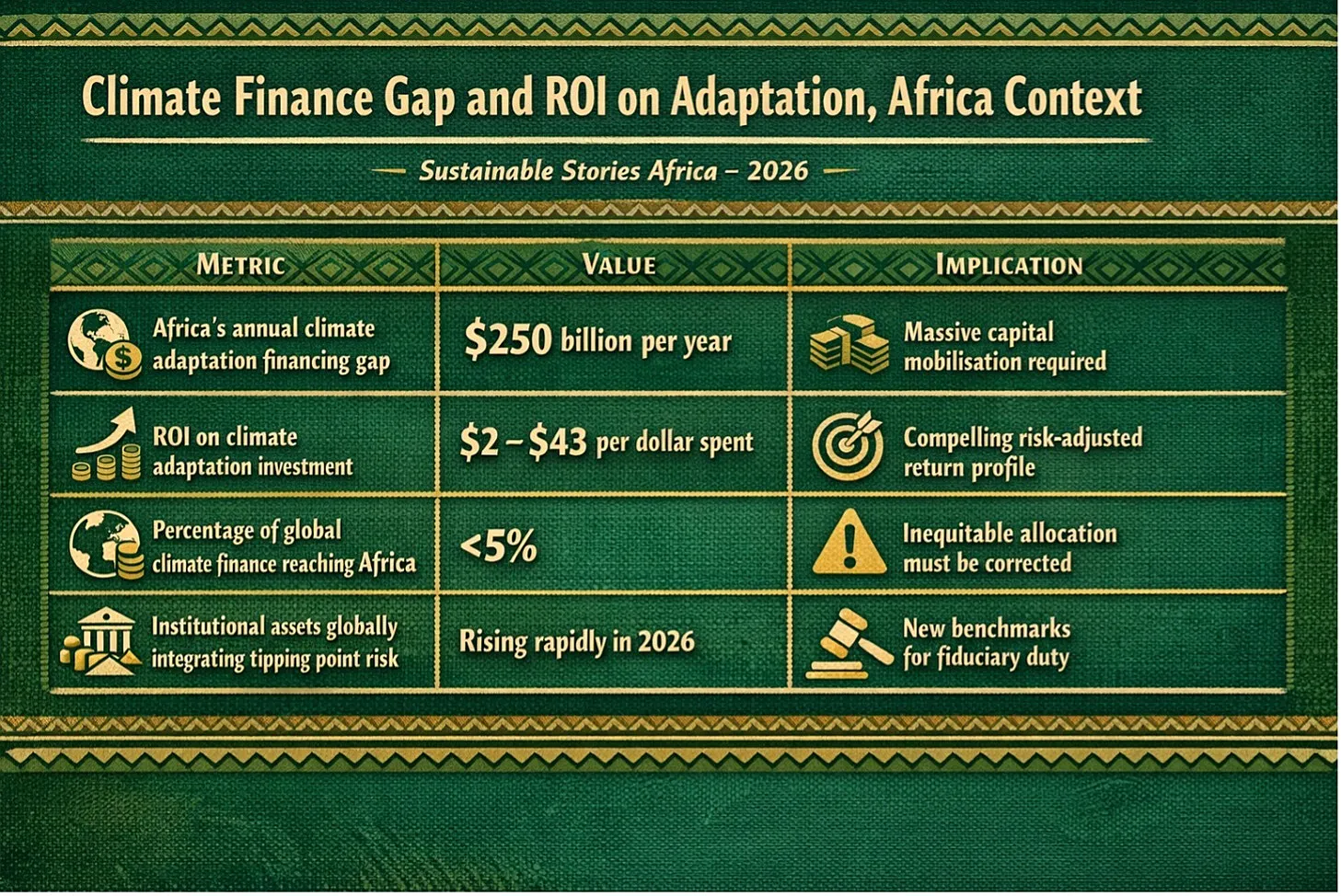
Climate Finance Gap and ROI on Adaptation, Africa Context
| Metric | Value | Implication |
|---|---|---|
| Africa's annual climate adaptation financing gap | $250 billion per year | Massive capital mobilisation required |
| ROI on climate adaptation investment | $2 – $43 per dollar spent | Compelling risk-adjusted return profile |
| Percentage of global climate finance reaching Africa | <5% | Inequitable allocation must be corrected |
| Institutional assets globally integrating tipping point risk | Rising rapidly in 2026 | New benchmarks for fiduciary duty |
Pricing the Future Before It Prices You
The message from JPMorgan's institutional advisory desk is clear, and African financial actors must heed it without delay.
Every pension fund trustee, sovereign wealth manager, development finance officer, and corporate CFO on the continent should be asking a single, urgent question: are our long-term scenarios stress-tested against irreversible climate thresholds?
If the answer is no, portfolios are overexposed to risks that global capital markets are only just beginning to price, meaning Africa's institutions risk being the last to protect their assets and last to access the capital being mobilised for resilience.
Policymakers must mandate climate-scenario analysis that includes tipping point models; institutional investors must update their fiduciary frameworks; and multilateral development banks must price concessional capital into Africa's adaptation infrastructure at the pace and scale the science now demands.
Path Forward – Pricing Climate Risk for Africa's Future
African institutional investors and regulators must urgently embed tipping-point scenario analysis into portfolio governance and sovereign risk frameworks.
Development finance institutions should accelerate blended adaptation finance tailored to Africa’s systemic exposures, from AMOC-linked rainfall disruption to coastal ecosystem decline and Sahel land degradation.
Those who lead will improve resilience, attract preferential climate finance and position Africa as an active architect of solutions, rather than a passive casualty of planetary boundaries.
Culled From: JPMorgan’s Institutional Clients Are Beginning to Price Climate Tipping Point Risk Into Long-Term Scenario Planning