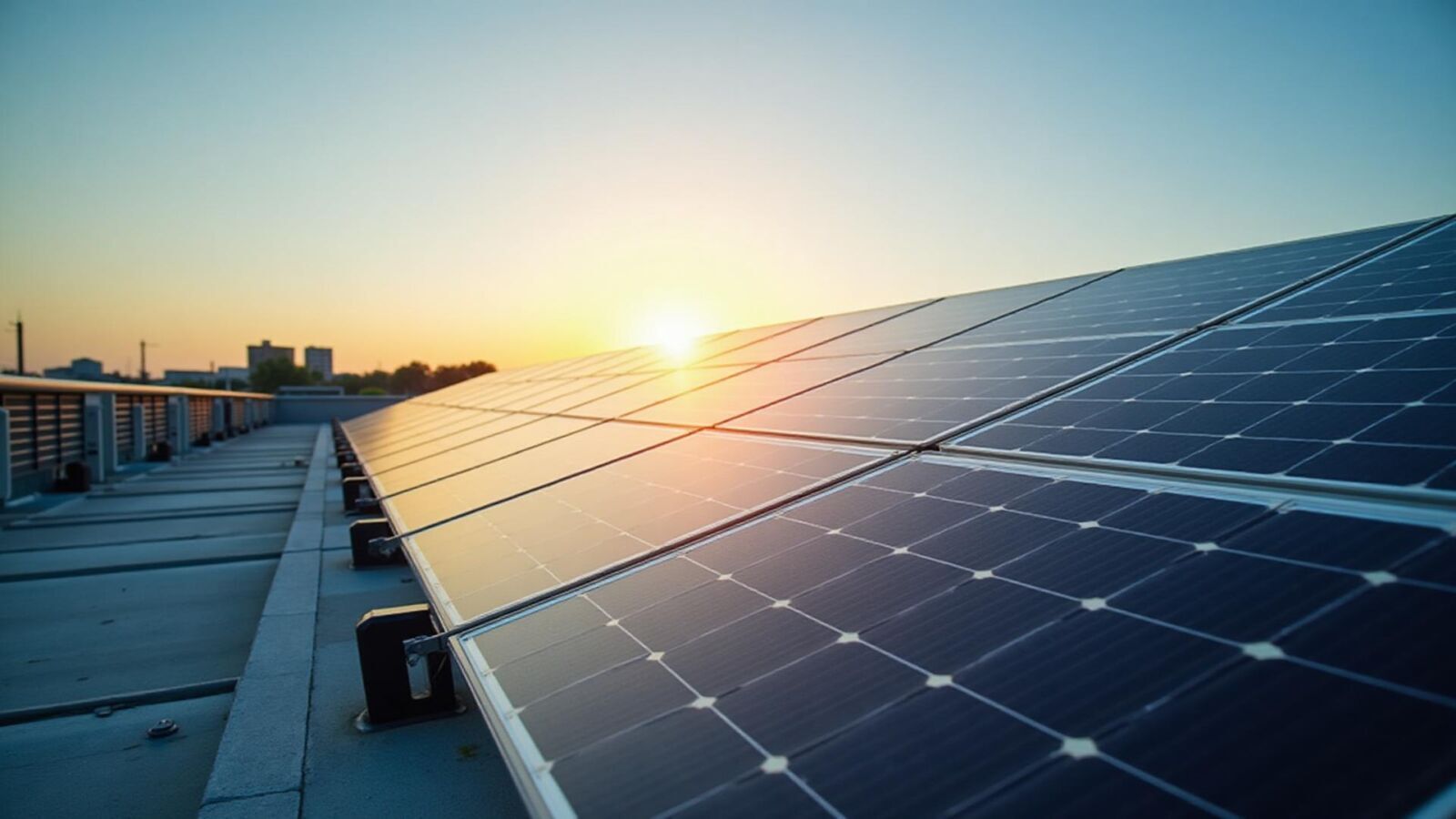
The International Finance Corporation (IFC) has committed $45 million to IPT PowerTech to deploy solar and battery hybrid energy systems across 2,235 telecom tower sites in Ethiopia, Liberia, and Sierra Leone, more than 90% of which are off-grid or in weak-grid areas.
The timing is pivotal. Digital connectivity in Sub-Saharan Africa is being held hostage by costly, polluting diesel generators, while only 10% of the region's mobile operators' energy comes from renewable energy.
This deal signals a convergence of clean energy finance and digital inclusion that could reshape both sectors for millions of underserved citizens.
Where the Grid Ends, the Story Begins
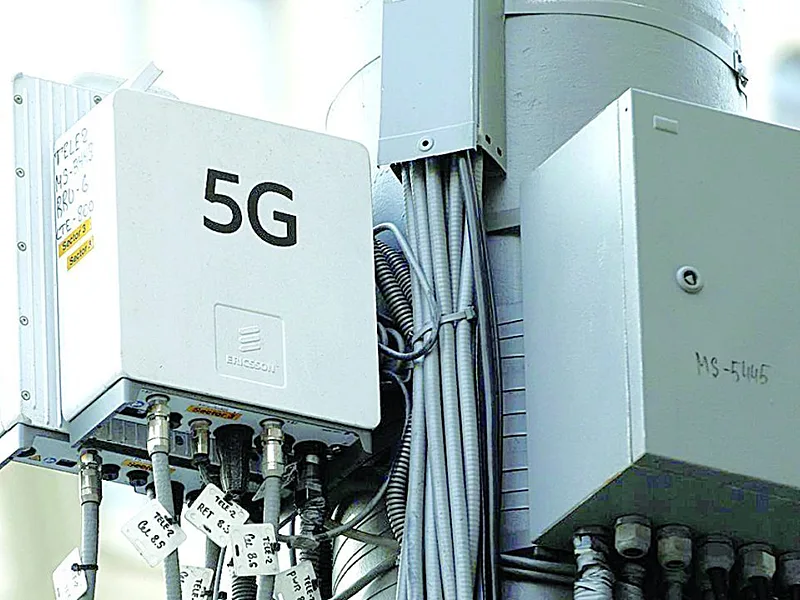
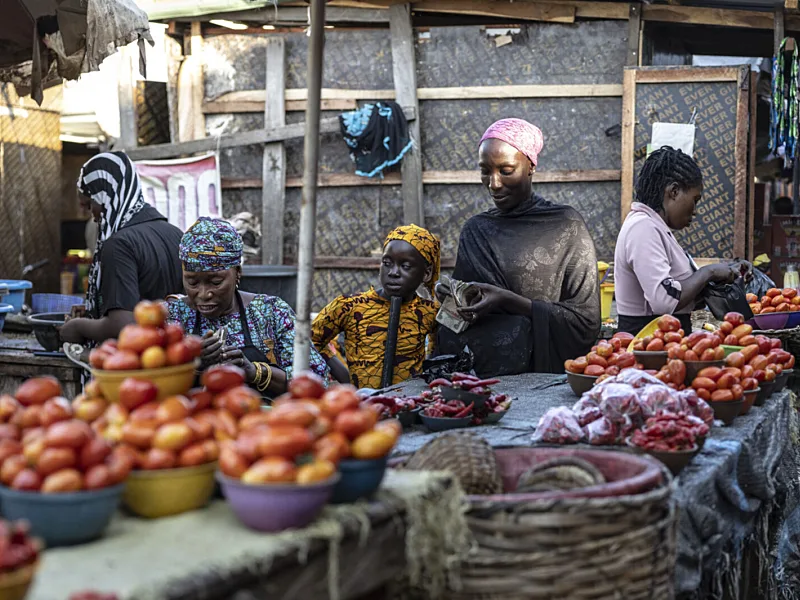
In rural Ethiopia, Sierra Leone and Liberia, everyday acts of care, trade and learning depend on a piece of infrastructure most people never see clearly: the telecom tower.
However, behind too many of those towers sits an expensive diesel generator, running in weak-grid or off-grid conditions and quietly raising the cost, fragility and carbon footprint of Africa’s digital economy.
That is the problem the IFC’s $45 million investment in IPT PowerTech is now trying to address. Announced on 25 March 2026, the package will support the upgrade, operation and maintenance of 2,235 telecom tower sites across the three countries, shifting them from diesel dependence toward solar and battery power.
The move is notable not only for its scale, but for what it signals: renewed multilateral confidence in frontier digital infrastructure.
Africa's Digital Divide Has a Diesel Problem
The scale of Africa’s telecom energy challenge is profound. Sub-Saharan Africa runs more than 240,000 tower sites, most of them still reliant on diesel despite the continent’s vast solar potential.
Renewable energy still accounts for only a small share of mobile operators’ power use, leaving connectivity exposed to high costs, slower rural expansion and a heavier carbon footprint.
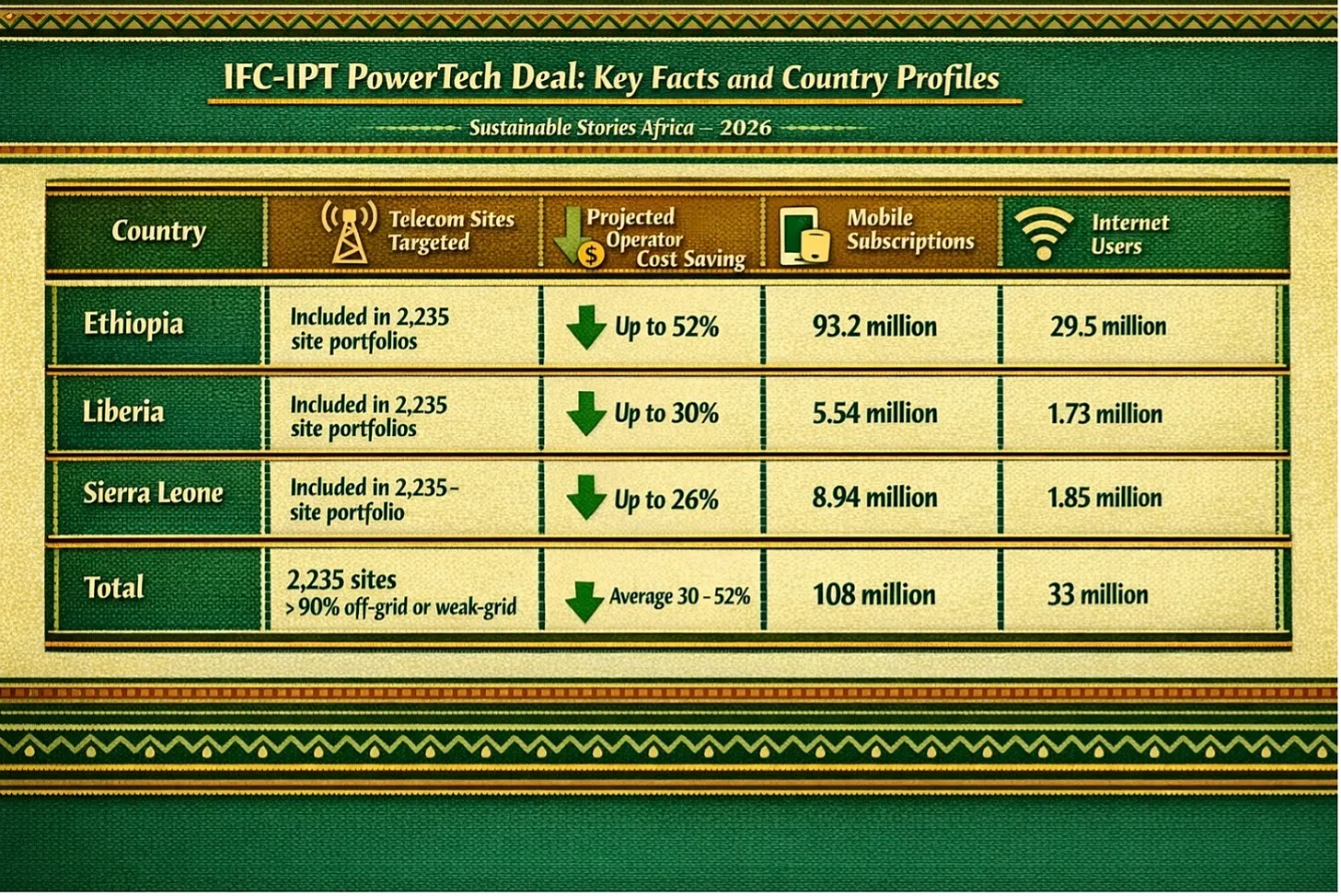
IPT PowerTech’s hybrid solar-and-battery model offers a practical response. By reducing diesel dependence, it could cut operating costs by up to 52% in Ethiopia, 30% in Liberia and 26% in Sierra Leone.
IFC-IPT PowerTech Deal: Key Facts and Country Profiles
| Country | Telecom Sites Targeted | Projected Operator Cost Saving | Mobile Subscriptions | Internet Users |
|---|---|---|---|---|
| Ethiopia | Included in 2,235 site portfolios | Up to 52% | 93.2 million | 29.5 million |
| Liberia | Included in 2,235 site portfolios | Up to 30% | 5.54 million | 1.73 million |
| Sierra Leone | Included in 2,235-site portfolio | Up to 26% | 8.94 million | 1.85 million |
| Total | 2,235 sites, >90% off-grid or weak-grid | Average 30 – 52% | ~108 million | 33 million |
The $45 million package combines a $27 million IFC A-Loan with $18 million in blended finance, using concessional capital to absorb frontier-market risk and unlock private investment where commercial lenders would otherwise stay away.
"By enhancing electricity stability for telecom infrastructure, this initiative will strengthen mobile coverage and deliver more reliable digital services to households, schools, health centres, and SMEs," the IFC stated in its announcement.
What Reliable Connectivity Would Unlock
The investment’s significance goes far beyond tower uptime. Replacing diesel with solar lowers operating costs, improves reliability and cuts emissions at once.
In markets such as Ethiopia, where internet access remains limited, that shift can determine whether millions are fully included in the digital economy or left behind.
For households and businesses, stronger networks support mobile money, telemedicine, remote learning and access to market information.
For operators, renewable-powered towers strengthen compliance, improve asset economics and, at scale, can make connectivity cleaner, cheaper and more dependable across sub-Saharan Africa.
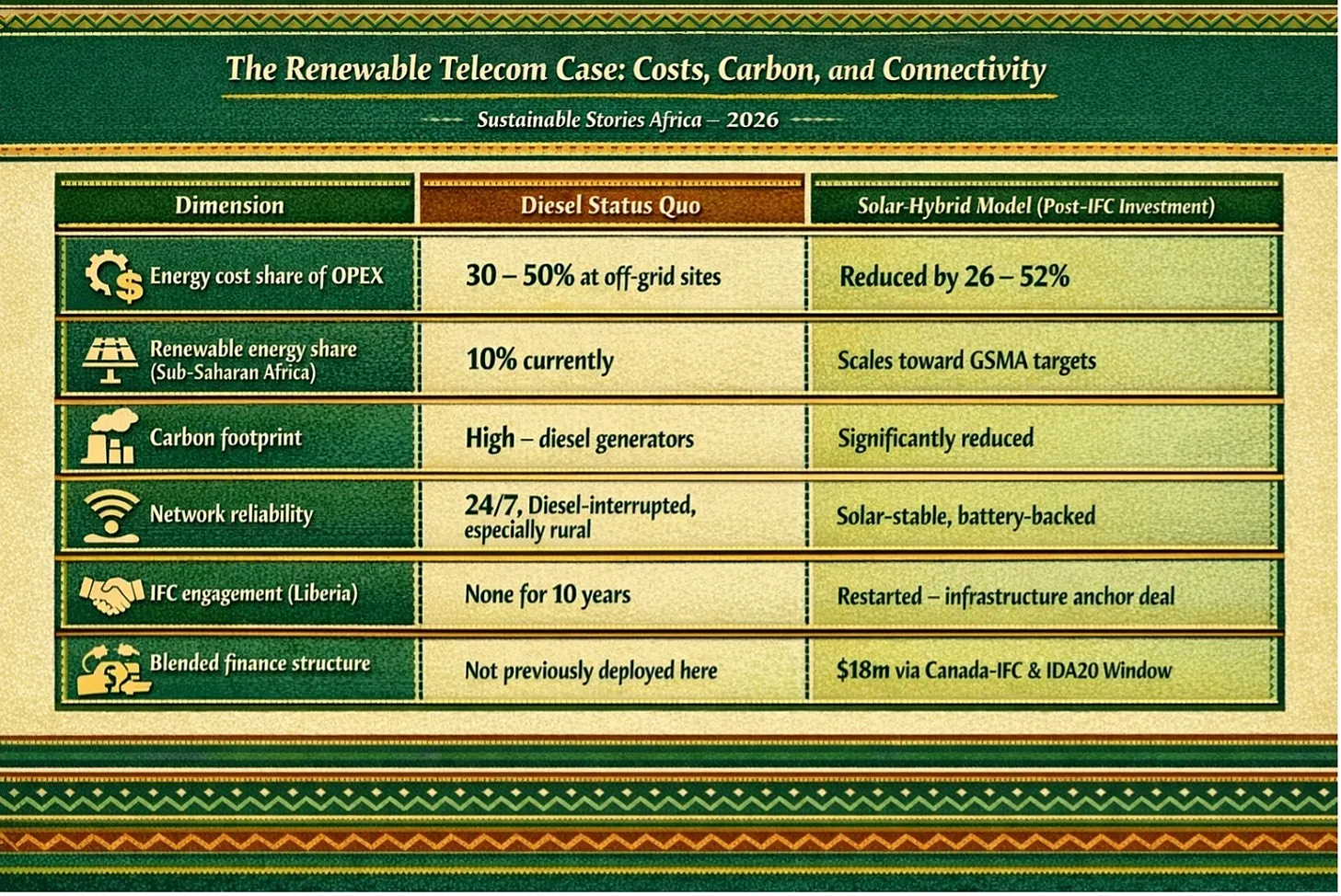
The Renewable Telecom Case: Costs, Carbon, and Connectivity
| Dimension | Diesel Status Quo | Solar-Hybrid Model (Post-IFC Investment) |
|---|---|---|
| Energy cost share of OPEX | 30 – 50% at off-grid sites | Reduced by 26 – 52% |
| Renewable energy share (Sub-Saharan Africa) | 10% currently | Scales toward GSMA targets |
| Carbon footprint | High – diesel generators, 24/7 | Significantly reduced |
| Network reliability | Diesel-interrupted, especially rural | Solar-stable, battery-backed |
| IFC engagement (Liberia) | None for 10 years | Restarted – infrastructure anchor deal |
| Blended finance structure | Not previously deployed here | $18m via Canada-IFC & IDA20 Window |
The Private Sector Must Follow IFC's Lead
This IFC investment should be seen as a template, rather than a one-off. The $45 million committed across three countries is small relative to the scale of Africa’s diesel-powered telecom network, and a full transition will require much larger pools of capital.
For operators, renewable power is now a business decision as much as an ESG one, lowering costs and improving resilience.
Development finance institutions must scale blended finance, while governments provide regulatory certainty.
For citizens, affordable, reliable connectivity remains essential infrastructure for inclusion, commerce and public services.
Path Forward – Sun, Signal, and Sovereignty
The IFC-IPT PowerTech deal in Ethiopia, Liberia, and Sierra Leone must serve as a replicable blueprint, scaling blended-finance structures to green Africa's entire telecom tower estate and driving renewable energy's share of operator consumption from 10% toward sector-wide targets.
For Africa's ESG agenda, clean telecom infrastructure represents a powerful convergence: cutting carbon, advancing digital inclusion, and strengthening the financial viability of connectivity companies. DFIs, operators, and governments must now co-invest with urgency, turning sun-powered signals into a continental standard, not a frontier exception.
Culled From: IFC backs solar-powered telecom expansion with $45m