
University College Dublin (UCD) will lead a €5.7 million national AI centre focused on accelerating climate action.
The initiative reflects growing recognition that data and artificial intelligence are central to solving climate challenges.
For governments, businesses, and emerging markets, it signals a shift toward decision-grade climate intelligence.
Data Becomes Climate Infrastructure
A €5.7 million investment into a national artificial intelligence centre led by University College Dublin (UCD) is positioning data as a core infrastructure layer in the global climate response.
The new centre, backed by Irish public funding and research partnerships, aims to deploy AI-driven tools to improve climate modelling, emissions tracking, and decision-making across sectors.
At a time when climate commitments are accelerating, but implementation gaps remain wide, the initiative targets a critical bottleneck: the lack of actionable, high-quality data.
For policymakers and investors, the message is clear: climate ambition without intelligence is no longer sufficient.
Why AI Is Now Central to Climate Strategy
Climate action is increasingly a data problem. Governments must track emissions in real time, businesses must measure and disclose impacts under evolving frameworks such as ISSB standards, and financial institutions must price climate risk accurately.
However, across both developed and emerging markets, data fragmentation remains a major constraint.
The UCD-led centre seeks to address this gap by:
- Developing AI models to predict climate risks and system impacts
- Enhancing emissions measurement and verification systems
- Supporting policy simulation and scenario planning
- Enabling cross-sector data integration
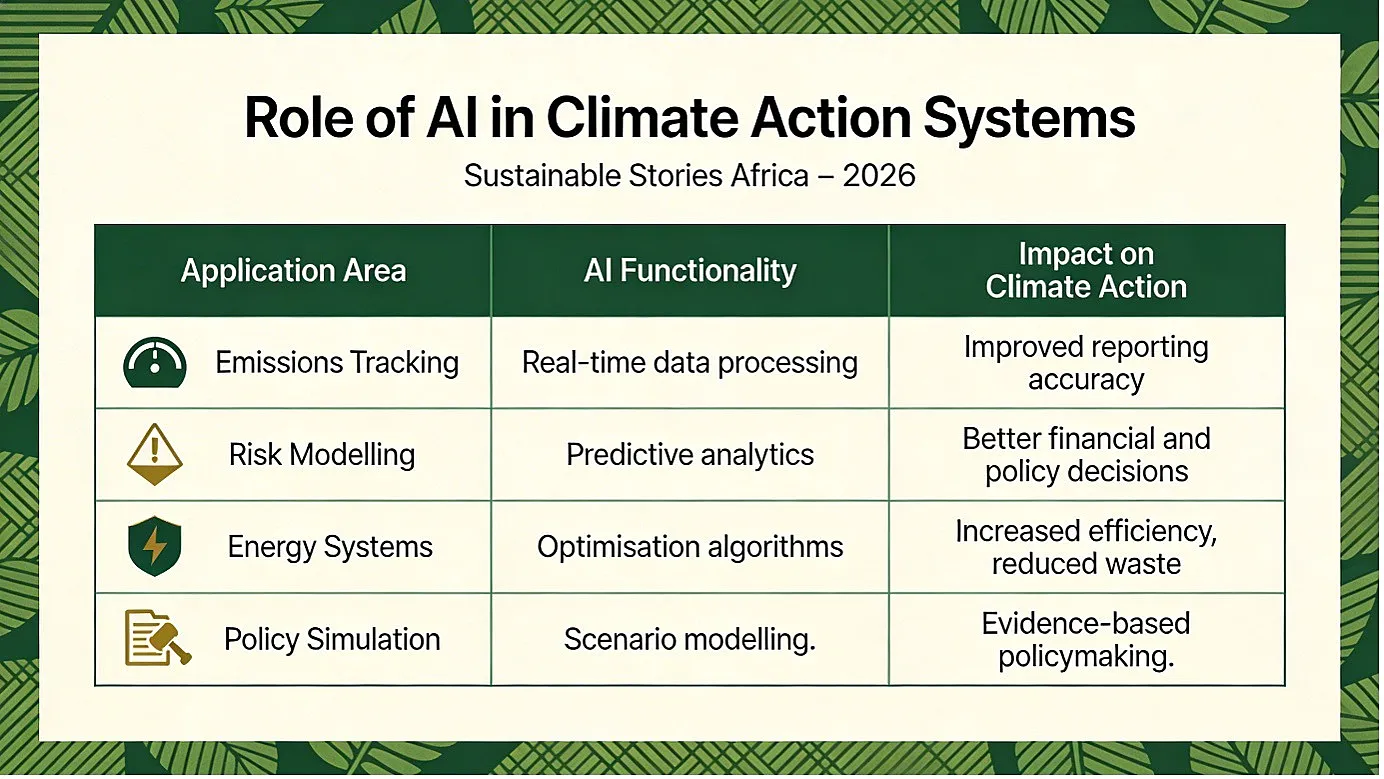
Role of AI in Climate Action Systems
Application Area | AI Functionality | Impact on Climate Action |
|---|---|---|
Emissions Tracking | Real-time data processing | Improved reporting accuracy |
Risk Modelling | Predictive analytics | Better financial and policy decisions |
Energy Systems | Optimisation algorithms | Increased efficiency, reduced waste |
Policy Simulation | Scenario modelling | Evidence-based policymaking |
The centre’s work aligns with a broader global trend: the convergence of climate science, digital infrastructure, and financial systems.
For African markets, where data gaps are often more pronounced, the implications are particularly significant. Without reliable data, ESG reporting remains inconsistent, and climate finance struggles to scale.
As one researcher involved in similar initiatives noted, “You cannot manage what you cannot measure. AI is becoming the tool that makes climate measurable.”
From Climate Commitments to Measurable Outcomes
The promise of AI-driven climate systems lies in turning ambition into execution.
If scaled effectively, initiatives like the UCD centre could enable:
Decision-Grade Data – Governments and companies move from estimates to precise, verifiable metrics
- Capital Allocation Efficiency: Investors channel funds into projects with measurable impact
- Regulatory Alignment: Easier compliance with evolving global sustainability standards
- Innovation Acceleration: Faster development of climate solutions across sectors
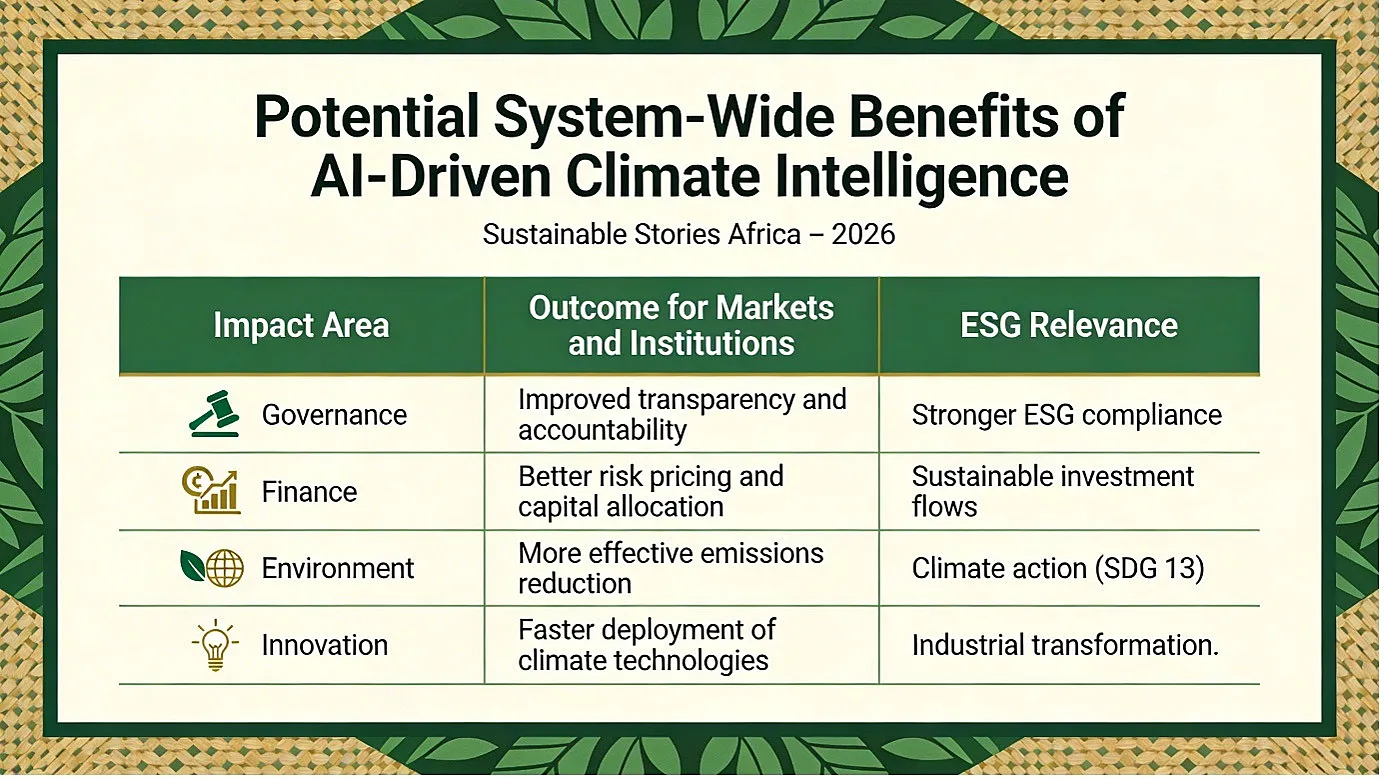
Potential System-Wide Benefits of AI-Driven Climate Intelligence
Impact Area | Outcome for Markets and Institutions | ESG Relevance |
|---|---|---|
Governance | Improved transparency and accountability | Stronger ESG compliance |
Finance | Better risk pricing and capital allocation | Sustainable investment flows |
Environment | More effective emissions reduction | Climate action (SDG 13) |
Innovation | Faster deployment of climate technologies | Industrial transformation |
However, the risks are equally clear. Without inclusive access to such technologies, data advantages could become concentrated in advanced economies, widening global disparities in climate action capacity.
Bridging the Global Climate Data Divide
To maximise impact, the UCD-led initiative must extend beyond national boundaries.
Three priorities stand out:
- Global Collaboration – Partnerships with institutions in Africa and other emerging markets to ensure knowledge transfer and shared capacity.
- Open Data Frameworks – Developing interoperable systems that allow data sharing across borders and sectors.
- Capacity Building – Training policymakers, regulators, and businesses to use AI-driven insights effectively.
For African governments and institutions, the emergence of such centres presents both an opportunity and a challenge: to integrate into global data ecosystems while building local capabilities.
Investors, meanwhile, are likely to view AI-enabled climate intelligence as a critical enabler of scalable, credible ESG investments.
Path Forward – Data-Driven Climate Systems Scale Globally
The UCD-led AI centre underscores a broader shift: climate action is becoming inseparable from data infrastructure and digital capability.
To deliver real impact, similar models must be replicated and adapted across emerging markets, ensuring that climate intelligence is not just advanced but also accessible, inclusive, and actionable at scale.
Culled From: UCD Leads €5.7 Million National AI Centre to Accelerate Climate Action