Tunisia’s drought crisis is no longer only an environmental warning. It is now a test of food security, rural livelihoods, infrastructure planning and public finance.
A new AfDB-backed summary report calls for stronger water governance, early warning systems, legal reform, innovative finance and treated wastewater reuse to help Tunisia move from crisis response to long-term resilience.
Tunisia’s Water Future Demands Urgency
Tunisia is confronting a drought challenge that is becoming more frequent, longer and more economically disruptive, according to the African Development Bank’s December 2025 summary report, Drought Planning, Preparation and Resilience Strategies: Case of Tunisia.
The report frames drought as a national development risk shaped by climate change, overexploited water resources, population pressure, intensive agriculture and fragmented institutional governance.
Its core message is direct: Tunisia already has strategies, infrastructure and technical expertise, but needs stronger coordination, financing and implementation to transform planning into resilience.
For African and emerging markets, Tunisia’s experience carries a wider lesson. Climate stress is no longer a distant adaptation issue. It is shaping food prices, public budgets, rural incomes, investor confidence and social cohesion in real time.
Drought Is Now Tunisia’s Economic Warning
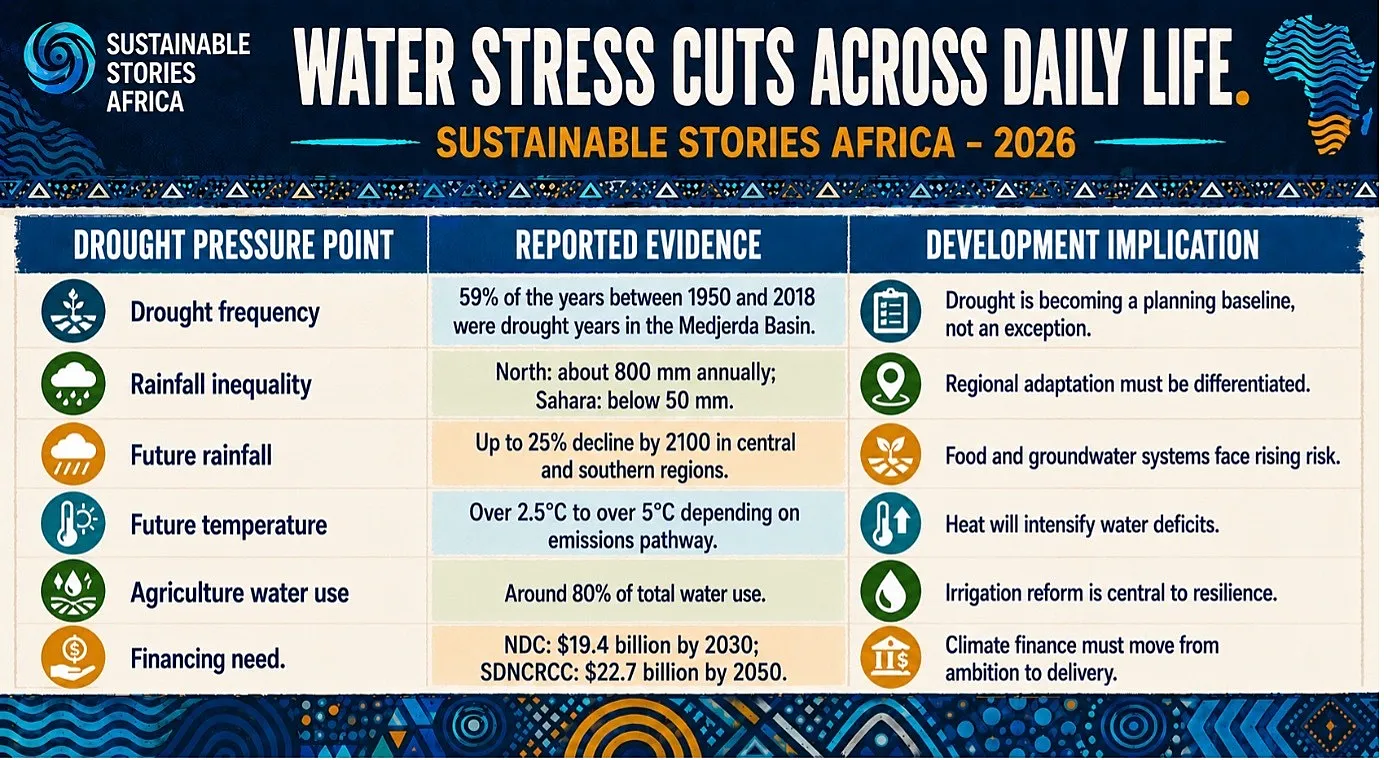
Nearly six in ten years between 1950 and 2018 were drought years in Tunisia's Medjerda Basin, according to Standardised Precipitation Index data reviewed in an AfDB-backed report.
What once registered as an exceptional climatic event in the 1970s and 1980s has since become more frequent, more severe, and more directly linked to national economic performance.
Tunisia's water challenge is rooted in geography but no longer contained by it.
- Northern areas receive around 800 millimetres of rainfall annually.
- Saharan regions receive less than 50 millimetres.
However, climate change, water demand, and groundwater overuse are narrowing that gap, with traditionally wetter northern zones now recording rainfall levels comparable to central semi-arid regions.
The climate projections are stark. CMIP6 models indicate Tunisia's drought vulnerability will intensify from 2030, with precipitation potentially falling by up to 25% in central and southern regions by 2100, while average temperatures could rise by 2.5°C to 5°C, depending on emissions pathways, creating compound drought conditions where heat and water scarcity simultaneously weaken farms, ecosystems, and natural groundwater recharge.
Water Stress Cuts Across Daily Life
The human cost of Tunisia's drought crisis is visible in farms, food markets, rural employment, and household budgets.
Agriculture is especially exposed given its dependence on rainfall, when drought reduces cereal output, stocks decline, prices rise, and vulnerable households face tighter food access.
The 2015–2016 drought sharply reduced national cereal production, generating agricultural and fiscal pressures that rippled through public budgets, export revenues, and import costs.
Recent economic data reflects the same pattern. Tunisia recorded GDP growth of 1.4% in 2024, supported by a 12.1% improvement in agricultural performance in the fourth quarter. Inflation eased to 7% in 2024 from 9.3% in 2023, partly due to improved local production and relieved food price pressure.
However, climate-sensitive products, including lamb, poultry, tomatoes, and citrus, continued to signal the fragility of water-stressed food systems.
The impact extends beyond agriculture. Tourism, industry, and urban centres compete for increasingly scarce water resources, while ageing distribution infrastructure leaks water and raises service delivery costs.
Groundwater abstraction rose steadily between 2015 and 2022, intensifying pressure on underground reserves.
Resilience Can Protect Food And Jobs
Tunisia is not without tools; it has important assets that require better coordination.
Its water infrastructure base is substantial, encompassing dams, canals, and irrigation schemes, alongside a strong policy architecture including the Water 2050 strategy, the National Adaptation Plan, and the Carbon Neutral and Climate Resilient Development Strategy 2050.
However, plans alone cannot hold back drought. The National Drought Plan, released in 2020 across four pillars - vulnerability mapping, early warning systems, mitigation measures, and institutional coordination - remains largely inoperative due to weak implementation mechanisms, limited dedicated funding, and insufficient inter-institutional follow-up.
The opportunity lies precisely in this gap. Modernising governance, mobilising finance, and scaling practical technologies, such as treated wastewater reuse, decentralised desalination, artificial groundwater recharge, smart irrigation, and GIS-based planning, could transform drought resilience into a development platform.
Critically, the report identifies behaviour change as an equally important lever, requiring farmers, municipalities, schools, and communities to embrace water stewardship and structural reform.
Reforms Must Move From Plans To Delivery
Tunisia's water governance challenge is fundamentally structural. Responsibilities are fragmented across ministries, agencies, operators, and regional structures, creating duplication, overlapping mandates, and weak accountability.
The absence of a permanent, integrated coordination system remains a major barrier to coherent planning, investment prioritisation, and effective crisis response.
The AfDB-backed report proposes six reform levers:
- Establishing a national water and drought management coordinating authority at the strategic government level
- Developing a reliable early warning system using climate projection tools, SPEI indices, and hydrometeorological data
- Modernising the Water Code to reflect current climate realities, including drought resilience and treated wastewater reuse
- Mobilising adapted and innovative finance through green or water bonds, climate micro-insurance, and carefully structured PPPs
- Building technical capacity across institutions and local authorities
- Integrating water-saving culture into education and vocational training.
The financing challenge is substantial. Tunisia's NDC estimates adaptation financing needs at $19.4 billion by 2030, while the Carbon Neutral and Climate Resilient
Development Strategy projects $22.7 billion by 2050. PPPs could help bridge the gap, but Tunisia's 2015 framework lacks water-sector-specific provisions, a clear contracting authority, and bankable project preparation capacity.
Low tariffs and weak cost recovery further limit private investor appetite without well-structured risk-sharing and guarantees.
Stakeholder consultations across 22 institutions reinforced this diagnosis, identifying institutional conflict, weak coordination, limited resources, political short-termism, and financing constraints as core barriers.
Proposed solutions included wastewater reuse linked to green hydrogen, real-time telemetry monitoring, climate-adapted smart irrigation, and agricultural insurance schemes.
Path Forward – Make Water Resilience Bankable
Tunisia’s drought response must shift from emergency management to planned resilience: stronger governance, early warning, legal reform, treated wastewater reuse, local capacity and climate finance.
The priority is implementation. Water must be treated as strategic economic infrastructure in the 2026 – 2030 development cycle, with bankable projects, transparent coordination and reforms that protect farms, households and future growth.