Kenya has lifted water access to about 70%, but sanitation remains the harder test: low sewer coverage, underfunded utilities, climate pressure and weak project preparation.
An AfDB-supported policy brief argues that utilities, SMEs, investors, governments and researchers must work together to make sanitation investable, inclusive and resilient.
Sanitation Needs Stronger Utility Partnerships
Kenya’s sanitation sector is entering a decisive phase: the country has built momentum in water access, financing plans and utility reform; however, sanitation delivery still has significant effects on the scale of urban growth, climate stress and the needs of low-income communities.
A 2025 policy brief, Strengthening Utility Partnerships for Sustainable, Resilient, and Inclusive Sanitation in Kenya, says the next frontier is not only building infrastructure.
It is building partnerships that allow utilities to work with regulators, funders, small enterprises, researchers and county governments to expand sanitation services despite financing gaps and climate pressures.
The brief was based on discussions among water and sanitation experts in Kenya and the region, including a session at the Kenya Water and Sanitation International Conference held from June 24 to 27, 2025.
Sanitation Remains Kenya’s Harder Gap
Kenya is classified as water-scarce but has achieved about 70% overall access to water, with a universal water supply planned by 2030.
However, sanitation remains structurally constrained, especially in urban and low-income areas where most households rely on on-site systems such as latrines and septic tanks.
The investment need is large. Kenya’s National Water and Sanitation Investment and Financing Plan identified more than 2,500 projects requiring about KES 882 billion, or roughly $6.8 billion, to improve national access to water and sanitation by 2030.
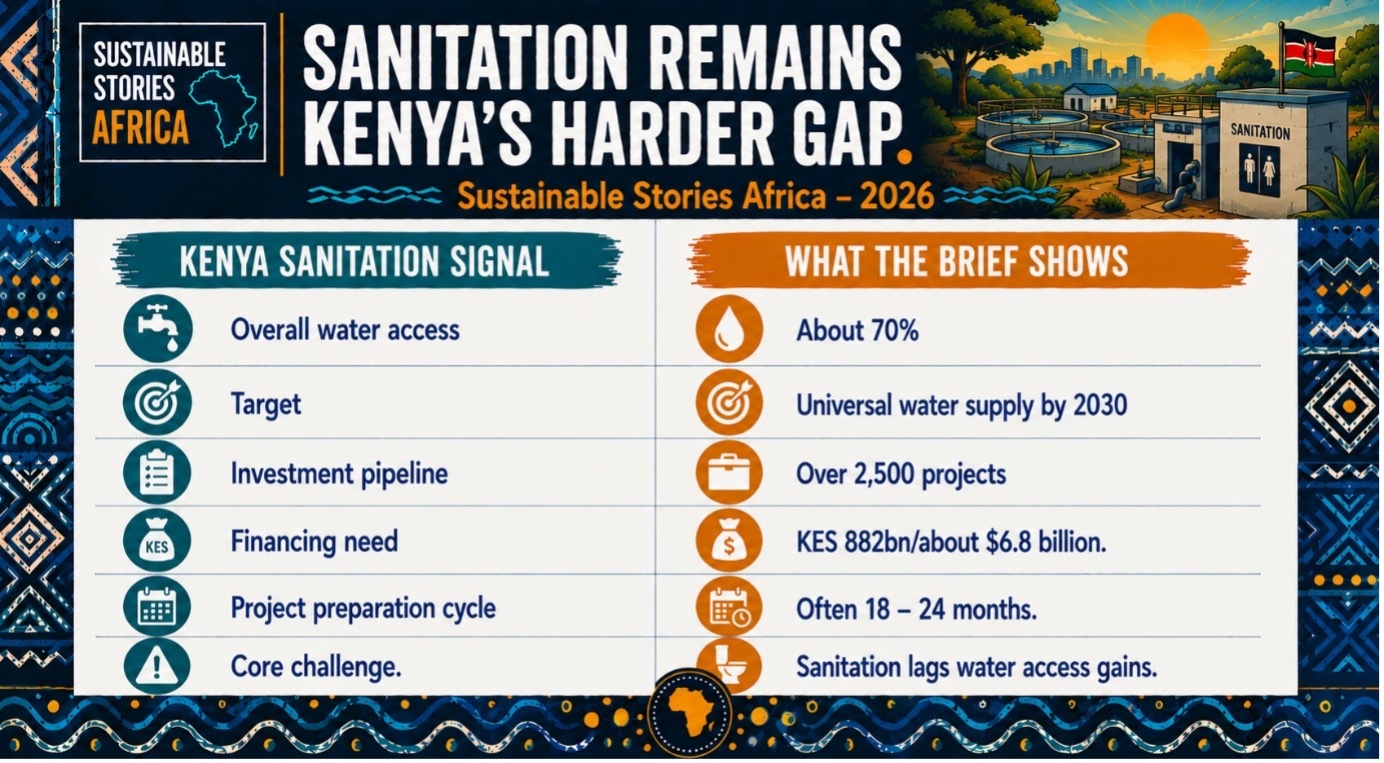
This is why sanitation is now a governance, finance and climate-resilience story. Tariffs often fail to cover operational costs, utilities lack resources for project preparation, and climate variability raises maintenance costs while disrupting services.
Nakuru Shows What Partnerships Can Do
The brief uses Nakuru Water and Sanitation Company, NAWASSCO, as a practical case study.
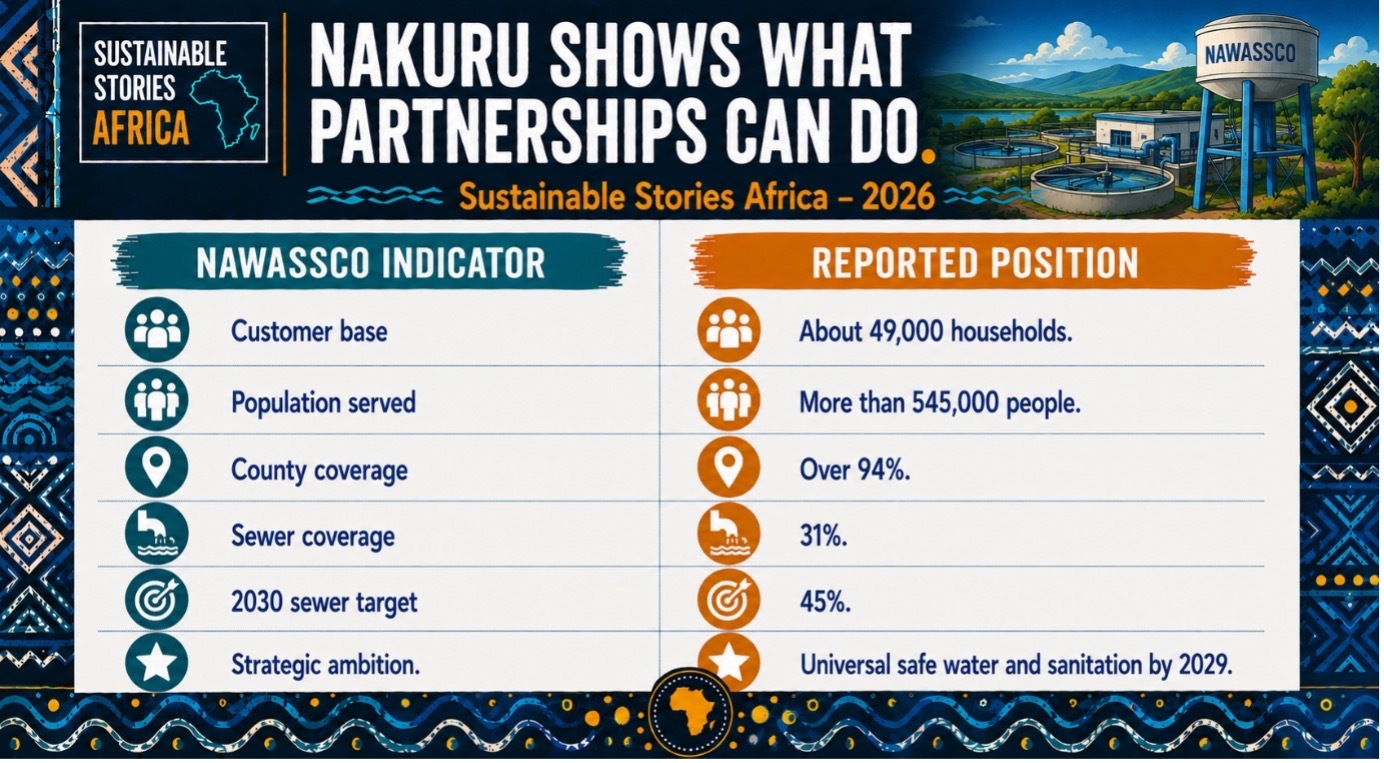
NAWASSCO serves over 545,000 people in Nakuru County, covering more than 94% of the county’s population.
It has achieved 31% sewer coverage and plans to expand that to 45% by 2030.
Its strategic goals include universal access to safely managed water and sanitation services within its service area by 2029.
Nakuru’s lesson is that utilities do not have to solve every problem alone. The county created the Nakuru Countywide Sanitation Technical Steering Committee and the Citywide Inclusive Sanitation Committee, bringing together water, health, environment, finance, planning, utilities, development partners, residents’ associations and academia.
That structure helps align planning, donor funding, technical knowledge and local implementation, the kind of coordination that sanitation systems often lack.
Inclusive Models Can Reach Underserved Communities
Nakuru’s service model shows how sanitation can become more inclusive when utilities formalise relationships with private and community providers.
The county has 12 privately licensed exhauster operators contracted to provide faecal sludge emptying services. NAWASSCO also works with small and community-based service providers through formal agreements, enabling the collection of sludge from informal settlements to designated treatment and recovery facilities.
The circular economy angle is especially important. NAWASSCOAL Ltd, a subsidiary created in 2018, processes faecal sludge into fuel briquettes and biochar under the MakaaDotcom and ikomizizi seed ball brands.
It produces about 20 metric tonnes monthly and has sold more than 700 metric tonnes, contributing to waste reduction and resource recovery.
This is where sanitation moves from a cost centre to a resilience opportunity: cleaner neighbourhoods, safer waste handling, new SME roles, lower pollution and potentially stronger local revenue models.
Finance, Data, and Research Must Align
The brief’s recommendations are targeted at five groups.
- Utilities should formalise commercial partnerships with SMEs, invest in interoperable data platforms, create research and development capacity, digitise customer and financial systems, and partner with peer utilities for learning.
- Investors and donors should fund project preparation, support guarantees and results-based financing, and back utility-SME partnerships, data infrastructure and research.
- Governments should implement Kenya’s National Sanitation Management Policy, institutionalise coordination, explore mechanisms such as betterment levies and create flexible ways for donor funding to reach utilities.
- Research organisations should co-create agendas with utilities, broker knowledge and support investment planning.
- Sanitation SMEs should share performance data, develop scalable models aligned with public standards and participate in coordination platforms.
NAWASSCO’s digital journey shows why data matters. The utility moved from manual systems to accounting platforms, end-to-end integration, mobile money payments, digital meter reading, cloud data security and a customer mobile app for real-time fault reporting and bill payments.
Path Forward – Make Sanitation Investable
Kenya’s sanitation challenge now requires bankable projects, stronger utilities, formal SME partnerships, climate-smart planning and better data.
The priority is clear: turn sanitation from fragmented service delivery into a coordinated investment ecosystem.
With the right partnerships, utilities can expand coverage, protect public health and build resilient urban services for low-income communities.