Nearly 600 million people in sub-Saharan Africa still live without electricity, making access to power one of the continent’s defining development tests.
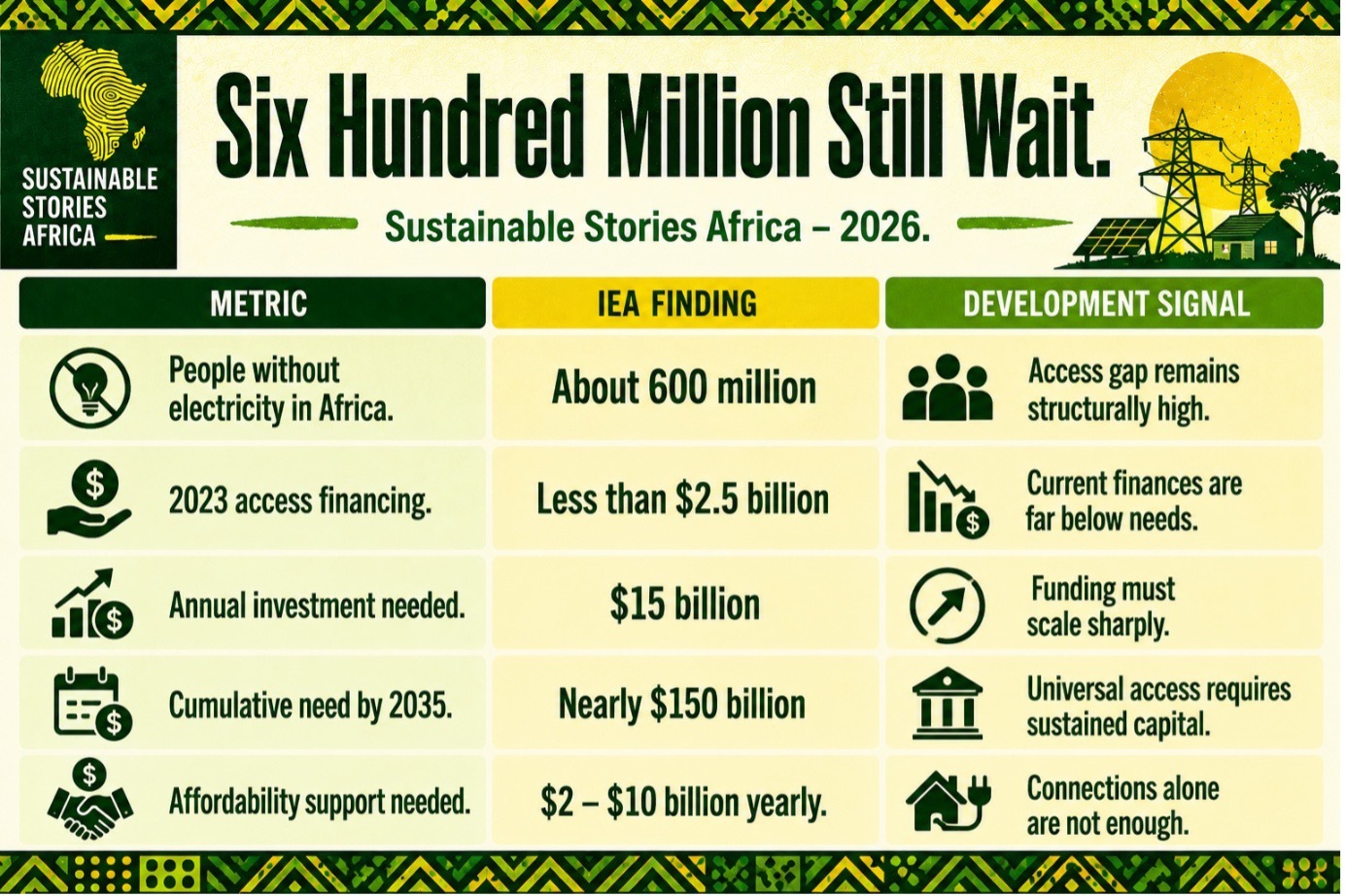
The IEA says universal access by 2035 will require nearly $150 billion in cumulative investment, alongside smarter finance, stronger regulation and targeted affordability support.
Power Access Becomes Africa’s Growth Test
Electricity access in Africa is no longer only an infrastructure story. It is now a finance, affordability and development story.
The International Energy Agency’s Financing Electricity Access in Africa report warns that electrification is barely keeping pace with population growth, leaving around 600 million people in sub-Saharan Africa without access as of 2024.
- For households, that means children studying under weak light, clinics struggling with unreliable power, farmers missing cold-chain opportunities and small businesses paying more for less energy.
- For governments and investors, it means the continent’s growth ambitions depend on whether capital can reach the communities where commercial returns are hardest but development impact is highest.
Six Hundred Million Still Wait
Nearly two out of every five people in Africa still lack electricity. Fewer than 19 million people gained access in both 2023 and 2024, below the 23 million recorded in 2019, showing that progress has not fully recovered from pandemic-era disruptions.
The IEA says less than $2.5 billion was committed for new electricity access connections in sub-Saharan Africa in 2023.
That is far below what is needed to close the gap. Finance is also uneven: half of the flows went to only six countries, Angola, Kenya, Mozambique, Nigeria, Senegal and South Africa, while rural areas, where 80% of people without access live, remain underserved.
This mismatch is crucial. Electricity access is most needed in dispersed, lower-income and rural communities; however, finance often follows denser markets, stronger regulations and better-paying customers.
Finance Remains Too Public And Scarce
The financing structure reveals a deeper weakness.
Private finance accounted for less than 30% of total electricity access flows in 2023, reaching $640 million, compared with $1.8 billion in international public finance.
Public finance remains essential because many electricity access projects serve households with limited ability to pay. However, public budgets are already under pressure from debt, subsidies and utility losses.
In 23 sub-Saharan African countries, government budget allocations for electricity access rose from $1.1 billion in 2024 to $1.9 billion in 2025, signalling political priority but also fiscal strain.
The IEA’s message is not that private capital should replace public finance. It is that public, concessional and private capital must be blended more intelligently.
Grants, guarantees, low-cost loans and patient equity need to carry risk where ordinary commercial lenders cannot.
Grids, Mini-Grids, and Solar Homes
A single technology cannot deliver the desired pathway to universal access to power. The IEA’s ACCESS pathway points to a mix: about $7 billion annually for grid expansion, $5 billion for mini-grids and $3 billion for solar home systems.
Grids remain critical in urban and peri-urban areas, where density makes connections cheaper. However, decentralised systems, especially mini-grids and solar home systems, are essential for rural communities located far from existing networks.
The report’s technology diagram shows access can come through national grid networks, mini-grids serving multiple users, or stand-alone systems serving individual households.
This matters because Africa’s access challenge is geographically diverse: a trading hub near a town, a farming village and a displaced community need different financing and technology models.
Affordability Is The Real Test
Connecting a household is only the first step. The IEA defines basic electricity access as roughly 50 – 75 kilowatt-hours per household per year, enough for basic services such as lighting, phone charging and radio.
However, higher consumption is needed for productive use, business growth and wider development.
The affordability gap is significant. The IEA estimates that 220 million people in sub-Saharan Africa, approximately 40% of those without access, may be unable to afford even the basic electricity bundle.
That increases to 400 million people for an essential bundle. Closing this affordability gap would require an additional $2 billion to $10 billion per year.
Cost of capital is a major barrier. Access-to-electricity projects in Africa face financing costs that are three to four times higher than comparable grid projects in advanced economies.
Lowering those financing costs could reduce project costs by 15% – 25%, making basic electricity affordable for 40 million people.
Better Finance Can Unlock Demand
The opportunity is larger than household lighting. Electricity can power irrigation, cold storage, milling, clinics, schools, digital services and small manufacturing.
Productive users matter because businesses consume nearly three times as much power per connection as households, while public institutions such as schools and healthcare centres consume six times as much.
That demand can make projects more bankable. A mini-grid connected to homes alone may struggle.
A mini-grid connected to homes, a clinic, a grain mill, a cold room and small shops has a stronger revenue base.
This is where access to electricity becomes an ESG and economic-development priority: it can cut emissions from diesel generators, improve livelihoods, expand education and health services, and support local enterprise.
Governments, Financiers, and Firms Must Move
Governments need integrated electrification plans that clearly define where grids, mini-grids and solar home systems make most sense.
They also need stable mini-grid regulations, fair tariff rules, faster approvals and policies that reduce import costs for quality solar systems.
Development finance institutions and donors should use concessional capital more strategically, especially for underserved communities, early-stage project development, affordability support and risk mitigation.
The IEA says concessional finance will need to rise to about $6.2 billion per year by 2035, compared with roughly $1 billion annually between 2019 and 2023.
Private investors can help scale decentralised solutions, but they need bankable pipelines, local-currency financing and risk-sharing tools.
Domestic banks, pension funds and capital markets should be brought into the sector through guarantees, technical assistance and blended-finance structures.
Women-led businesses also need targeted support. The IEA notes that women play a pivotal role in access to electricity; however, they face barriers to finance, including weak access to collateral and lower engagement with formal financial systems.
Path Forward – Power Access With Purpose
Africa’s electricity access agenda must shift from counting connections to financing reliable, affordable and productive power.
The priority is clear: scale investment, lower capital costs, support poor households and make access useful for enterprise.
Universal electricity access by 2035 is possible, but only if finance reaches rural, fragile and underserved communities.
Power must become a platform for jobs, resilience, education, health and inclusive growth.