Africa’s next growth story may not be written only in oil, minerals or labour, but in data, artificial intelligence and frontier technologies.
The Economic Report on Africa 2026 argues that innovation could help the continent escape low-productivity growth; however, only if governments invest in skills, infrastructure, finance and data sovereignty.
Innovation Becomes Africa’s Growth Test
Africa is entering a decisive economic moment: growth is improving, but the model behind it remains fragile.
The United Nations Economic Commission for Africa’s Economic Report on Africa 2026, titled Growth Through Innovation, reports that the continent’s future competitiveness increasingly depends on its ability to generate, govern and apply data and frontier technologies.
The report places a clear warning at the centre of the debate. Africa has recorded steady growth, but much of it has come from adding more labour, land and capital, not from deep productivity gains.
That means economies can expand without transforming enough to create resilient jobs, diversified exports or stronger industrial value chains.
For African governments, investors, and businesses, the message is urgent: innovation is no longer a side agenda.
It is becoming the foundation of industrial policy, fiscal resilience, climate adaptation and inclusive growth.
Growth Recovery Meets Productivity Reality
Africa’s economy is projected to grow by about 4.0% in 2026, supported by infrastructure investment, stabilising commodity prices and improving trade flows. But the report says that recovery alone will not solve the continent’s deeper challenge: weak productivity, persistent poverty, debt-service pressure and uneven digital access.
The central argument is simple but powerful. Data are now economic assets. Artificial intelligence, digital platforms, blockchain, biotechnology, clean-energy systems and advanced manufacturing all depend on data. If African countries cannot control, process and commercialise their own data, they risk becoming consumers of the new economy rather than producers of value.
That risk is already visible. The report notes that much of Africa’s data is stored, processed and monetised outside the continent, while Africa hosts less than 1% of global data centres. This turns digital infrastructure into a sovereignty issue, not just a technology gap.
Data, Skills, and Infrastructure Matter Most
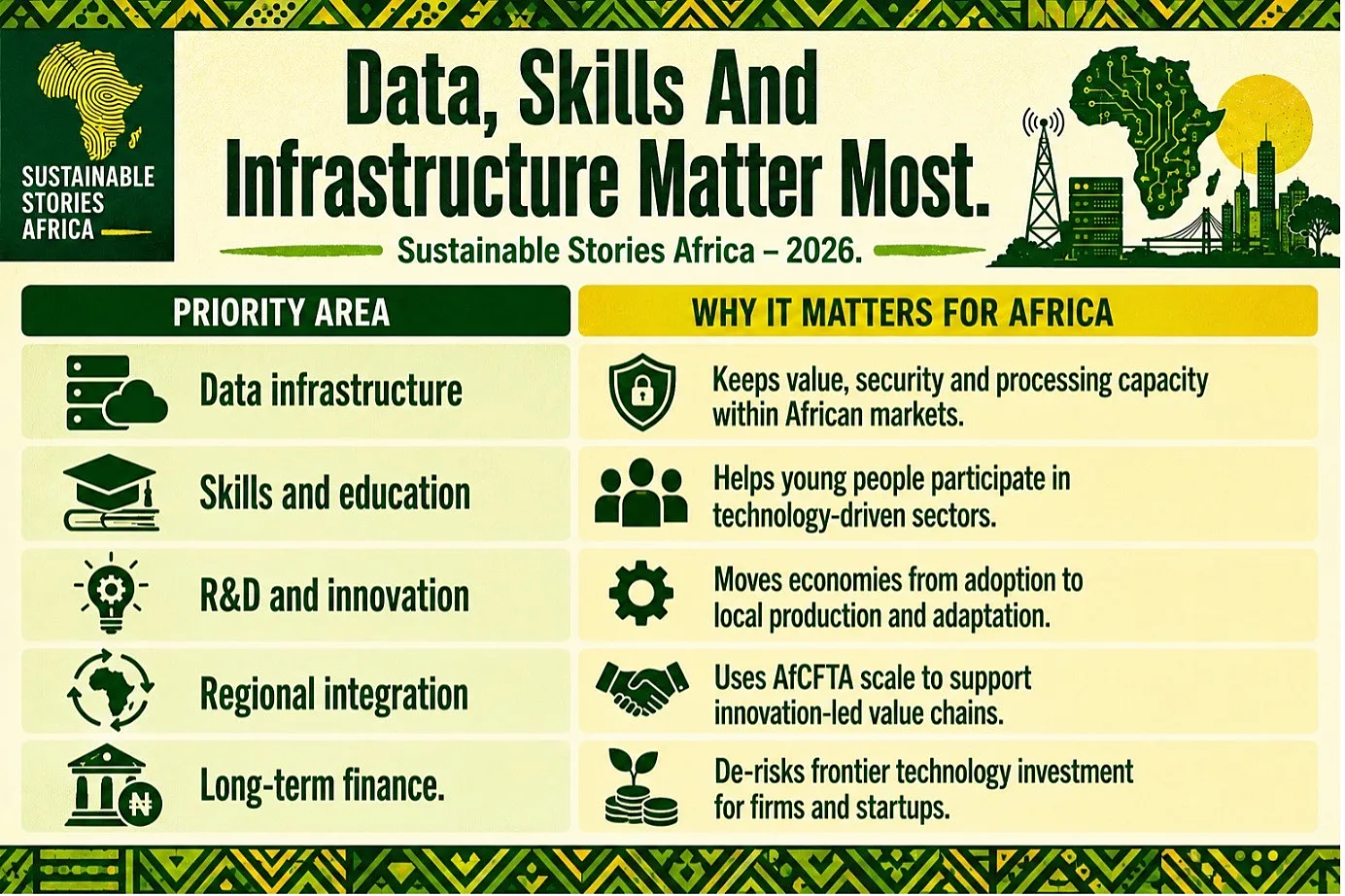
The report’s strength is that it does not present technology as magic.
It argues that frontier technologies deliver results only when countries build the surrounding ecosystem: reliable electricity, broadband, research institutions, financing tools, regulation, industrial clusters and skilled workers.
This is why the report distinguishes between “digital expansion” and “ecosystem readiness.”
- A country can have mobile apps and fintech growth; however, it still fails to achieve broad productivity gains if factories lack power, farmers lack irrigation, and young people lack technical training.
The social stakes are equally serious.
- Africa’s digital gender divide remains persistent, and skills gaps could deepen inequality if women, rural communities and informal workers are left out of the transition.
Innovation Can Unlock Better Livelihoods
The opportunity, however, is substantial.
Frontier technologies could improve agricultural yields, reduce logistics costs, expand healthcare delivery, strengthen digital payments, improve tax administration and support cleaner industrial growth.
- In agriculture, smart tools can help farmers use water, fertiliser and weather data more efficiently.
- In health, digital IDs and drone-enabled logistics can improve access to medicines.
- In trade, platforms such as cross-border payment systems can reduce transaction costs and support the African Continental Free Trade Area.
Africa also has strategic advantages. The report highlights the continent’s young population, large critical minerals base, and strong renewable-energy potential.
These assets could support green hydrogen, batteries, electric vehicles, data centres and regional power markets, if countries move beyond raw commodity exports into processing, manufacturing and technology-enabled services.
Governments Must Shift From Pilots
The next step is implementation.
- Governments need clear national technology roadmaps tied to industrialisation, not scattered pilot projects.
- Regulators must protect privacy and cybersecurity while allowing innovation to scale.
- Development banks and private financiers should expand innovation bonds, blended-finance facilities and regional credit lines for high-productivity sectors.
Businesses also have a role.
- African firms need to invest in data systems, workforce training, research partnerships and technology adoption that improve productivity rather than simply automating old inefficiencies.
For citizens, the practical issues are access: affordable internet, digital literacy, technical education and inclusion in new job pathways.
Path Forward – Build Africa’s Innovation Economy
Africa’s innovation agenda must focus on data sovereignty, skills, infrastructure, finance and regional markets.
Without these foundations, frontier technologies may widen inequality rather than transforming growth.
The priority is not technology for its own sake. It is productive, inclusive and sustainable development, where African economies create value, protect data, build industries and turn innovation into jobs, resilience and shared prosperity.