Africa’s new Water Vision 2063 treats water not as a sector issue, but as the foundation for growth, sanitation, food security, jobs and peace.
The policy warns that climate change, population growth and infrastructure gaps could undermine Agenda 2063 unless governments invest boldly, govern inclusively and cooperate across borders.
Water Now Defines Africa’s Future
Africa has adopted a long-term water and sanitation agenda that places one of the continent’s most basic resources at the centre of industrialisation, climate resilience and social stability.
The Africa Water Vision 2063 and Policy, produced by AMCOW and the African Union Commission, sets out a continental ambition for “a water-secure and resilient Africa with safe sanitation for all.” Published for the 39th Ordinary Session of the AU Assembly in February 2026, the policy frames water as a strategic asset for Agenda 2063, rather than merely a public utility.
Its core message is direct: without sustainable water availability and safe sanitation, Africa’s ambitions for poverty reduction, food security, renewable energy, industrialisation, regional integration and peace will remain exposed.
Water Security Is Economic Security
Water is Africa’s most vital strategic resource, the policy argues, because it sustains lives, powers economies and binds nations together. But that resource is under pressure from climate change, population growth and infrastructure gaps.
The scale of demand is sobering. Africa’s population, estimated at 1.5 billion in 2024, is projected to reach 2.5 billion by 2050 and 3.2 billion by 2070.
Food production would need to double, while agricultural water withdrawals are projected to rise from 160 – 180 cubic kilometres per year in 2020 to 400 – 450 cubic kilometres by 2070.
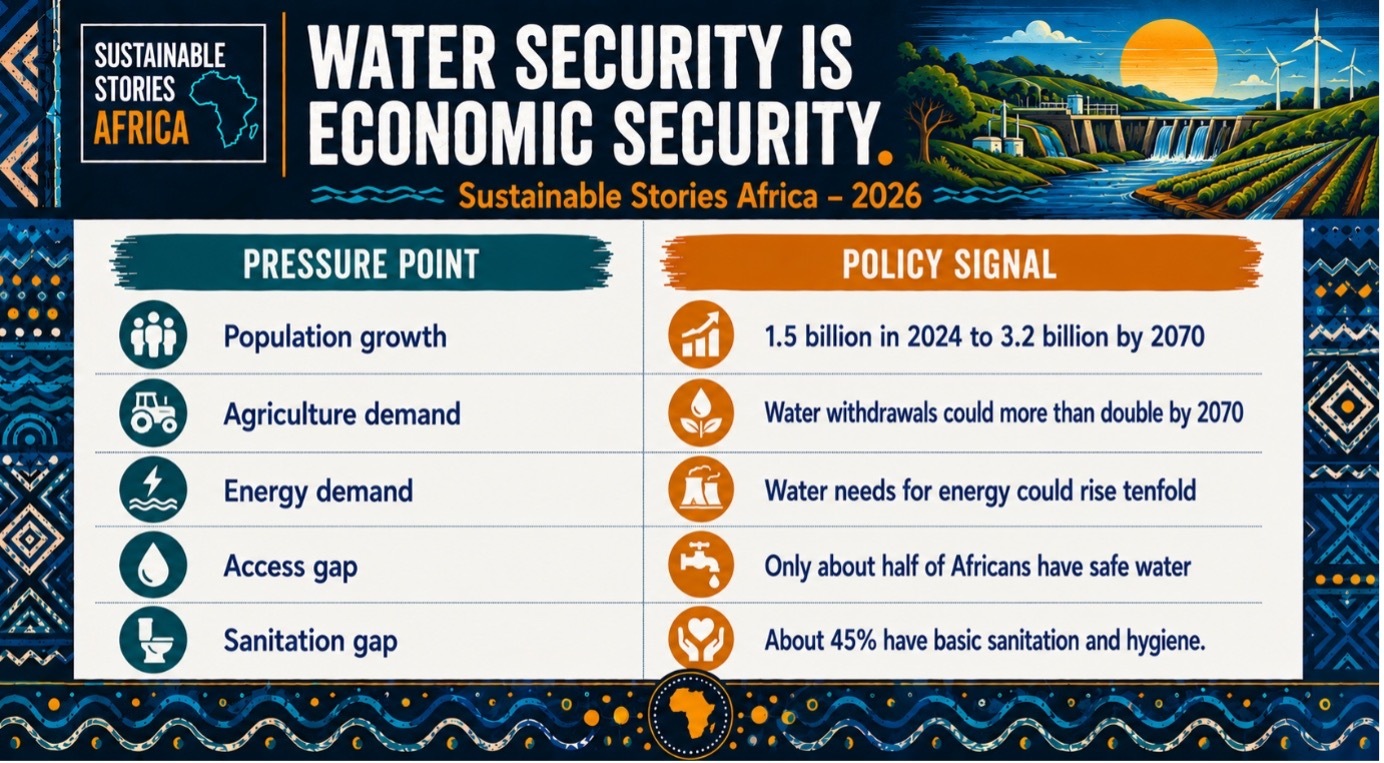
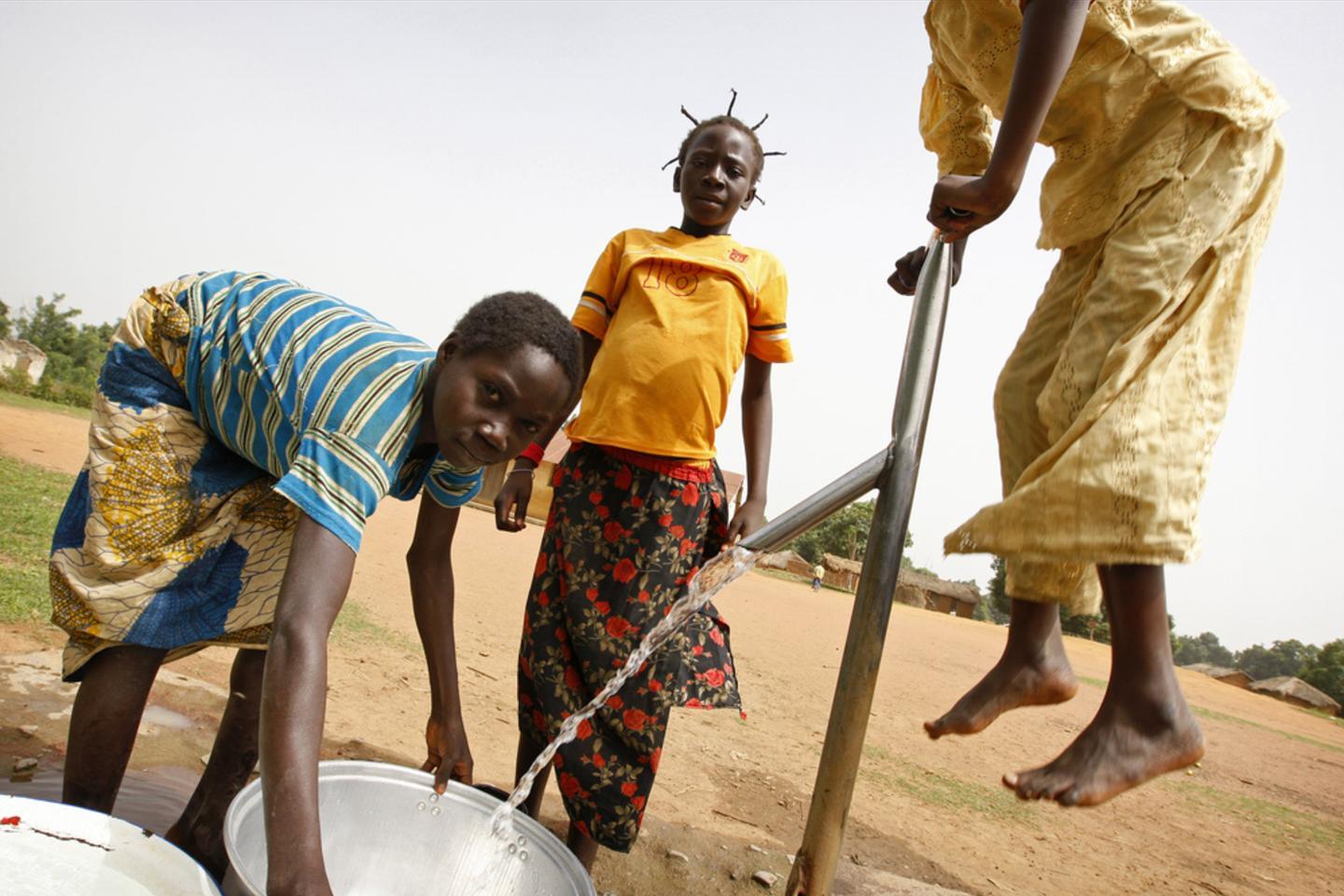
The policy also notes that only about half of Africa’s population has access to safe water, while just 45% has basic sanitation and hygiene services.
Eight Visions Anchor The Policy
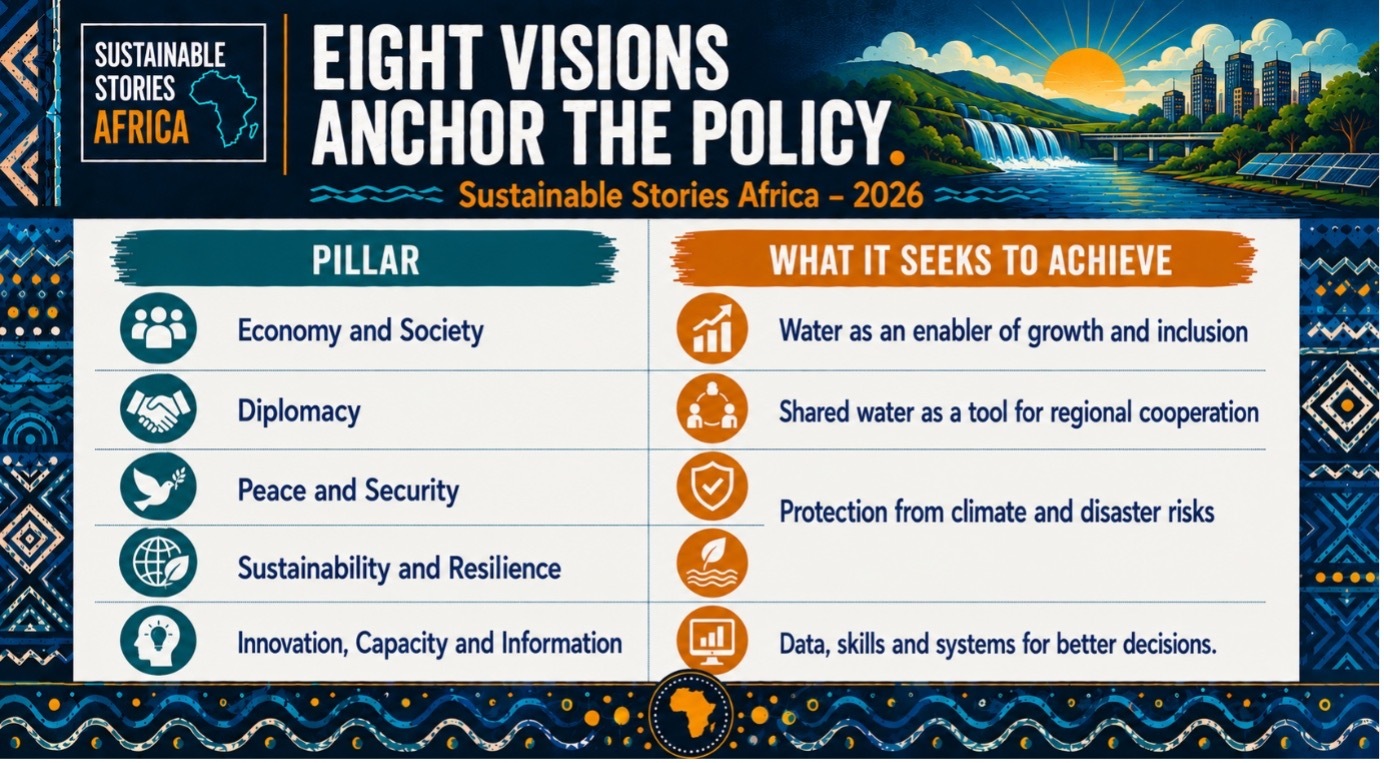
The Africa Water Vision 2063 is organised around eight vision statements covering WASH access, economic transformation, blue economy growth, governance, transboundary cooperation, disaster resilience, human capital and water information systems.
Its framework is built around four action pillars: Economy and Society; Diplomacy, Peace and Security; Sustainability and Resilience; and Innovation, Capacity and Information.
This is where the policy becomes more than a sanitation document. It links water to agriculture, industry, energy, migration, public health, regional trade and peacebuilding.
The report states that 90% of Africa’s surface water crosses borders, while 40% of the continent’s population depends on shared aquifers. That makes cooperation “existential,” not optional.
Water Can Become A Growth Engine
The policy’s opportunity is powerful: if Africa treats water as core infrastructure, it can unlock jobs, reduce disease burdens, improve productivity, strengthen food systems and support climate-resilient industrialisation.
The foreword calls water a potential “engine of inclusive growth and sustainable development” and “a catalyst for continental unity and prosperity.”
The policy also calls for a sanitation economy revolution, shifting from waste disposal to resource recovery through circular systems, innovation and regulation.
It further prioritises digital water intelligence, nature-based solutions, women and youth empowerment, and stronger transboundary governance.
- For households, that means dignity, health and time saved.
- For farmers, it means more reliable irrigation.
- For cities, it means safer drainage, cleaner waterways and reduced disease risk.
- For investors, it creates a clearer pathway for bankable water infrastructure.
Governments Must Finance Water Differently
The policy is blunt about what must change: water needs stronger political prioritisation, better data, de-risked investment and more effective governance.
It calls for water to be integrated into national economic planning, positioned as a strategic asset for industrialisation, agriculture and energy, and used to unlock climate-resilient financing.
Governments are expected to accelerate universal access to safely managed water, sanitation and hygiene; make water a continental security priority; strengthen transboundary basin governance; invest in digital systems; and empower women, youth and marginalised communities as water stewards.
The implementation pathway begins with investment-led regional integration from 2026 to 2033.
This phase prioritises agreed transboundary water infrastructure aligned with PIDA-PAP and AfCFTA, de-risked public-private partnerships, five flagship IWRM-for-development projects, and open water-related data platforms in 60% of shared basins.
Path Forward – Water Must Lead Development
Africa’s water agenda now requires delivery, not declarations.
The next steps are stronger financing, basin-level cooperation, credible water data, climate-resilient infrastructure and universal access to safe sanitation.
The policy’s message is clear: water security is development security.
If Africa gets it right, water can drive jobs, health, food security, peace and climate resilience by 2063.