Battery recycling innovation is accelerating as countries race to secure lithium, cobalt, nickel and other critical minerals.
The shift matters because batteries now sit at the centre of electric vehicles, grids, industrial competitiveness and national energy security.
For Africa, the opportunity is clear: move from mineral extraction to circular value chains.
Old Batteries Become Strategic Assets
Battery recycling is moving from a waste-management issue to a frontline energy-security strategy, as nations seek new ways to reduce dependence on concentrated critical-mineral supply chains and keep more value inside domestic and regional economies.
Green Building Africa, citing recent International Energy Agency findings, reports that battery-circularity patent activity grew 42% annually between 2017 and 2023, outpacing wider battery-manufacturing innovation.
Around 14 million electric-vehicle batteries are expected to reach the end of life by 2040, creating a growing feedstock for recycling, reuse and secondary materials supply.
The change comes as clean-energy systems become more battery-dependent. Electric vehicles, grid storage, telecom towers, data centres and renewable-energy projects all need reliable mineral inputs.
The IEA says battery recycling innovation is rising as countries seek stronger critical-mineral supply and energy security.
The Circular Battery Race Widens
The global battery economy is now defined by two pressures: rising demand for minerals and rising concern over where those minerals come from.
Lithium, cobalt, nickel and graphite are essential to many battery chemistries, but their mining, processing and refining are geographically concentrated.
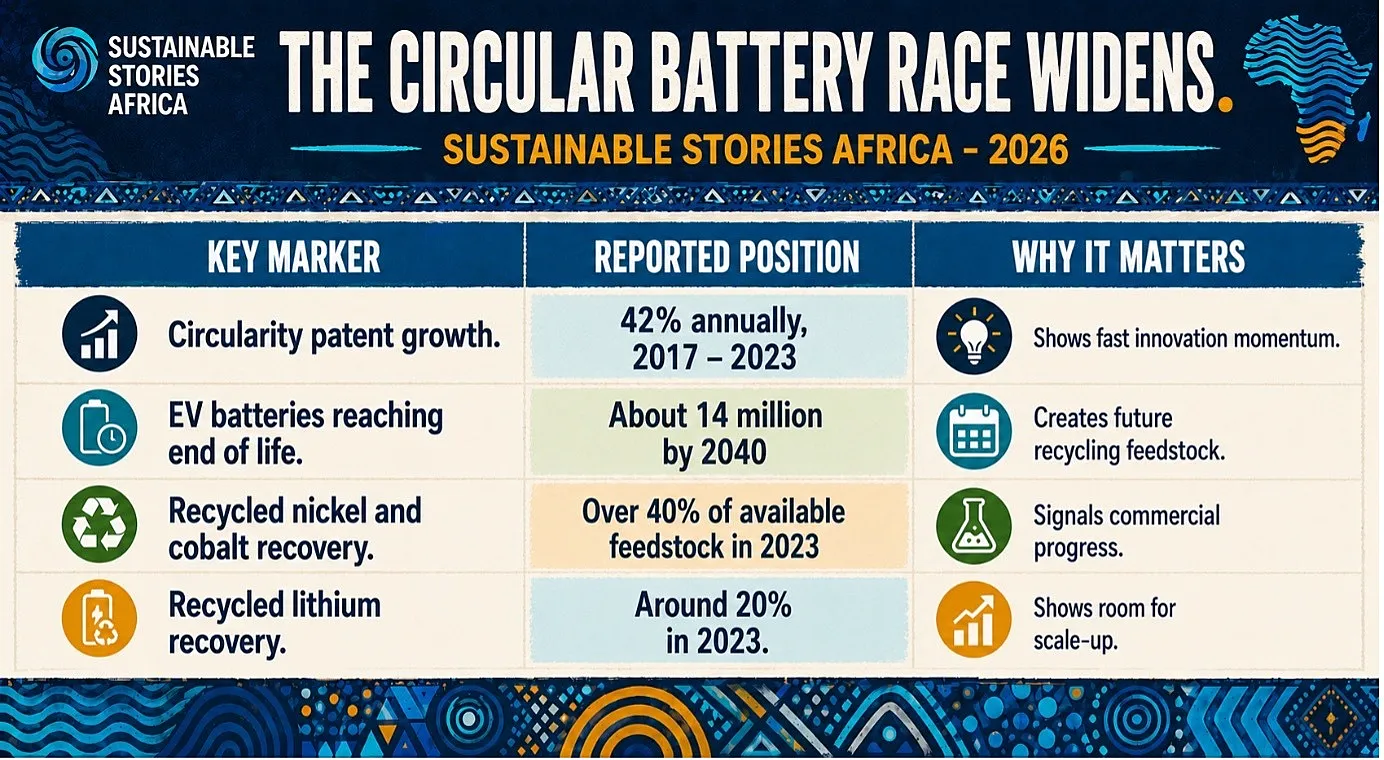
The IEA says production of recycled battery metals, including nickel, cobalt and lithium, is growing quickly from a low base.
In 2023, metal volumes recovered relative to available feedstock, reaching more than 40% for nickel and cobalt, and 20% for lithium.
For African markets, this is not distant industrial policy. It affects mining economies, import bills, e-mobility plans and renewable energy deployment.
- A country that imports batteries without building repair, reuse and recycling systems may inherit future waste and lose future value.
- A country that plans early can turn spent batteries into jobs, skills and secondary raw materials.
Africa Can Move Beyond Extraction
Battery recycling gives Africa a chance to rethink its role in the clean-energy economy. The continent already holds important reserves of critical minerals, including cobalt, lithium, manganese and graphite.
However, the greater development question is whether African countries remain exporters of raw materials or build more of the value chain at home.
The African Union’s Green Minerals Strategy frames critical minerals as a route toward sustainable industrialisation and energy security, not just export earnings.
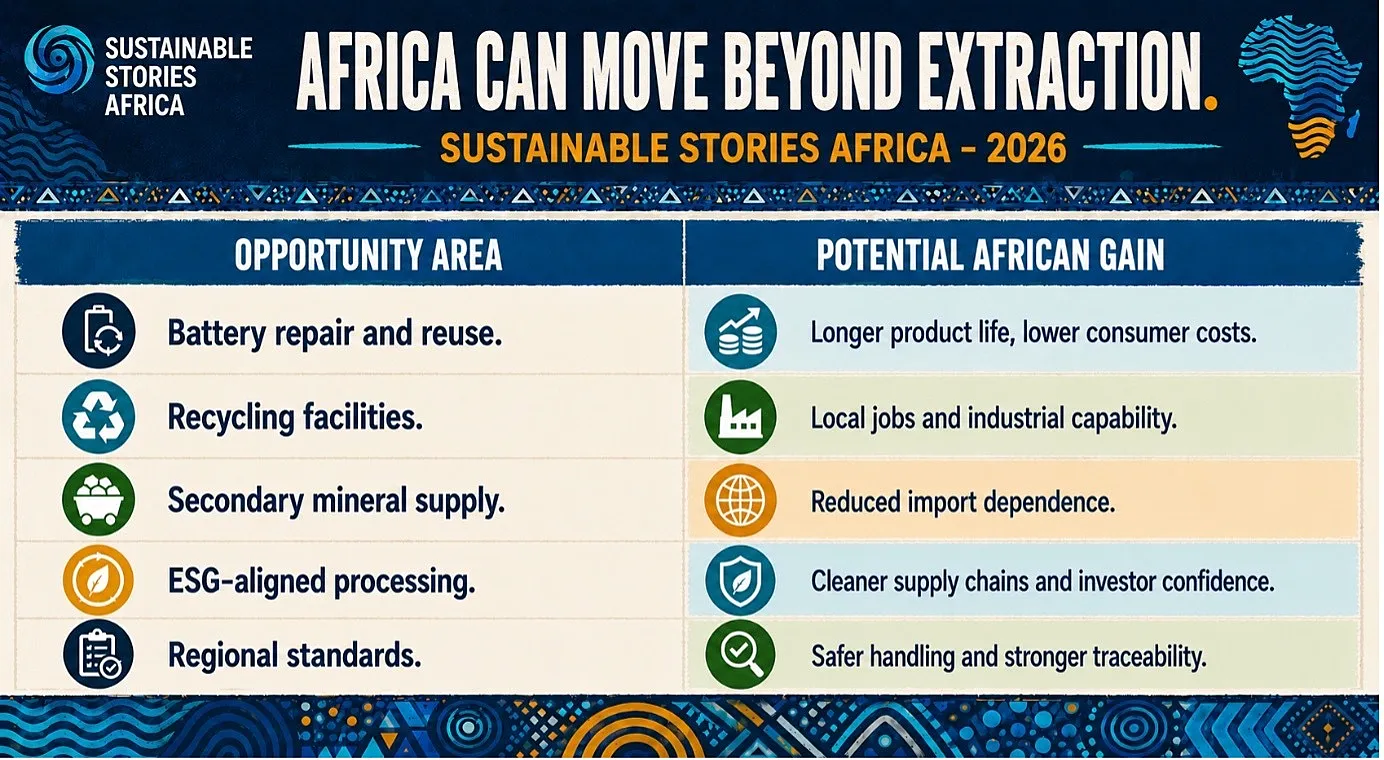
The upside is practical. Recycled minerals can reduce pressure on new mining, lower environmental impacts, and improve supply resilience. IEA Executive Director Fatih Birol said recycling and reuse can ease supply chain pressure, reduce environmental impacts and create new economic opportunities.
Build Rules Before Waste Scales
African governments should not wait until battery waste becomes a crisis. They need policies now for collection, safety, transport, repair, second-life use, producer responsibility and certified recycling.
Investors also need clarity. Recycling plants require predictable feedstock, skilled workers, environmental permits and reliable electricity.
Without regulation, informal handling could expose workers and communities to unsafe practices.
With regulation, battery circularity can become part of Africa’s green industrial strategy.
Development financiers, automakers, telecom companies, solar firms and battery importers should be brought into national circular-economy plans.
The goal should be simple: every battery entering an African market should have a responsible end-of-life pathway.
Path Forward – Turn Waste Into Industrial Value
Battery recycling is becoming a strategic pillar of energy security, industrial policy and ESG performance.
Africa’s priority is to build circular battery systems early: safe collection, regional standards, recycling investment and local value addition.
Well done, the continent can turn spent batteries into jobs, cleaner supply chains and a stronger position in the global energy transition.