The Democratic Republic of Congo is pursuing an equity stake in a $270 million electricity interconnector with Zambia.
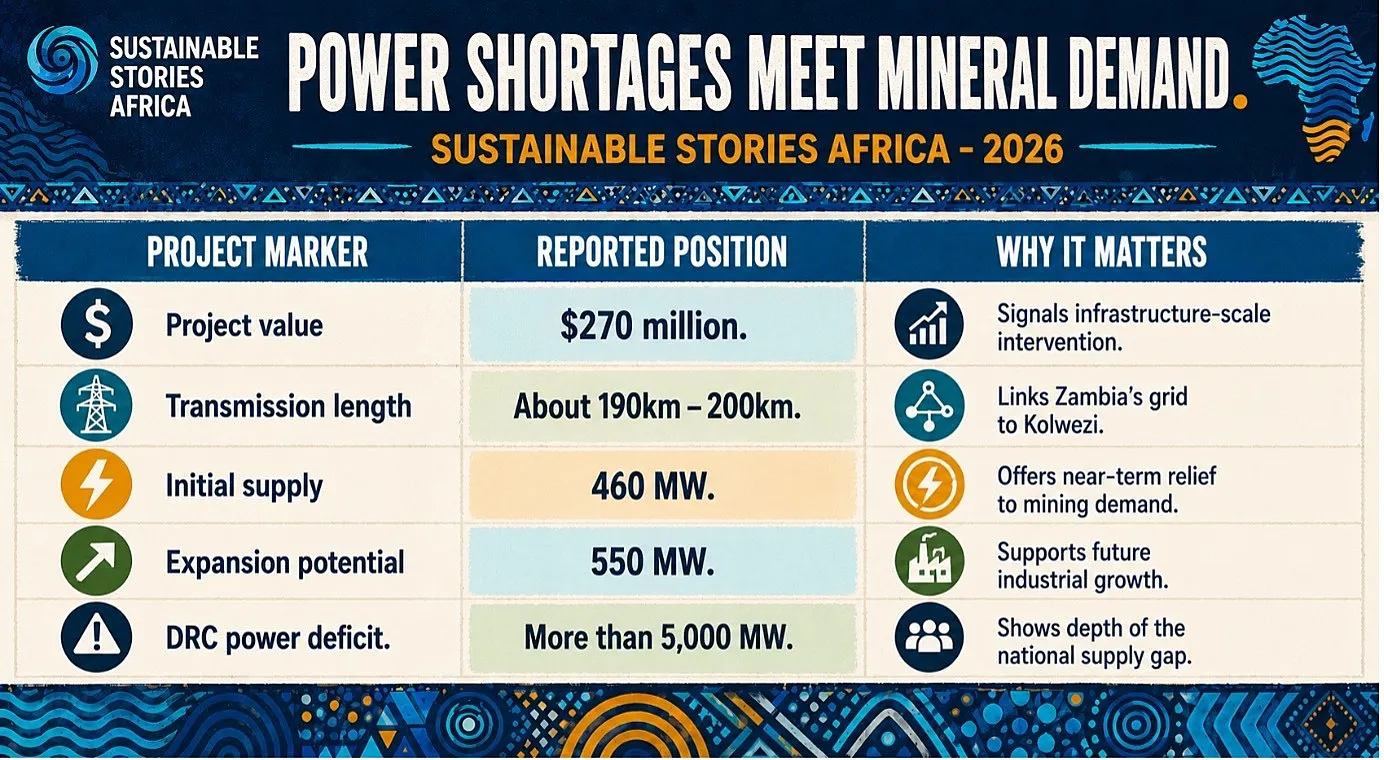
The project could deliver up to 550 MW to Kolwezi, the heart of Congo’s copper and cobalt belt.
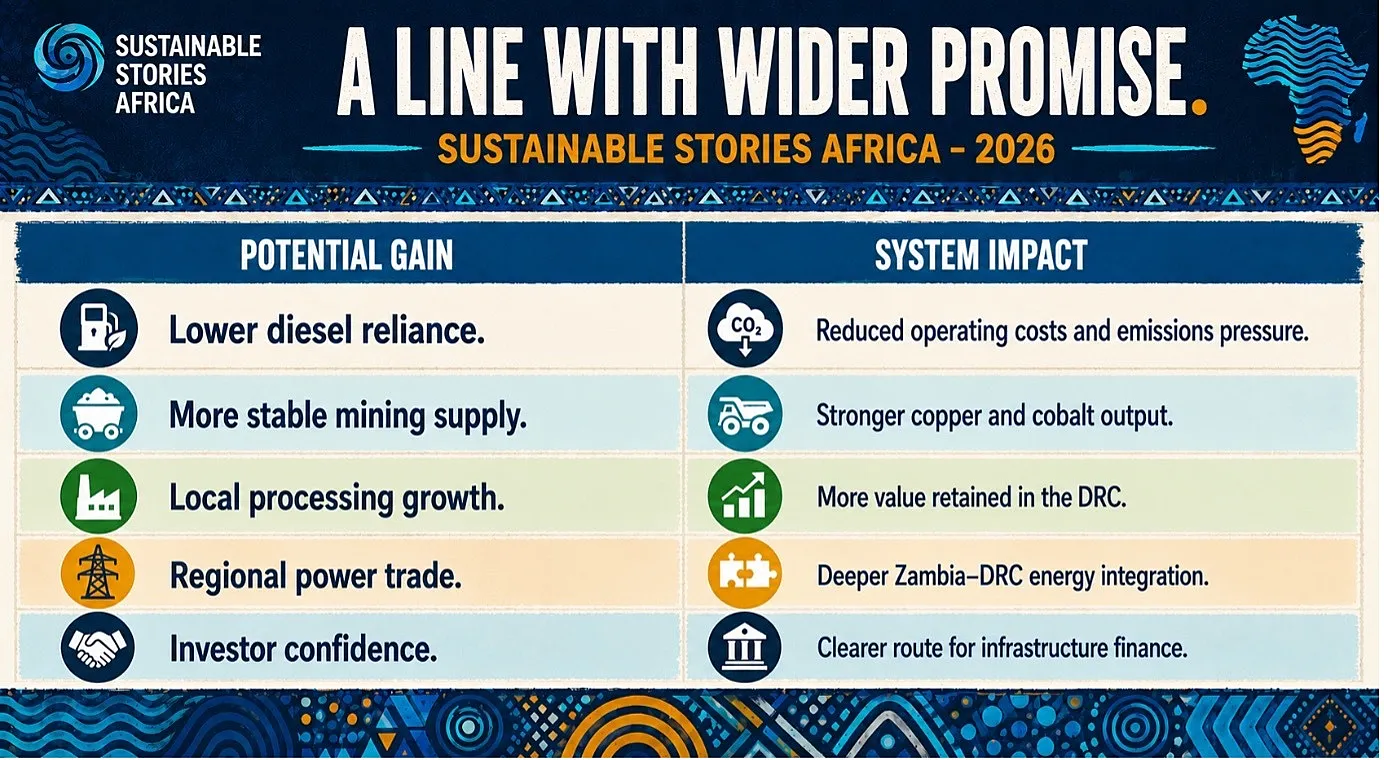
For miners, workers and industrial planners, the line could reduce dependence on diesel and unlock local processing.
Congo Looks Beyond Its Grid
The Democratic Republic of Congo is seeking an equity stake in the $270 million Kalumbila–Kolwezi Interconnector Project, a cross-border transmission line designed to move electricity from Zambia into Congo’s mineral-rich southern corridor.
The project would connect the ZESCO substation at Kalumbila in north-western Zambia to Kolwezi in the DRC via a roughly 190km to 200km high-voltage line.
Green Building Africa reports that the line is expected to supply an initial 460 MW, with expansion potential of up to 550 MW as mining and industrial demand grow.
The move matters because Congo’s energy deficit is no longer only a utility problem. It is now a mining, industrialisation and climate-risk problem.
The DRC holds globally significant copper and cobalt resources, yet its power shortages are forcing mining operators to rely on costly diesel backup systems to sustain production.
Power Shortages Meet Mineral Demand
The proposed interconnector comes as Congo’s southern mining region faces rising demand from copper production, cobalt processing and new value-addition ambitions.
Business Insider Africa reported that the DRC faces an electricity deficit estimated at more than 5,000 MW, with the mining-heavy south accounting for at least 900 MW of unmet demand.
For communities around Kolwezi, power scarcity is felt through jobs, prices and local services.
When mines depend on diesel, production costs rise. When factories cannot count on a stable supply, processing-investment slows.
When grids remain weak, the broader economy misses the chance to turn mineral wealth into manufacturing, skills and local enterprise.
The project is being developed by Enterprise Power DRC and its Zambian subsidiary, while Zambia’s Energy Regulation Board has approved construction permits, clearing an important regulatory step.
A Line With Wider Promise
If delivered well, the interconnector could do more than keep mines running. It could help Congo move from raw mineral extraction toward more local processing, where more value stays inside the economy.
That ambition is already visible. The Kamoa-Kakula copper complex has begun producing copper anodes at a new smelter designed to handle up to 500,000 tonnes annually, adding another layer of electricity demand to the region.
For Africa’s energy transition, this is the difficult centre of the story: critical minerals need reliable power, but reliable power needs investment, regulation and regional coordination. Congo cannot industrialise its mineral economy on fragile grids alone.
Build Bankable Regional Infrastructure
The DRC’s proposed stake should now be matched by transparent project governance, fair pricing and strong ESG safeguards.
Cross-border power infrastructure can unlock major industrial benefits, but only when contracts are credible, tariffs are clear, and communities see measurable gains.
Kinshasa and Lusaka must also ensure that mining demand does not crowd out wider development needs.
Transmission lines built for industry should strengthen national systems, support local employment and create pathways for cleaner electricity access beyond mine sites.
The long-term answer will still require larger generation capacity, including delayed hydropower ambitions around Inga III. But the Kalumbila–Kolwezi line offers a nearer-term test: whether regional power trade can move fast enough to support Africa’s mineral economies without deepening inequality or diesel dependence.
Path Forward – Turn Power Into Shared Value
The DRC’s stake pursuit should become a broader industrial compact: reliable electricity for mining, stronger grids for communities and cleaner growth for the copper belt.
The priority is disciplined execution, bankable financing, transparent regulation, cross-border cooperation and ESG accountability that turns mineral demand into shared African value.
Culled From: DRC seeks stake in US$270 million Zambia power interconnector - Green Building Africa