Europe’s Carbon Border Adjustment Mechanism entered its definitive regime on January 1, 2026, turning carbon data into a market-access requirement.
Exporters of iron, steel, aluminium, cement, fertilisers, hydrogen and electricity now face sharper demands from EU buyers.
For African producers, the message is clear: emissions accounting is no longer optional. It is becoming part of competitiveness.
Carbon Data Now Decides Market Access
Europe’s carbon border tax has moved from rehearsal to reality, creating a new commercial test for exporters whose goods enter the European Union.
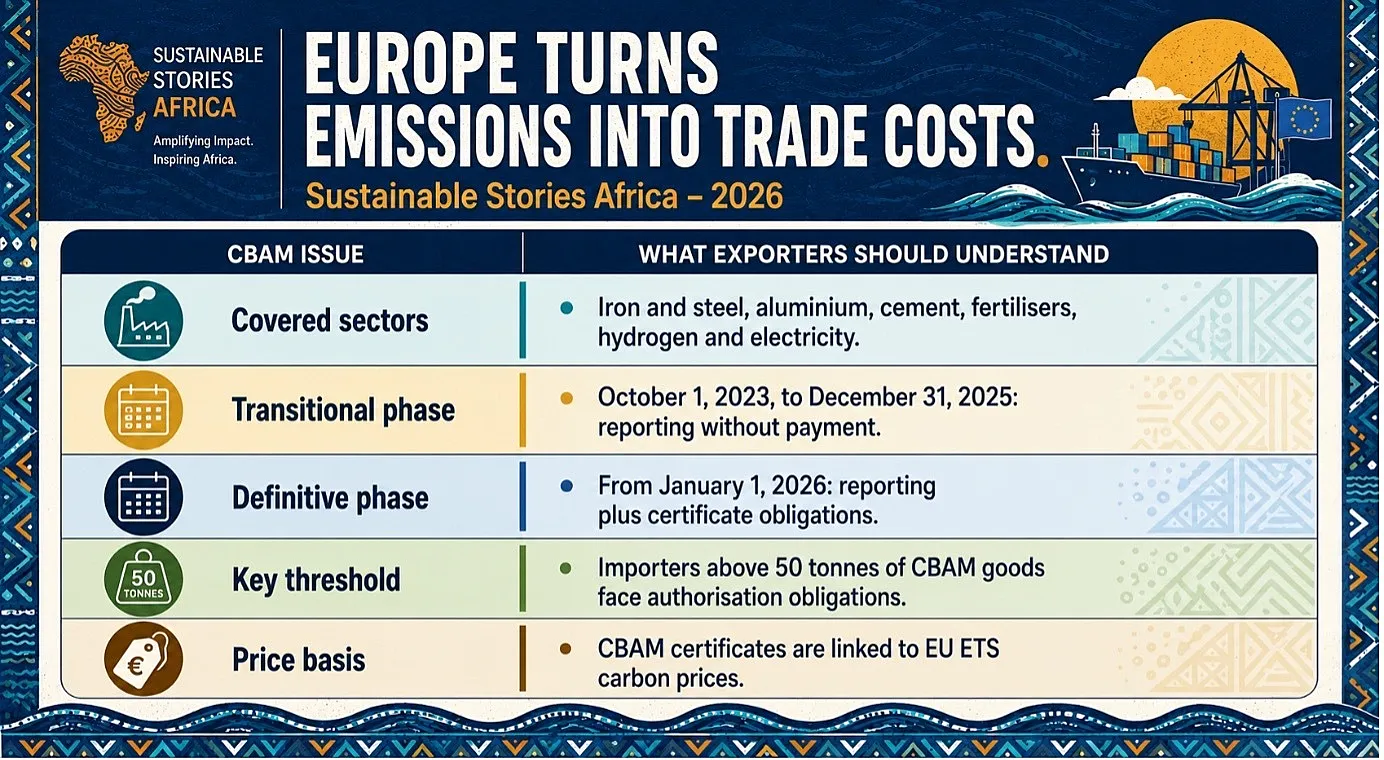
The EU’s Carbon Border Adjustment Mechanism, or CBAM, entered its definitive regime on January 1, 2026, after a transitional reporting phase that ran from October 2023 to December 2025.
EU importers bringing in more than 50 tonnes of covered CBAM goods must apply for authorised declarant status, report embedded emissions and buy certificates linked to the EU carbon market.
For exporters in Africa and the wider Global South, CBAM is not paid directly at the factory gate.
However, it will increasingly shape contracts, pricing, data requests and buyer preference.
A steel mill in Nigeria, an aluminium supplier in Mozambique, or a fertiliser producer in North Africa may now be asked by European customers to prove not only quality and delivery capacity, but also carbon intensity.
Europe Turns Emissions Into Trade Costs
CBAM currently covers carbon-intensive sectors including iron and steel, aluminium, cement, fertilisers, hydrogen and electricity. The UK government’s guidance notes that the regulation applies to EU importers. Still, those importers may request information from manufacturers, exporters, brokers, and other supply chain actors to meet compliance requirements.
The mechanism works by requiring EU importers to declare embedded emissions and surrender certificates equivalent to those emissions.
Certificate prices are calculated from EU Emissions Trading System allowance prices, using a quarterly average in 2026 and weekly averages from 2027.
That turns emissions into a trade variable. Higher-carbon goods may become more expensive to land in Europe, while lower-carbon producers can gain an edge if they can document cleaner production.
Cleaner Producers Can Gain an Advantage
For African exporters, CBAM can feel like another compliance burden from a distant market. However, it can also become a competitiveness strategy.
Companies that begin measuring direct and indirect emissions, improve energy efficiency, switch to cleaner power and ensure verified production data may protect access to European buyers.
They may also strengthen their case with banks, development finance institutions and sustainability-linked investors.
The risk is that smaller exporters are left behind. Many firms still lack metering systems, product-level emissions data, internal ESG teams or access to affordable verification.
Without support, CBAM could widen the gap between large, well-capitalised exporters and smaller producers trying to participate in global value chains.
Exporters Must Prepare Before Shipments Move
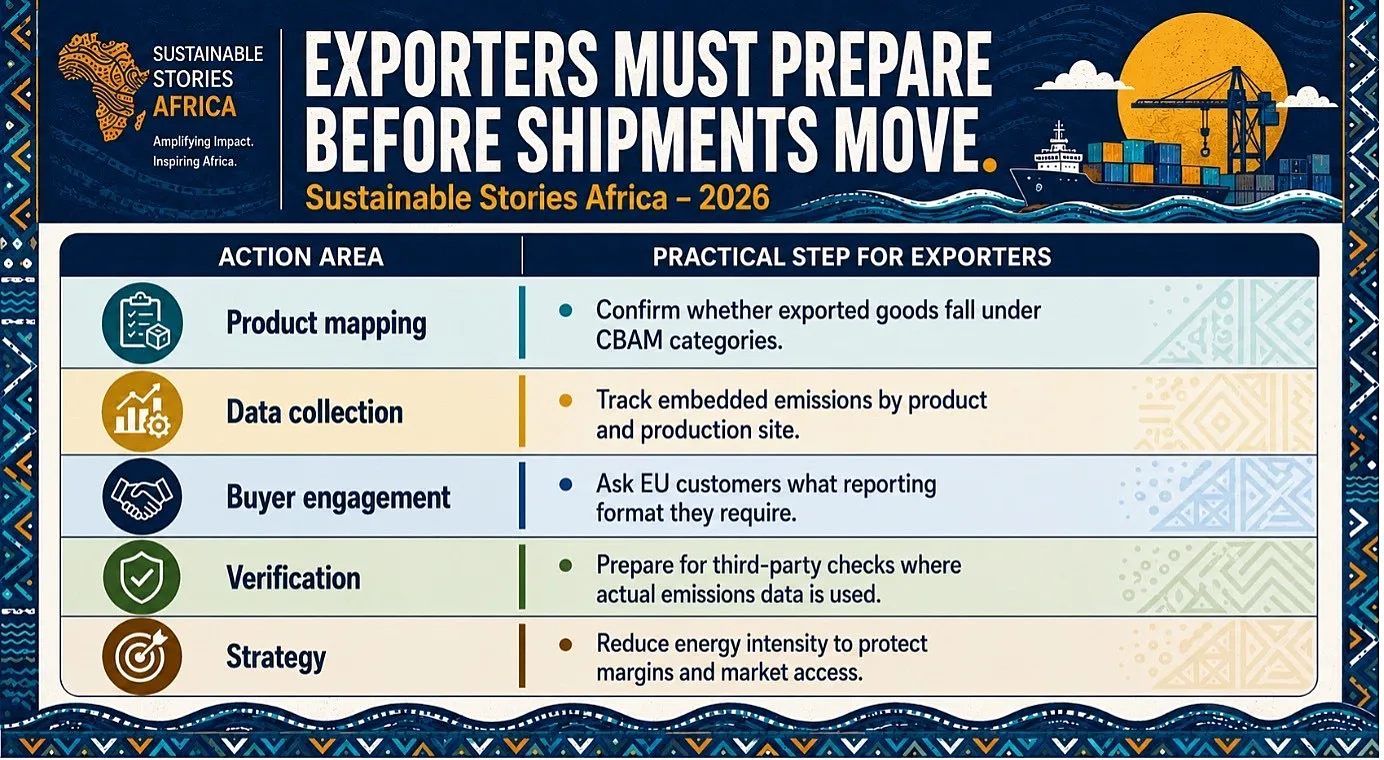
The practical response should begin now. Exporters should map whether their products fall within CBAM codes, identify EU customers affected by the rules, collect installation-level emissions data and prepare documentation that importers can use for declarations.
They should also review energy sources, production inputs, transport assumptions, and any already proposed domestic carbon price.
Under CBAM, importers may deduct a carbon price already paid in the country of production if they can prove it.
CBAM’s first major financial deadline for 2026 imports is expected in 2027. Recent practitioner guidance notes that the first annual declaration and certificate surrender for 2026 imports is due by September 30, 2027, with certificate sales beginning on February 1, 2027.
Build Carbon Readiness Into Export Strategy
African exporters should treat CBAM as a boardroom issue, not a paperwork task. Governments, trade agencies and business associations must help firms build emissions data systems, access verification and negotiate fair recognition of local transition realities.
The path forward is practical: measure emissions, improve efficiency, document claims and engage buyers early.
In Europe’s new carbon-linked trade environment, credible data may become as important as price, quality and delivery.
Culled From: EU CBAM 2026: A Practical Guide for Exporters Facing Europe's Carbon Border Tax